


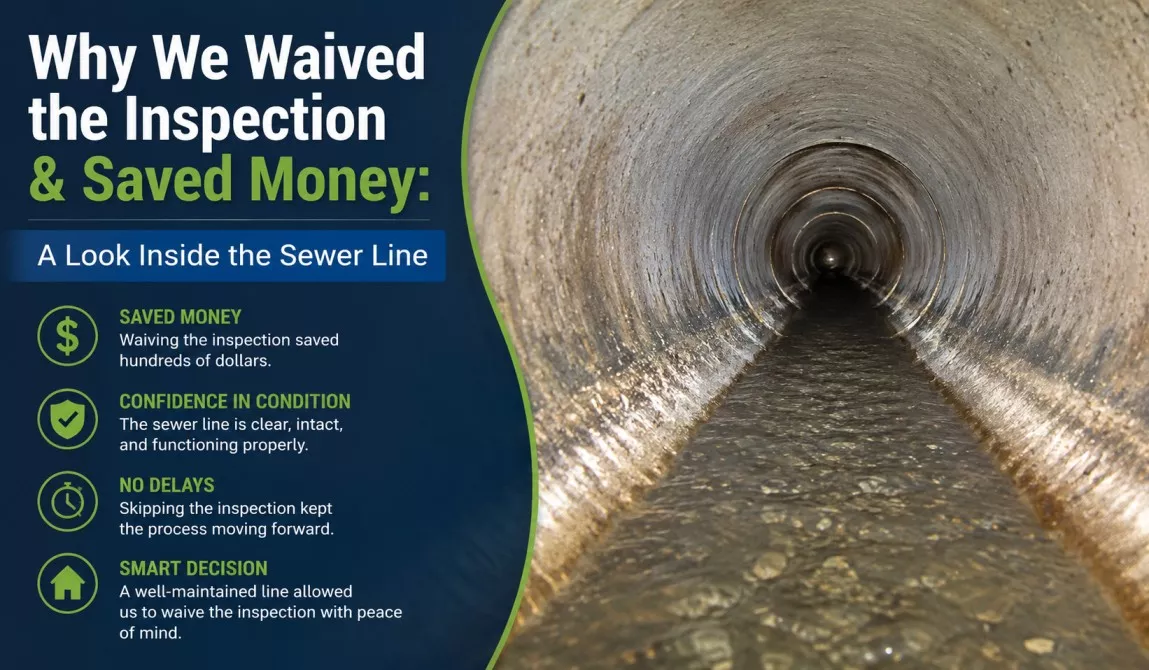
Why We Waived the Inspection & Saved Money: A Look Inside the Sewer Line
The Short Answer
In a competitive housing market, we waived the general home inspection to win the deal — but we kept one targeted inspection: the sewer line. For $225, a camera snaked through 60 feet of aging clay pipe and revealed root intrusion, a cracked lateral, and a failing connection. The seller paid $9,500 in concessions. That’s the kind of math that changes how you think about inspections.
Quick Answers
- Why was the general inspection waived? The market was competitive; multiple offers were expected and waiving was a strategic move to strengthen the offer.
- Why was the sewer still inspected? Sewer damage is invisible, expensive, and not covered by homeowner’s insurance — a standard inspection rarely catches it.
- Typical sewer inspection cost: $150–$350, averaging around $200–$225 in most metro markets.
- Common issues discovered: Root intrusion, cracked clay pipes, offset joints, grease buildup, and improper pipe grade.
- Potential repair costs: $3,000–$25,000+ depending on the extent of damage and pipe depth.
- Overall money saved in this case: Approximately $9,275 in negotiated seller concessions after a $225 inspection.
- Main takeaway: Waiving an inspection is a calculated risk. Waiving a sewer scope inspection, especially in homes over 30 years old, is almost always a costly mistake.
What Does It Mean to Waive a Home Inspection?
A home inspection waiver means the buyer agrees to purchase the property without requiring the seller to complete or address findings from a standard third-party inspection. This waiver is written into the purchase contract and, once signed, is binding.
Standard home inspections typically cover:
- Roof condition and attic
- HVAC systems and ductwork
- Electrical panels and wiring
- Plumbing fixtures and water pressure
- Foundation and structural components
- Windows, doors, and insulation
In a normal market, buyers use the inspection report as leverage — to negotiate repairs, credits, or a price reduction. But in a competitive market, sellers can simply reject offers contingent on inspection outcomes and take a cleaner offer instead.
What waiving does NOT mean: It doesn’t mean you forfeit all due diligence. Buyers can still order targeted, specialized inspections — including sewer scope inspections, mold testing, foundation assessments, or radon testing — outside of a general inspection contingency. These are often called “informational inspections” or specialty inspections and can be written into offers without alarming sellers.
This distinction is critical. Waiving the general inspection ≠ waiving all inspections.
Why We Chose to Skip the Traditional Inspection
The home was a 1962 ranch-style property in a first-ring suburb. The listing went live on a Thursday. By Saturday, there were seven competing offers. The sellers wanted to close in 21 days and had zero interest in entertaining inspection contingencies.
Our choices were simple: compete or walk away.
Here’s the risk calculus that led to the decision:
What the general inspection would likely show: The home had been owner-occupied for 22 years, was visibly well-maintained, had a newer roof (2018, per disclosure), updated HVAC (2020), and passed a city certificate of occupancy. The major-ticket visible items were covered.
What it would likely miss: Underground plumbing. Always underground plumbing.
A licensed home inspector walks through a home in 2–3 hours. They check what they can see. They run faucets, test GFCIs, and knock on walls. What they cannot do — without specialized equipment — is look inside your sewer pipes.
We waived the general inspection. We did not waive the sewer scope.
Why the Sewer Line Was Too Important to Ignore
Sewer lines are the single most underinspected system in residential real estate. Here’s why that matters:
They are underground and invisible. No visual inspection can assess a sewer line’s integrity. Not an inspector, not the seller, not even a plumber standing in the basement.
They are expensive to fix. Partial sewer line repairs range from $1,500–$5,000. Full replacements — digging up a yard, replacing 50–100 feet of pipe — routinely cost $8,000–$25,000. In some urban markets with deep pipe runs under driveways or landscaping, that number can climb higher.
They are not covered by standard homeowner’s insurance. Unless you carry a separate sewer line rider or home warranty, a collapsed lateral is entirely out-of-pocket.
Older homes are especially vulnerable. Homes built before 1980 frequently have clay, Orangeburg (tar paper), or cast iron sewer laterals. These materials deteriorate over decades. Tree roots find every hairline crack. The older the home, the higher the probability of some degree of sewer compromise.
Sellers rarely know. Unlike a leaky roof or failing HVAC, sewer issues produce few symptoms until they fail catastrophically. A seller can be completely honest — and completely unaware — that their 60-year-old clay pipe has 40% root infiltration.
For a $225 inspection, the risk calculus was simple.
What a Sewer Scope Inspection Revealed
The inspection took 45 minutes. A licensed plumber fed a flexible camera cable into the cleanout access at the exterior foundation. Here’s what the camera found, moving from the house toward the municipal main:
Feet 0–18: Clean, functional cast iron. Some scale buildup, normal for age.
Feet 18–31: Transition joint from cast iron to clay. Slight offset — pipe sections had shifted, creating a small ledge where solids could catch.
Feet 31–52: Active root intrusion. Fine root tendrils had grown through a cracked joint at foot 38. At the time of inspection, roots occupied approximately 35% of the pipe’s diameter. Not an immediate failure, but a guaranteed blockage within 1–3 years without intervention.
Feet 52–60 (municipal connection): The clay-to-municipal-main connection showed a section of pipe with compromised grade — meaning the pipe was not sloped properly toward the main, causing slow drainage and accelerating buildup.
None of this was visible from inside the home. The toilets flushed fine. Drains ran normally. The seller had no idea.
The repair estimate from a licensed plumber:
- Root clearing and joint repair at foot 38: ~$1,200
- Full lateral replacement (trenchless method): ~$8,800–$11,200
- Grade correction at municipal connection: included in lateral replacement
Total remediation if addressed post-closing: $10,000–$12,400
We went back to the sellers with the camera footage, the plumber’s written estimate, and a request for a $9,500 credit at closing.
They said yes.
Common Sewer Problems Found in Older Homes
The problems found in this inspection are not unusual. These are the most commonly discovered sewer issues in pre-1985 residential properties:
Root Intrusion
Tree and shrub roots are drawn to the moisture and nutrients inside sewer pipes. They enter through hairline cracks, joint gaps, and damaged sections. Over time, they grow into large masses that cause blockages and structural damage to the pipe wall.
Most at risk: Homes with large trees within 30 feet of the sewer lateral. Oak, willow, and maple are especially problematic.
Clay Pipe Degradation
Clay vitrified pipe (VCP) was the standard material from the early 1900s through the 1970s. While durable when intact, it becomes brittle with age, susceptible to shifting soil, and the joints are not sealed — they rely on tight fit, which loosens over decades.
Orangeburg Pipe
A paper-based pipe material used from the 1940s through the early 1970s, Orangeburg was marketed as a cheap alternative to cast iron. It absorbs moisture, deforms, and ultimately collapses. Homes with Orangeburg pipe virtually always require full replacement.
Offset or Separated Joints
Soil movement, freeze-thaw cycles, and nearby construction can cause pipe sections to shift, creating offsets at the joints. These create ledges where solids catch, accelerating blockages.
Improper Pipe Grade
Sewer pipes must maintain a consistent downward slope (typically ¼ inch per foot) toward the municipal connection. Pipes that sag, dip, or run flat accumulate waste and eventually fail.
Grease and Scale Buildup
In older homes where cooking grease has been routinely poured down drains, a thick layer of grease and mineral scale can coat the pipe interior, reducing flow capacity significantly.
Real Cost Comparison: $200 Inspection vs. $10,000 Repair
| Item | Cost |
|---|---|
| Sewer scope inspection | $150–$350 |
| Root clearing (minor, hydro-jetting) | $300–$600 |
| Partial pipe repair (spot fix) | $1,500–$4,000 |
| Trenchless pipe lining (cured-in-place) | $4,000–$12,000 |
| Full lateral replacement (open trench) | $8,000–$25,000 |
| Emergency sewer repair (backed up sewage) | $5,000–$20,000+ |
| Sewer line rider on homeowner’s insurance | ~$50–$100/year |
In this case:
- Inspection cost: $225
- Seller credit negotiated: $9,500
- Net financial benefit: $9,275
- ROI of the inspection: ~4,122%
Even in cases where the inspection reveals minor or no issues, the peace of mind and documented baseline is worth the $200. Buyers who skip it and discover problems 90 days post-closing have zero recourse.
How Sewer Issues Affect Home Value
Sewer problems directly impact market value in several ways:
Disclosure obligations. In most states, once a defect is known, sellers must disclose it. A post-purchase sewer failure that a seller could reasonably have known about may expose them to legal liability. Many sellers, when presented with camera evidence, prefer to negotiate rather than face a disclosure complication.
Resale complications. A home with a documented but unrepaired sewer issue will face the same inspection by the next buyer. Kicking the problem down the road doesn’t make it go away — it just means future buyers will ask for even larger concessions after delays have worsened the condition.
Lender requirements. Some lenders, particularly for FHA and VA loans, require proof of functional sewer service before closing. A known sewer defect can create underwriting complications.
Neighborhood infrastructure context. In older neighborhoods where one home has aging clay pipe, adjacent homes almost certainly do too. This creates a broader market signal. Buyers and agents who understand local infrastructure have a meaningful advantage.
When Buyers Should Always Get a Sewer Inspection
A sewer scope inspection is not optional in the following situations:
- The home is more than 30 years old. At this age, original sewer materials are at or past their expected service life.
- There are large trees on the property or nearby. Root systems extend 2–3 times the canopy radius underground.
- The home has been vacant or in foreclosure. Slow-drain symptoms may have gone unaddressed for years.
- The neighborhood has aging municipal infrastructure. Cities with known sewer main issues often see related lateral problems.
- You are waiving the general inspection. This makes targeted specialty inspections even more important, not less.
- Disclosure documents mention past plumbing issues. Past problems are reliable predictors of recurrence.
- The home is in a region with clay soil or freeze-thaw cycles. Soil movement accelerates joint separation and root intrusion.
Red Flags That Suggest Hidden Sewer Problems
Watch for these during showings and disclosure review:
- Slow drains throughout the home — not one drain, but multiple
- Gurgling sounds from toilets or drains after running water elsewhere
- Sewage odor in the basement, crawl space, or yard
- Unusually lush or green patches in the yard (sewage leaks fertilize grass)
- Soft or sunken ground along the path of the sewer lateral
- History of drain cleaning or rooter service in the seller’s disclosures
- Fruit flies or drain flies in unusual numbers inside the home
- Staining or moisture at the base of toilets or around floor drains
- Home age + original materials — if the year built is pre-1975 and pipes have never been replaced, treat it as a probable issue until proven otherwise
Benefits of a Sewer Camera Inspection
Beyond finding problems, the sewer scope inspection delivers several underappreciated benefits:
Documentation. You have video evidence of pipe condition, on record, at the date of purchase. If a neighbor’s tree root later causes damage, you have a baseline.
Negotiation leverage. Camera footage is concrete. It’s not a home inspector saying “the pipes are old.” It’s video of roots growing inside a pipe, with a plumber’s signed estimate attached.
Maintenance planning. Even if the pipes are in reasonable condition, the camera may reveal minor buildup, age-appropriate scale, or areas to monitor. You can schedule preventive rooter service before a problem develops.
Peace of mind. Knowing the condition of an invisible system that can cost $20,000 to replace is worth far more than the inspection fee.
Seller accountability. Once you present findings in writing with supporting documentation, sellers and their agents understand that the issue is now in their disclosure chain. Most choose to negotiate.
Sewer Inspection vs. Standard Home Inspection
| Feature | Standard Home Inspection | Sewer Scope Inspection |
|---|---|---|
| Covers sewer lines | No (visual only) | Yes (camera inside pipes) |
| Detects root intrusion | Rarely | Yes |
| Identifies pipe material | Sometimes (exterior visible) | Yes |
| Covers underground laterals | No | Yes |
| Typical cost | $300–$600 | $150–$350 |
| Duration | 2–4 hours | 30–60 minutes |
| Required by lenders | Sometimes | Rarely |
| Provides video documentation | No | Yes |
| Useful when waiving general inspection | Neutral | Critical |
The two inspections are not competitors. In a normal market, you want both. In a competitive market where the general inspection is waived, the sewer scope becomes the single most important protective tool a buyer has.
Expert Tips for First-Time Home Buyers
1. Negotiate inspection access before waiving anything.
Even when waiving inspection contingencies, most sellers will allow a short due diligence window for informational inspections. Ask for 5–7 days to complete a sewer scope, and frame it as a non-contingent review. Many sellers agree because it doesn’t create a renegotiation risk — but it can, and often does.
2. Hire the plumber, not the inspector.
Some home inspectors offer sewer scope add-ons. For primary due diligence, hire a licensed plumber who performs camera inspections as their core service. They will identify issues that a generalist inspector may interpret conservatively, and their repair estimates carry more weight in negotiations.
3. Request the raw video, not just a report.
A competent sewer inspector will provide you with the camera footage on a USB drive or via a file share link. This footage is your primary negotiation tool. Sellers and listing agents respond to video of root intrusion far more concretely than to a written summary.
4. Get a repair estimate on the same day.
Ask the plumber to provide a written repair estimate immediately following the inspection. Same-day documentation — camera footage plus a signed estimate — creates a complete, hard-to-dispute package for negotiation.
5. Understand what “functional” means.
A sewer line with 20% root intrusion is technically functional. It will also become non-functional within a predictable window. Don’t let a seller’s agent characterize “it’s working” as “it’s fine.” Ask for the plumber’s professional assessment of remaining useful life and likely remediation timeline.
6. Consider trenchless methods.
Trenchless sewer lining (cured-in-place pipe, or CIPP) can rehabilitate a damaged sewer line without excavating the yard. Costs are similar to traditional replacement in some markets but eliminate the disruption of digging up landscaping, driveways, or patios. Always ask for quotes on both methods.
7. Factor sewer condition into your offer price.
If you know going in that the home is 1965 construction with original clay laterals and large oak trees, your offer should reflect the statistical probability of sewer repair. You’re not being pessimistic — you’re being accurate.
Frequently Asked Questions
1. Is it risky to waive a home inspection?
Yes — waiving a home inspection carries real risk. Standard inspections catch structural, electrical, roofing, and HVAC issues that can cost thousands. However, in competitive markets, buyers often manage that risk by waiving the contingency while still completing informational inspections. The key is understanding what you’re giving up and making targeted decisions about which inspections to preserve.
2. How much does a sewer line inspection cost?
Sewer scope inspections typically cost $150–$350, depending on your location, the size of the property, and whether the inspection is performed by a dedicated plumber or a home inspector with camera equipment. In most mid-sized U.S. markets, $200–$225 is the typical range for a standard residential lateral inspection.
3. Can a standard home inspection detect sewer issues?
Rarely, and only indirectly. A home inspector can note slow drains, sewage odor, or visible pipe corrosion in the basement. They cannot see inside underground sewer laterals. Many inspection contracts include a disclaimer explicitly noting that underground pipes are outside the scope of a standard inspection. This is why a sewer scope is a separate, specialized service.
4. What are the signs of sewer line damage?
Common warning signs include slow drains throughout the home (not just one fixture), gurgling toilets, sewage odors in the basement or yard, unusually lush patches of grass above the sewer path, soft or sunken ground, and a history of drain cleaning or rooter service noted in seller disclosures. None of these signs are definitive — they’re indicators that warrant a camera inspection.
5. Is a sewer scope worth it before buying a house?
Almost always yes, and particularly for homes over 30 years old, homes with large trees nearby, or any property where you are waiving a general inspection. At $150–$350, the sewer scope is among the highest-ROI due diligence tools available to buyers. In cases where problems are found, the inspection cost is almost always recovered many times over through seller concessions.
6. How much does sewer line replacement cost?
Full sewer lateral replacement ranges from $3,000–$25,000+, depending on pipe length, depth, access, location (under a driveway or landscaping adds cost), and whether trenchless methods are feasible. Spot repairs for isolated damage run $1,500–$4,000. Emergency repairs following a sewage backup can add 20–40% in mobilization and cleanup costs. Most full replacements in suburban residential settings fall in the $7,000–$14,000 range.
Final Verdict: The Small Inspection That Saved Us Thousands
Here’s what the math showed in the end:
We paid $225 for a sewer scope inspection on a home where we had waived the general inspection to compete against six other offers. The camera found root intrusion, a cracked joint, and a failing lateral connection. The plumber provided a same-day written estimate of $10,000–$12,400 for full remediation.
We submitted the footage and estimate to the sellers. Three days later, we closed with a $9,500 credit applied to our closing costs.
Net benefit after the inspection fee: $9,275.
But beyond the money, this is what the sewer scope gave us:
- Certainty — we knew exactly what we were buying.
- Leverage — documented evidence, not opinion.
- A choice — we could have walked away, or negotiated differently.
- A baseline — we have pre-purchase documentation of pipe condition for future reference.
The lesson isn’t that waiving inspections is smart. It’s that targeted inspections — the ones focused on what a standard inspection can’t see — are often the most powerful tools in a buyer’s negotiation arsenal. And the sewer line is almost always where hidden risk lives.
In older homes especially, the question isn’t whether to get a sewer scope. The question is whether you can afford not to.


