


IRS Tax Kiosk Closures: What It Means for Taxpayers
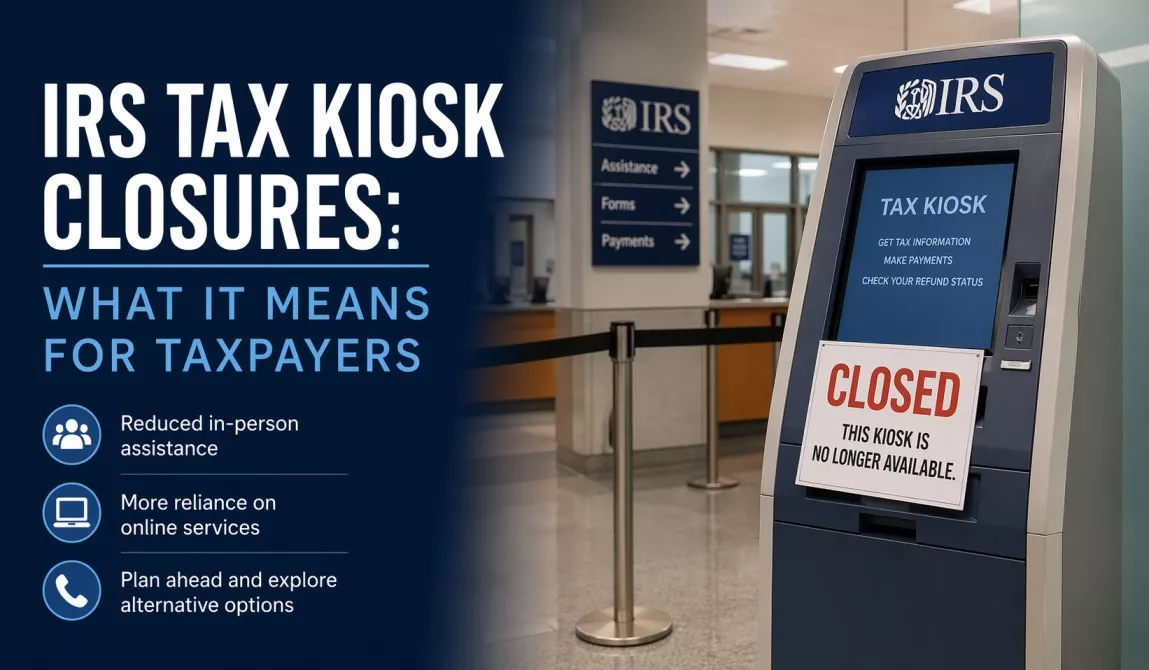
The IRS officially discontinued its self-service tax kiosk program at Taxpayer Assistance Centers (TACs) across the United States. As of mid-2025, the agency chose not to renew its $500,000 annual maintenance contract, and as a result, ended a program that had run since 2011. These closures directly affect taxpayers who previously relied on these in-person terminals to print tax transcripts, apply for Employer Identification Numbers (EINs), and access basic IRS services. Furthermore, the shift pushes millions of Americans toward fully digital or appointment-based alternatives, whether they are ready for that transition or not.
What Were IRS Tax Kiosks?
IRS tax kiosks were self-service computer terminals that the IRS installed inside Taxpayer Assistance Centers — its physical walk-in office locations. First launched in 2011, the program aimed to reduce wait times and give taxpayers a quick, independent way to handle simple tax-related tasks without speaking to an IRS employee.
For instance, a taxpayer could use a kiosk to complete any of the following tasks:
- Printing tax transcripts from prior years
- Applying for an Employer Identification Number (EIN)
- Accessing IRS online tools and resources without a personal device
- Getting information about account status and basic tax guidance
At their peak, the IRS deployed kiosks at 37 Taxpayer Assistance Centers across the country. By August 2024, 100 kiosks operated across those 37 locations, though staff reported many of them as non-functional for extended periods. In other words, even before the official closure, much of the program had already stopped serving taxpayers effectively.
Why Did the IRS Close the Tax Kiosks?
The closure of IRS tax kiosks was not a sudden decision. Rather, it came as the outcome of years of declining performance, poor maintenance, and shrinking taxpayer demand. Several factors together pushed the IRS toward ending the program entirely.
1. Severe Drop in Usage
First and most importantly, usage figures tell a stark story. At their peak in 2017, over 80,000 taxpayers used the kiosks annually. By 2024, however, that number collapsed to just 4,600 users between January and July alone — a decline of more than 94 percent in roughly seven years. After reviewing these numbers, the IRS concluded that continued investment simply made no financial sense.
2. Hardware Failures and Unreliable Maintenance
Beyond the usage decline, the physical condition of the kiosks created serious day-to-day problems. The IRS contracted a vendor for approximately $500,000 per year to handle kiosk hardware, software, network connectivity, and on-site technical services. Nevertheless, IRS employees consistently reported that the contractor responded slowly to service requests. Consequently, kiosks frequently sat broken and unusable for extended periods, frustrating both staff and taxpayers who arrived expecting working equipment.
To make matters worse, a January 2025 visit by Treasury Inspector General for Tax Administration (TIGTA) investigators to eight TACs with inoperable kiosks revealed that all machines were still not working — even though the IRS had earlier promised to resolve the issues by December 2024. That finding effectively confirmed what everyone already suspected: the vendor relationship had failed.
3. Outdated Technology
In addition to the maintenance problems, the technology itself had aged well past its useful life. The kiosks ran on outdated operating systems that users found difficult to navigate, especially those accustomed to modern smartphones and websites. Moreover, the old systems made it harder for the IRS to protect against contemporary cybersecurity threats. Rather than invest in a full hardware overhaul, the IRS decided to redirect those resources toward building better online tools.
4. Shift to Digital-First Services
Meanwhile, IRS.gov continued to expand its capabilities. Today, the platform lets taxpayers check refund status, set up payment plans, access transcripts, apply for EINs, and manage accounts entirely online. As digital adoption continued to rise among the general public, therefore, the IRS made a strategic choice to improve online access instead of maintaining aging physical terminals that fewer and fewer people used.
5. Contract Non-Renewal
Finally, the administrative end came down to a simple decision: the IRS declined to exercise the option year on the maintenance contract for 2025. With no contract in place, no mechanism existed to keep the kiosks running, and so the program came to a formal close.
Key Statistics: IRS Tax Kiosk Program by the Numbers
| Metric | Data |
|---|---|
| Year kiosk program launched | 2011 |
| Number of kiosks at peak | 100 units |
| Number of TACs with kiosks | 37 locations |
| Kiosk users in 2017 (peak) | 80,000+ taxpayers |
| Kiosk users Jan–Jul 2024 | 4,600 taxpayers |
| Usage decline (2017 to 2024) | Over 94% |
| Annual maintenance contract value | ~$500,000 |
| Year contract was not renewed | 2025 |
| Number of IRS TACs nationwide (pre-DOGE) | ~360 |
| IRS office leases marked for termination | 100+ |
The Broader Context: DOGE and IRS Restructuring
Importantly, the kiosk closures do not exist in isolation. They form part of a far larger and more disruptive overhaul of the IRS that the Department of Government Efficiency (DOGE) has driven under the Trump administration throughout 2025 and into 2026.
DOGE targeted over 100 IRS office leases for termination or non-renewal, affecting Taxpayer Assistance Centers in communities across the country. California leads the list with seven locations — including San Mateo, Stockton, Visalia, and Modesto. Massachusetts and Kentucky each follow with four proposed closures. Nationally, more than 113 taxpayer assistance offices appear in closure plans, and alongside those closures, the administration also moved to lay off approximately 6,500 IRS employees.
To understand how significant that shift is, consider that the IRS previously operated around 360 Taxpayer Assistance Centers — a network it had actively grown in recent years using funds from the Inflation Reduction Act of 2022. That law originally gave the IRS nearly $80 billion for modernization and enforcement. However, Republicans clawed back more than half of that funding through subsequent spending bills, which significantly slowed the planned expansion before DOGE accelerated the reversal.
Additionally, DOGE drove the dismantling of Direct File — a free electronic filing tool that the Biden administration launched to help low-income taxpayers file without paying for third-party software. That program cost over $40 million to develop, and its elimination left many nonprofit tax-prep organizations struggling to absorb the resulting surge in demand from the communities they serve.
IRS Staffing and Service Reduction: At a Glance
| Category | Before DOGE Cuts | After / During Cuts |
|---|---|---|
| Average phone wait time | ~3 minutes | Rising (30+ minutes pre-reform level) |
| In-person TAC locations | ~360 | 100+ proposed closures |
| IRS employees targeted for layoff | N/A | ~6,500 |
| Direct File availability | Operational | Dismantled |
| Self-service kiosks | 100 at 37 TACs | Discontinued |
| Paper return share (2025) | ~6% of all returns | Being actively reduced |
Who Is Most Affected by the Kiosk Closures?
Not all taxpayers feel the impact equally. In fact, several groups face a disproportionately difficult challenge now that kiosks no longer exist as an option.
Low-Income and Unbanked Taxpayers
For many low-income taxpayers, kiosks offered a free, walk-in access point that did not require owning a personal device. Without that option, these individuals must either purchase a device, use a library computer, or visit an IRS office and wait days or weeks for a staffed appointment. As a result, a group that already faces financial barriers now encounters additional logistical ones as well.
Elderly Adults
Similarly, older adults who feel less comfortable with digital platforms found genuine value in kiosks. Those terminals provided a structured, guided interface inside a familiar, physical environment. Moving these taxpayers to fully online IRS tools, therefore, requires either help from a family member or formal technical training — neither of which many seniors can easily access.
Rural Communities
Rural taxpayers often drive hours to reach the nearest TAC. Consequently, losing a self-service option at those offices removes what was sometimes the only way to complete a simple task in a single trip. Furthermore, if that nearest TAC itself faces closure under DOGE lease terminations, rural taxpayers may find themselves with no practical in-person option at all.
Small Business Owners
For small business owners, speed and convenience matter greatly. Previously, they could walk into a TAC, use a kiosk to look up an EIN or pull a tax transcript, and leave within minutes. Now, however, those same tasks require either setting up an online account or scheduling an in-person appointment — both of which demand considerably more time and planning.
Limited English Proficiency (LEP) Taxpayers
Kiosks also served LEP taxpayers in a subtle but important way: they allowed users to work at their own pace without pressure. In contrast, a staffed appointment with a set time limit and a live agent can feel more stressful and intimidating. Community organizations that serve LEP populations have, therefore, raised specific concerns about losing this self-paced resource.
What Kiosk Tasks Taxpayers Used Most vs. What’s Now Available Online
| Previous Kiosk Task | Online Equivalent | Where to Access |
|---|---|---|
| Print tax transcript | Get Transcript tool | IRS.gov/get-transcript |
| Apply for EIN | Online EIN Application | IRS.gov/ein |
| Check refund status | Where’s My Refund? | IRS.gov/refunds |
| Set up payment plan | Online Payment Agreement | IRS.gov/opa |
| Access tax forms | Forms and Publications | IRS.gov/forms |
| View account balance | IRS Online Account | IRS.gov/account |
Alternatives Now Available to Taxpayers
Even though kiosks are gone, taxpayers still have access to a solid range of alternatives. The IRS, alongside several nonprofit organizations, offers resources that vary by income level, age, location, and digital comfort. Knowing which option fits your situation can save a great deal of time and frustration.
IRS Online Account
The IRS Online Account at IRS.gov lets taxpayers view their balance, make payments, access tax records, set up payment plans, and manage authorization requests — all without visiting an office. However, taxpayers should note that creating an account requires identity verification through ID.me, which some users find challenging on the first attempt. Completing that step in advance of any filing deadline is strongly advisable.
Taxpayer Assistance Centers (TACs)
TACs remain the primary in-person option for taxpayers who need face-to-face help. To schedule an appointment, call 844-545-5640. Because walk-ins rarely receive service, the IRS strongly recommends calling ahead and bringing a government-issued photo ID along with any relevant tax documents to the appointment.
IRS Free File
Taxpayers earning $84,000 or less may qualify to file their federal return for free through IRS Free File partner software at IRS.gov/freefile. Despite its wide availability, this program remains one of the most underused resources in the country. As a result, many taxpayers pay for commercial filing services when they would qualify to file at no cost. Checking eligibility before purchasing any third-party software is worth the extra minute.
VITA (Volunteer Income Tax Assistance)
VITA offers free, certified tax preparation for taxpayers earning $67,000 or less, people with disabilities, and those with limited English proficiency. Trained volunteers prepare returns at thousands of community sites nationwide. To find a location near you, visit IRS.gov/vita.
Tax Counseling for the Elderly (TCE)
TCE specifically serves taxpayers aged 60 and older. Because the AARP Foundation runs the program through its Tax-Aide initiative, it operates at more than 7,000 locations during filing season. Furthermore, TCE specializes in pension and retirement income questions that matter most to seniors, making it a much more targeted resource than generic filing services.
IRS Phone Assistance
The IRS general helpline at 1-800-829-1040 connects taxpayers with assistors who handle a wide range of questions. That said, call wait times have climbed significantly as staffing levels have declined. For shorter waits, taxpayers should call early in the morning on Tuesday through Thursday rather than on busy Monday mornings.
Low Income Taxpayer Clinics (LITCs)
For taxpayers who find themselves in disputes with the IRS — such as audits, appeals, or collection actions — LITCs offer free or low-cost legal representation. Reach them at 202-317-4700 or through the IRS website. These clinics serve a narrower audience, but for those who qualify, they provide invaluable professional support that would otherwise cost hundreds of dollars in legal fees.
Comparison of Taxpayer Service Channels
| Channel | Cost | Requires Internet | Requires Appointment | Best For |
|---|---|---|---|---|
| IRS Online Account | Free | Yes | No | General self-service |
| TAC In-Person Visit | Free | No | Yes | Complex issues |
| IRS Free File | Free | Yes | No | Filing returns |
| VITA Sites | Free | No | Sometimes | Low-income filers |
| TCE / AARP Tax-Aide | Free | No | Sometimes | Seniors |
| IRS Phone Line | Free | No | No | Questions and guidance |
| LITC | Free/Low-cost | No | Yes | Tax disputes |
| Paid Tax Professional | Paid | No | Yes | Complex situations |
Key Takeaways
- The IRS officially ended its self-service kiosk program in 2025 after choosing not to renew the $500,000 annual maintenance contract with the program vendor.
- At their peak in 2017, over 80,000 taxpayers used the kiosks annually. By mid-2024, however, that number had fallen to just 4,600 — a decline of more than 94 percent in seven years.
- The kiosks covered only 37 of the IRS’s approximately 360 Taxpayer Assistance Centers, meaning the program already had a limited geographic reach well before the closure.
- Beyond the kiosk program, DOGE-driven restructuring has pushed proposals to close more than 100 TAC office locations and lay off approximately 6,500 IRS employees.
- The groups most harmed by the closures include elderly taxpayers, low-income individuals, rural residents, limited English proficiency filers, and small business owners who relied on fast walk-in access.
- Nevertheless, strong free alternatives exist, including IRS.gov online tools, VITA sites, TCE and AARP Tax-Aide programs, and in-person TAC appointments that taxpayers can schedule in advance.
- The IRS is moving toward a digital-first service model. Even so, that transition creates real access gaps for the tens of millions of Americans who still struggle with navigating online government tools.
- The full impact of workforce reductions and office closures on IRS service quality will only become clear after the 2026 tax season concludes in October.
Frequently Asked Questions (FAQs)
Q: When exactly did the IRS stop the kiosk program?
A: The IRS chose not to exercise the option year on the kiosk maintenance contract in 2025. By January 2025, TIGTA investigators visited eight TACs and found all kiosks still non-functional. The IRS then confirmed the program’s discontinuation in August 2025.
Q: How many kiosks did the IRS have, and where were they?
A: At their peak, the IRS operated 100 kiosks across 37 Taxpayer Assistance Centers around the country. Even so, the program never covered the full network of roughly 360 IRS offices, so its reach was always limited compared to the broader TAC system.
Q: What can I do instead of using a kiosk?
A: Most tasks that kiosks handled — including printing transcripts, applying for EINs, checking refund status, and setting up payment plans — now exist as online tools at IRS.gov. For in-person help, call 844-545-5640 to schedule a TAC appointment ahead of your visit.
Q: Will my local IRS office still be open?
A: Many IRS offices remain open. However, over 100 face potential lease terminations because of DOGE cost-cutting. California, Massachusetts, and Kentucky have the most proposed closures. To confirm your nearest office’s status, use the TAC locator at apps.irs.gov/app/office-locator.
Q: Is IRS.gov secure for filing and accessing personal information?
A: Yes. IRS-approved platforms run on encrypted, secure systems. Furthermore, accessing an IRS online account requires identity verification through ID.me, which adds an extra layer of protection for all taxpayers.
Q: What free options exist for those who cannot file online?
A: VITA sites serve taxpayers earning $67,000 or less, while TCE and AARP Tax-Aide programs help taxpayers aged 60 and older. Both programs operate at thousands of locations nationwide and do not require taxpayers to have internet access at home, making them genuinely accessible alternatives.
Q: How has DOGE affected IRS services beyond kiosk closures?
A: In addition to ending the kiosk program, DOGE has pushed approximately 6,500 IRS employee layoffs, proposed the closure of over 100 TAC offices, and eliminated the Direct File free filing program. Together, these changes raise serious concerns about longer wait times, delayed refunds, and weaker enforcement of high-income tax evasion.
Q: I am elderly and not comfortable with computers. What should I do?
A: The AARP Tax-Aide program, which operates under the TCE initiative, provides free in-person tax help to seniors at more than 7,000 locations nationwide during filing season. Call 888-227-7669 or visit irs.treasury.gov/freetaxprep to find a site near you.
Q: Will the IRS introduce any replacement for the kiosks?
A: The IRS has stated that it actively explores modern alternatives such as updated hardware or laptop-based digital access at select TAC locations. TIGTA also recommended these kinds of modernized options, especially for users who lack reliable home internet. As of early 2026, however, the IRS has not yet announced a confirmed replacement program.
Q: Does the kiosk closure affect my ability to get a tax refund?
A: The kiosk closure itself does not affect refund processing directly. Taxpayers can still check refund status through the “Where’s My Refund?” tool at IRS.gov/refunds or by calling 1-800-829-1954. That said, broader IRS staffing reductions may slow the processing of returns that require any manual review.
Final Thoughts
The end of the IRS tax kiosk program marks a small but telling chapter in a much larger story about how the U.S. government delivers public services in the digital age. For the majority of taxpayers who already file online and rarely visit an IRS office, these closures will go entirely unnoticed. For the millions who relied on in-person services — especially older adults, rural residents, and low-income filers — however, each reduction in physical access carries real and lasting consequences.
Above all, what matters most right now is awareness. Knowing that free alternatives exist — from VITA sites and TCE programs to the IRS Online Account — can make a meaningful difference for taxpayers who might otherwise feel stranded by these changes. Moreover, for policymakers, the data delivers a clear message: the true cost of limiting access to government services is not purely financial. Ultimately, it measures itself in the confidence, fairness, and long-term compliance of the entire tax system.
As a practical next step, staying informed, using official IRS channels, and seeking help early in the filing season remain the most effective actions any taxpayer can take in this rapidly changing environment.


