


Why McDonald’s New AI Drive-Thru Is Facing Criticism
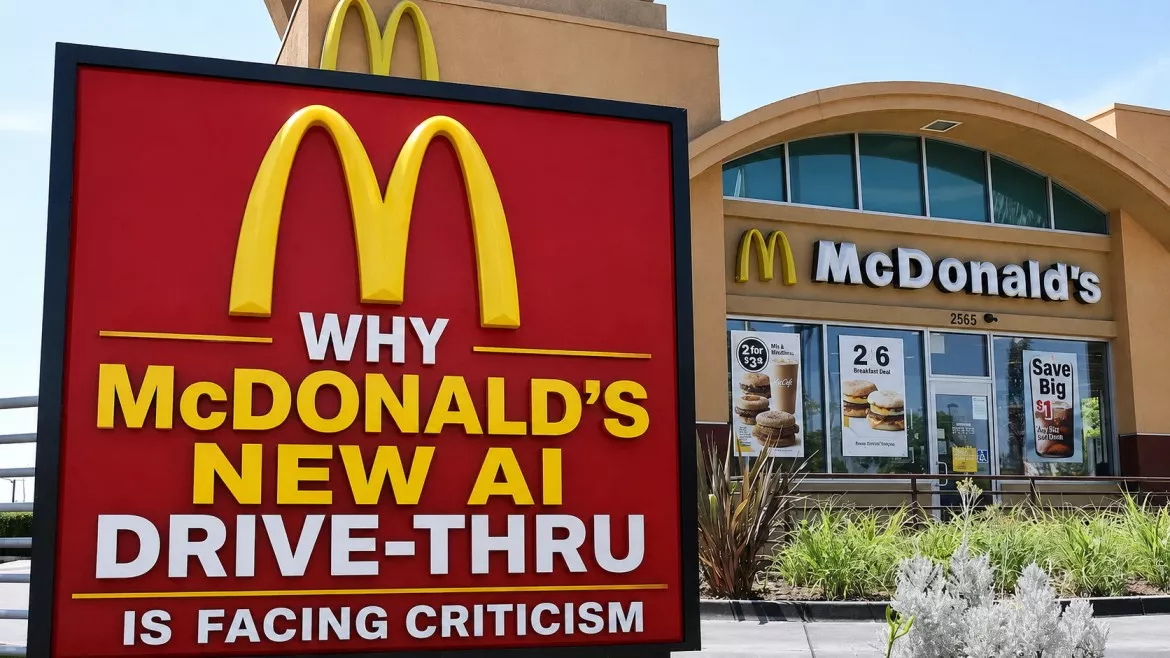
McDonald’s has always been a pioneer of fast-food efficiency — from standardized kitchens to self-service kiosks. Its most ambitious technology experiment yet, however, has generated a wave of criticism. An AI-powered drive-thru ordering system attracted media scrutiny and exposed a stark gap between artificial intelligence’s promise and its real-world performance.
The story spans two distinct acts. The first is a cautionary tale: a failed IBM partnership that ended in 2024. The second is a renewed, better-equipped attempt now underway with Google in 2026. Together, they reveal why McDonald’s AI drive-thru is facing criticism — and why the company refuses to abandon the vision.
What Is McDonald’s AI Drive-Thru System?
The IBM Partnership: McDonald’s First AI Experiment
McDonald’s first foray into AI-powered ordering began in 2021. The company partnered with IBM to test an automated voice ordering system — officially called the Automated Order Taker (AOT). The pilot ran at more than 100 drive-thru locations across the United States.
The concept was straightforward. A customer pulls up to the speaker and states their order. An AI voice assistant interprets and records it — no human crew member required. The system used speech recognition technology designed to handle complex requests, suggest upsell items based on context, and process orders faster than human employees.
McDonald’s CEO Chris Kempczinski framed the initiative as part of a broader push to modernize restaurant operations. The chain believed AI could process orders more accurately during peak hours. It would also reduce the cognitive load on crew members and scale across thousands of locations globally.
By 2024, however, McDonald’s pulled the plug. The company announced the end of its IBM partnership. The AOT system was shut off at all test locations no later than July 26, 2024. McDonald’s USA Chief Restaurant Officer Mason Smoot confirmed the decision in a memo obtained by CNBC. He cited the need to find “a future voice ordering solution.”
ArchIQ: McDonald’s Second Chance with Google
Fast-forward to June 2026. McDonald’s unveiled a second attempt: ArchIQ, a new AI operating platform developed with Google Cloud. It is currently being piloted at five US restaurant locations as part of the company’s “McDonald’s Next” strategy.
The drive-thru voice assistant is nicknamed Archy. It handles orders in both English and Spanish. According to a McDonald’s franchise account on X, roughly 90% of orders are completed without human escalation. Every US McDonald’s location is reportedly receiving Google Edge Cloud hardware in anticipation of a broader rollout.
Despite improved numbers, the public reaction has been cautious — and the memory of the IBM-era failures long.
Why Did Customers Criticize the AI Drive-Thru?
The criticism of McDonald’s AI drive-thru has been loud, sustained, and often painfully specific. The IBM-era system generated complaints spanning ordering errors, communication breakdowns, and a viral social media backlash that reshaped public perception.
Incorrect Orders
The most damaging criticism was simple: the AI got orders wrong — sometimes spectacularly so.
In early 2023, TikTok user Ren Adams documented her experience at a McDonald’s drive-thru powered by the automated system. She had intended to order a hash brown, a sweet tea, and a Coke. The AI added nine sweet teas to her order instead. She abandoned the line without purchasing anything.
In another widely shared video, TikTok user Madilynn Cameron filmed herself ordering water and vanilla ice cream. The AI inexplicably added two sides of butter and four ketchup packets to her order. “McDonald’s, I’m done,” she said on camera.
Perhaps most memorably, a 2023 video shows the AI repeatedly adding chicken nuggets to a customer’s order. The customer laughed and asked it to stop. It kept adding nuggets anyway. These were not isolated incidents. They represented a systemic failure to accurately parse real human speech in real drive-thru conditions.
For a brand built on reliability, errors of this nature carry significant reputational risk. A customer who receives the wrong order experiences the opposite of the efficiency McDonald’s promised. So does one who spends extra minutes correcting a confused AI.
Communication Challenges
Behind the ordering errors lay a deeper technical problem: the AI struggled to understand many of its users.
Insiders told CNBC that the system had difficulty processing certain accents and speech patterns. This is not a minor edge case. McDonald’s operates in extraordinarily diverse communities. Customers speak with regional accents, non-native inflections, and a wide range of dialects. A system that fails with any meaningful segment of that population cannot be considered ready for mass deployment.
Background noise compounded the problem. Drive-thru environments are inherently noisy. Car engines idle, windows roll down, traffic rumbles, wind gusts. Early speech recognition systems struggled to isolate the customer’s voice from all that ambient sound. A misheard word in a fast-food order can cascade into a completely wrong meal.
Complex or customized orders presented a third challenge. Simple requests like “a large Coke” might be handled adequately. But McDonald’s menu is vast. Customers frequently customize — removing ingredients, substituting items, or combining orders for multiple people. The IBM system’s ability to handle these scenarios proved limited.
Viral Social Media Reactions
What might have remained anecdotal complaints became a cultural moment because of social media.
TikTok, in particular, gave customers a frictionless way to film and share their drive-thru encounters. The format was irresistible: a quick video, a frustrated or amused customer, and an AI making a baffling mistake. These clips spread rapidly. They accumulated millions of views and generated news coverage far beyond what McDonald’s corporate communications could counter.
The viral dynamic created a feedback loop. The more such videos circulated, the more customers arrived at AI-equipped locations expecting a humorous failure — sometimes even filming preemptively. Public perception hardened against the technology before most people had experienced it firsthand.
This is a crucial lesson for any brand deploying AI in public-facing contexts. A handful of highly shareable failures can define a technology’s reputation. The overall accuracy rate matters far less than those memorable mistakes.
What Benefits Was McDonald’s Hoping to Achieve?
Understanding why McDonald’s invested so heavily in AI ordering — twice — requires understanding the pressures the fast-food industry faces.
- Labor costs are rising across the United States. Minimum wage increases in several major states have pushed crew compensation higher. An AI system that reliably takes orders eliminates one of the highest-turnover positions in the restaurant, with compounding cost savings at scale.
- Speed of service is a competitive differentiator in fast food. Drive-thru wait times have become a key metric. An AI that processes orders instantly — without pausing to clarify or consult a screen — theoretically reduces queue times. McDonald’s data suggested the IBM system could outperform human order-takers in speed under ideal conditions.
- Consistency was another goal. Human employees have good days and bad days. They get distracted, mishear requests, and occasionally key in the wrong item. An AI performs identically on its thousandth order as on its first — removing variability from the customer experience.
- Scalability gave the initiative its strategic logic. McDonald’s operates more than 40,000 locations worldwide. A technology that works at 100 restaurants can, with sufficient investment, be deployed to all of them. The unit economics improve dramatically at that scale.
Finally, the initiative was part of a long-term automation strategy. McDonald’s leadership understood that early deployments might be imperfect. The competitive advantage of mastering AI ordering — before rivals did — was seen as worth the reputational risk of early experimentation.
Are AI Drive-Thru Systems Ready for Widespread Use?
The honest answer is: not yet — but closer than before. Both McDonald’s experience and broader industry patterns confirm this.
The IBM-era system revealed structural limitations in conversational AI as it existed in 2021–2024. Speech recognition models trained on standard American English performed poorly across diverse accents. Natural language processing struggled with the non-linear, incomplete sentences real people use to place orders. Background noise suppression was insufficient for outdoor environments.
Where AI Currently Falls Short
AI performs well when conditions are controlled: a quiet space, a simple request, a patient speaker. It struggles at the intersection of noise, diversity, and complexity. That is precisely where a high-volume fast-food drive-thru operates.
Competitors have had mixed results. White Castle partnered with SoundHound AI to bring voice ordering to more than 100 locations. Panera, Arby’s, and Popeyes have tested OpenCity’s “Tori” voice assistant in their drive-thru lanes. Popeyes UK reported 97% accuracy from a pilot program. That sounds impressive. But a 3% error rate still means a meaningful number of frustrated customers receiving the wrong meal.
Human interaction remains superior in specific scenarios. These include complex multi-item orders with modifications, customers who change their minds mid-order, and non-native English speakers. Moments requiring empathy — like handling an upset customer or a payment issue — also favor human staff.
What the ArchIQ System Changes
The new ArchIQ system appears meaningfully better. Bilingual capability and Google’s machine learning infrastructure suggest McDonald’s has addressed several gaps that doomed the IBM effort. But five pilot locations is a far cry from validated readiness at scale.
What Experts Say About AI in Fast-Food Restaurants
Technology and customer service analysts broadly agree that AI ordering has a legitimate future in fast food — but that the current moment requires caution.
The key insight from McDonald’s first attempt is that a controlled test that yields public failures still provides valuable data. As the Museum of Failure noted in its analysis, testing at 100 locations rather than deploying at 40,000 was the right approach. The experiment cost McDonald’s some reputational capital but saved it from a potentially catastrophic system-wide failure.
Analysts point to natural language processing advances as the decisive variable. Models trained on broader linguistic datasets — including diverse accents, speech patterns, and conversational formats — perform significantly better than earlier systems. The integration of large language models into voice interfaces changes the calculus considerably. That development was largely unavailable when the IBM partnership was structured.
The hybrid human-AI model has emerged as the prevailing expert recommendation. AI should assist human order-takers, not replace them. It can flag potential errors, handle simple repeat orders, and escalate complex requests to a crew member. The ArchIQ system’s reported 90% autonomous completion rate implicitly embraces this framework: 10% of orders still go to a human.
Customer service specialists emphasize that trust, once lost, is slow to rebuild. The viral videos from 2023 set lasting expectations. McDonald’s and its competitors must actively work to overcome them, even as the underlying technology has improved.
How McDonald’s May Improve Future AI Ordering Systems
McDonald’s second attempt demonstrates that the company absorbed lessons from its first. Several technical and operational improvements characterize the ArchIQ approach.
Advanced speech recognition built on Google’s infrastructure offers substantially better performance across accents and dialects than the IBM system achieved. Google’s models benefit from billions of data points and continuous retraining, giving them a meaningful head start over purpose-built restaurant AI.
Multilingual capability is a direct response to the communication challenges of the IBM era. Archy’s bilingual design reflects a more realistic model of McDonald’s customer base. It also hints at further language support as the system matures.
Human oversight integration is now structural rather than an afterthought. McDonald’s has positioned ArchIQ as an assistant rather than a replacement. It supports crew members and escalates when needed. This removes the pressure on the AI to be flawless on every interaction.
Kitchen and operational intelligence extends the system beyond ordering. ArchIQ is described as a “master brain” for restaurant operations — monitoring kitchen workflows, alerting managers to bottlenecks, and helping staff prioritize tasks. This broader value proposition makes the technology useful even when voice ordering requires human backup.
Customer feedback integration will be essential as the pilot expands. Systematic analysis of ordering failures will allow McDonald’s and Google to continuously improve the model, shrinking the error rate over time.
What This Means for the Future of Restaurant Automation
McDonald’s experience — failure, reassessment, and renewed attempt — is likely a template for the entire fast-food industry.
Several major chains are actively developing or deploying AI ordering systems. Wendy’s has tested a conversational AI called FreshAI. Taco Bell has explored voice AI for drive-thrus. The economic pressures driving these investments — rising labor costs, staffing challenges, demand for speed — have not diminished. If anything, they have intensified.
Consumer expectations are evolving in parallel. Younger customers regularly interact with AI assistants like Siri, Alexa, and Google Assistant. They have both higher tolerances for AI-mediated transactions — and higher expectations of accuracy. A system that adds nine sweet teas to an order will face immediate social media exposure. For this generation, sharing that video is second nature.
The future of AI-assisted ordering is likely augmentation rather than replacement — at least in the near term. AI will handle routine, predictable orders with speed and accuracy. Human crew members will remain essential for exceptions, customizations, and moments requiring genuine hospitality. The best-performing chains will design their systems around this division of labor intelligently.
The broader trajectory points toward increasing automation. As AI models improve and hardware costs fall, the business case for voice ordering will strengthen. McDonald’s ArchIQ pilot — with its Google infrastructure, bilingual capability, and kitchen integration — represents the most credible attempt yet to make that future viable.
Frequently Asked Questions
Why is McDonald’s AI drive-thru facing criticism?
McDonald’s AI drive-thru faced criticism primarily because its first system failed repeatedly in public view. Built with IBM between 2021 and 2024, it produced frequent ordering errors and struggled with accents and background noise. It also generated viral videos showing the AI adding bizarre, unrequested items to customer orders. The new ArchIQ system, launched in pilot in 2026, is also meeting skepticism from consumers who remember the earlier failures.
What problems did customers experience with the AI system?
Customers reported receiving incorrect orders and difficulty with customized or multi-item orders. The AI also failed to understand many accents and speech patterns. Notable examples include a customer who received nine sweet teas instead of one, and another whose order of ice cream and water was supplemented with butter and ketchup packets.
Has McDonald’s stopped using AI drive-thru technology?
McDonald’s ended its partnership with IBM and shut down the original Automated Order Taker system in July 2024. However, the company has not abandoned AI ordering. In June 2026, it announced ArchIQ — a new AI platform developed with Google — currently being piloted at five US locations as part of its “McDonald’s Next” strategy.
How does AI ordering work in restaurants?
AI ordering systems use voice recognition to capture what a customer says at the drive-thru speaker. Natural language processing then interprets the request and translates it into an order. The system displays the order on a screen for customer confirmation before finalizing it. More advanced systems, like ArchIQ, also monitor kitchen operations and alert staff to workflow issues.
Will AI replace fast-food workers?
AI is unlikely to fully replace fast-food workers in the near term. Current systems handle routine orders but require human backup for complex customizations, payment issues, and situations requiring empathy. Most industry analysts expect a hybrid model — AI handling repetitive tasks while human employees focus on higher-value interactions.
Are AI drive-thrus becoming more common?
Yes. Several major chains including Wendy’s, White Castle, Panera, Arby’s, and Popeyes have tested AI voice ordering in their drive-thrus, with varying results. As the technology improves and labor costs rise, adoption is expected to increase. The pace will depend on each chain’s ability to achieve reliable accuracy before going public.
Conclusion
Why McDonald’s new AI drive-thru is facing criticism is a question with both a short answer and a longer one.
The short answer: the technology, in its first iteration, did not work well enough. It misunderstood customers, added wrong items, struggled with diverse voices, and produced memorable failures that became internet fodder.
The longer answer reveals something more instructive. McDonald’s criticism is as much about expectation management and timing as it is about technical capability. The company deployed voice AI before the technology was mature enough for real drive-thru conditions — chaotic, diverse, and high-volume. The public expected more. Social media gave frustrated customers a powerful amplifier.
The structural challenges AI faces at the drive-thru are real but not permanent. Speech recognition is improving. Natural language models are becoming more contextually aware. Multilingual support is expanding. The ArchIQ system and its Google-powered infrastructure represent a meaningfully different attempt than the IBM partnership that preceded it.
What McDonald’s experience ultimately reveals is this: deployment timing matters as much as technology quality. An AI system that is 85% accurate in a lab can fail spectacularly in the field. Those failures — filmed and shared — can define public perception for years. The companies that succeed will test rigorously, scale gradually, and maintain honest human oversight. They will resist announcing transformative innovation before the technology is ready to deliver.
McDonald’s is trying again. Whether Archy succeeds where its predecessor stumbled will reveal how far AI has genuinely come — and how much further it still has to go.


