


Craigslist Apartment Hunting Tips for SF, NYC & LA
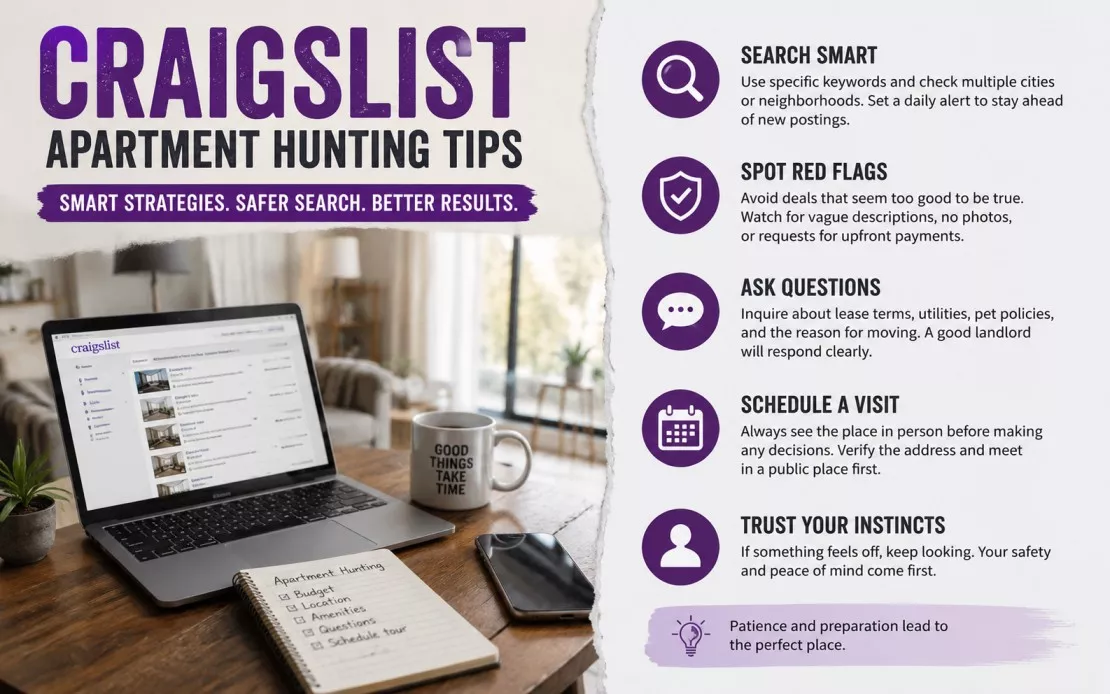
Walk into any conversation about apartment hunting in San Francisco, New York City, or Los Angeles, and someone will inevitably say: “Have you tried Craigslist?” The platform launched in 1995, has barely changed its interface since then, and is still where thousands of renters find their homes every single day.
That’s not nostalgia. That’s strategy.
The newer platforms — Zillow, Apartments.com, Rent.com — have excellent filters and polished UX, but they’re also where everyone else is looking. Craigslist’s dated design and lack of algorithmic ranking create an information asymmetry that savvy renters have exploited for decades: listings appear raw, unboostable, and in chronological order. A private landlord with a rent-controlled unit in the Mission District and a flexible move-in date is far more likely to post it on Craigslist than anywhere else.
That said, Craigslist is also a playground for scammers, and in a city like NYC where broker fees can add one to two months of rent to your moving costs, a single bad decision can cost thousands of dollars.
This guide is built for renters who want to use Craigslist intelligently — as one powerful tool within a broader strategy, with city-specific knowledge that actually reflects how these rental markets work in 2026.
Why Craigslist Still Works in 2026
Direct Landlord Access
Large property management companies dominate listings on Zillow and Apartments.com. Craigslist remains the preferred channel for small landlords, owner-operators, and people renting out a single unit in a building they live in. These landlords often prioritize a reliable tenant over the highest bidder — meaning your personal pitch, delivered quickly and professionally, carries real weight.
First-Mover Advantage
When a landlord lists on Craigslist, they often want to fill the unit fast. Unlike aggregator platforms where listings linger for algorithmic optimization, Craigslist postings frequently go to the first qualified applicant who shows up. Speed — measured in hours, not days — is a competitive advantage.
Hidden Deals and Below-Market Units
Rent-controlled apartments in SF, pre-war walkups in Brooklyn, and off-market units in LA’s residential neighborhoods rarely appear on major platforms. Landlords with desirable rent-controlled units often don’t want to advertise widely and generate dozens of applications. A short Craigslist post with minimal details accomplishes what they need: finding one good tenant quietly.
Lower Competition on Certain Listings
Counterintuitively, Craigslist’s interface friction discourages casual browsers. Renters using Zillow or Apartments.com can inquire with one tap. On Craigslist, you need to compose an actual email. That small barrier means serious renters — people who’ve done their research and have their documents ready — tend to rise to the top.
Craigslist vs. the Competition: A Honest Comparison
| Platform | Best For | Weaknesses |
|---|---|---|
| Craigslist | Private landlords, rent-controlled units, fast turnaround | Scams, no verification, dated interface |
| Zillow Rentals | Large buildings, verified listings, good filtering | Less private-landlord inventory |
| Apartments.com | Apartment complexes, property management | Limited individual listings |
| Facebook Marketplace | Local community listings, sub-lets | High scam rate, inconsistent quality |
| HotPads | Map-based search, transit proximity | Thinner inventory in some cities |
| Rent.com | Mid-market rentals, national search | Less useful for hyper-local searches |
The smartest renters check Craigslist and two or three other platforms simultaneously. No single platform has a monopoly on great apartments.
Understanding the Rental Markets: SF, NYC & LA Compared
Before diving into tactics, understand the landscape. These three cities are all expensive, competitive, and renter-heavy — but they operate very differently.
| Factor | San Francisco | New York City | Los Angeles |
|---|---|---|---|
| Avg. 1BR Rent (2026) | $2,800–$3,400 | $3,200–$4,500 | $2,200–$3,000 |
| Avg. 2BR Rent (2026) | $3,800–$5,000 | $4,500–$6,500 | $3,000–$4,200 |
| Security Deposit | 2 months max | 1–2 months | 2 months max |
| Income Requirement | 40–45x monthly rent | 40x monthly rent | 2.5–3x monthly rent |
| Broker Fees | Rare | Common (1–2 months) | Rare |
| Key Challenge | Speed, tech competition | Fees, guarantors | Car dependency, sprawl |
| Rent Control | Strong (pre-1979 buildings) | Moderate (ETPA) | Moderate (RSO) |
| Best Time to Search | Sept–Oct, Jan–Feb | Jan–Feb, Aug–Sept | Oct–Feb |
| Most Competitive | SOMA, Noe Valley, Mission | Manhattan, prime Brooklyn | Santa Monica, Silver Lake |
The Core Craigslist Apartment Hunting Strategy
Set Up Smart Search Filters
Craigslist’s filters are minimal but effective when used precisely. Every search session should define:
- Price range: Set your ceiling 10–15% above your true budget. Private landlords often negotiate, especially near month-end.
- Bedrooms: Search both your target and one step up/down — a “1BR” in one listing might be listed as “studio + den” in another.
- Neighborhood: Use the geographic checkboxes, but also manually search neighborhood names in the keyword field. “Lower Pacific Heights” appears in body text, not dropdown categories.
- Pets, parking, laundry: Filter these where available, but also include them as keyword searches — “pet friendly,” “parking included,” “in-unit laundry.”
Create Instant Listing Alerts
This is one of the most underutilized Craigslist features. Set up saved searches with email alerts — when a new listing matching your criteria is posted, you receive an email immediately. For competitive markets, checking Craigslist twice daily isn’t enough. Alerts mean you’re notified within minutes of posting.
On mobile, third-party apps like Listia or CPlus for Craigslist can push notifications to your phone faster than Craigslist’s native email system.
Respond Faster Than Other Renters
The first hour matters more than any other variable. Studies of rental inquiries consistently show landlords in competitive markets often choose from the first five to ten responses they receive. Here’s how to be among them:
Build a renter profile in advance. Write a 3–4 sentence introduction: your occupation, why you’re moving, rental history (e.g., “I’ve rented in [city] for 4 years with no late payments”), and one personal detail that makes you memorable. Keep it under 150 words.
Draft a reusable inquiry template that you can personalize in 60 seconds:
Hi — I saw your listing for [address/neighborhood] and I’m very interested. I’m a [profession] looking to move [timeframe], and your unit fits exactly what I need. I have all documents ready including pay stubs, credit report, and references. Would you be available for a showing this week? I’m flexible on timing. Thanks, [Name] — [phone number]
Have your documents organized in a digital folder so you can attach them instantly. Landlords who receive a complete application package on first contact move fast.
San Francisco-Specific Craigslist Tips
San Francisco’s rental market is one of the most peculiar in the country: extraordinarily expensive, heavily regulated, and shaped by a decade-long cycle of tech booms and pandemic corrections. In 2026, it remains competitive but has softened from 2022 peaks in some neighborhoods.
Understand Rent Control Before You Sign
San Francisco’s Rent Ordinance covers residential units built before June 13, 1979. If a building qualifies, annual rent increases are capped (typically 2–3% based on CPI), and landlords face significant restrictions on evictions. This makes rent-controlled apartments extraordinarily valuable long-term — a tenant who’s been in a Mission District 1BR for a decade may be paying $1,400 for an apartment that would rent for $3,200 today.
Craigslist is where many of these units surface. When you see a 1979 or earlier building date in a listing, or when a unit seems priced below market in a desirable neighborhood, ask directly: “Is this unit covered under SF’s Rent Ordinance?”
Neighborhood Intelligence
Mission District: Extremely competitive, culturally vibrant, and well-served by BART at 16th and 24th Streets. Focus your search on older apartment buildings along side streets, where private landlords are more common. Be prepared for tech-worker competition on anything under $3,000 for a 1BR.
Sunset District (Inner/Outer): Frequently overlooked yet consistently good value. Fog is frequent, but rents run $200–$600 less than the Mission for comparable units, and the N-Judah light rail connects directly to downtown. Families and longtime SF residents dominate this market, which means lower turnover and a calmer application process.
Richmond District: Similar in character to the Sunset — affordable by SF standards, with an excellent food scene and proximity to Golden Gate Park. The 38-Geary bus is one of SF’s busiest lines, making it a solid choice for renters who don’t need to be near BART.
SoMa (South of Market): Tech-adjacent, expensive, and dominated by newer construction with less rent control coverage. As a result, most buildings here are professionally managed and list on Zillow first — however, Craigslist occasionally surfaces condos rented directly by individual owners at more negotiable rates.
Noe Valley: Sunny, walkable, and family-friendly, though premium pricing reflects that desirability. Notably, in-law units (sometimes called “garden apartments”) posted by homeowners appear frequently on Craigslist here and rarely anywhere else — making it one of the strongest use cases for Craigslist specifically in SF.
Commute Realities
Always map your commute before viewing. San Francisco’s transit is strong in some corridors and poor in others. A unit in the Excelsior that looks affordable on paper can mean a 75-minute commute to a SoMa office via two buses. Use the SFMTA trip planner alongside your Craigslist search.
New York City-Specific Craigslist Tips
New York’s rental market is the most complex in the country. Broker fees, guarantor requirements, co-op board approvals, and income thresholds create hurdles that don’t exist elsewhere. Craigslist remains relevant here — but knowing what you’re looking at is essential.
Navigating Broker Fees
Many NYC Craigslist listings are posted by brokers, not landlords. The listing may say “no fee” when it means the landlord pays the fee — or the fee structure may be buried in the listing. Since 2019’s FARE Act (now more consistently enforced), landlords who hire the broker must pay the fee — but broker-listed apartments on Craigslist often don’t clarify this upfront.
Always ask directly: “Is there a broker fee, and who is responsible for it?” Get the answer in writing before viewing.
Income and Guarantor Requirements
NYC landlords typically require that annual income equals 40 times the monthly rent. On a $3,000 apartment, that’s $120,000/year — a threshold that excludes recent graduates and many service workers even for basic apartments.
When income doesn’t qualify, landlords require a guarantor (co-signer), and most NYC-specific guarantor requirements are even stricter: 80x the monthly rent annually, and often the guarantor must reside in the tri-state area (NY, NJ, CT).
Third-party guarantor services like Insurent and The Guarantors offer fee-based alternatives ($500–$1,200 typically) and are widely accepted in NYC.
Borough-by-Borough Strategy
Manhattan: Lowest vacancy rates, highest prices. Craigslist listings here move in hours. Focus on Washington Heights, Inwood, and East Harlem for relative value. Midtown and downtown postings are overwhelmingly professional listings.
Brooklyn: The most diverse rental market in the system. Williamsburg and Park Slope are premium. Crown Heights, Bushwick, and Bay Ridge offer real value. Craigslist is strong here — many small landlords with 2–4 unit buildings post exclusively on Craigslist.
Queens: Consistently underrated. Astoria, Jackson Heights, and Forest Hills offer excellent transit access (the N/W and E/F/M trains), diverse food scenes, and rents 20–30% below comparable Brooklyn neighborhoods. Great value for remote workers and professionals.
Bronx: The most affordable borough with improving neighborhoods near the Metro-North corridor. Riverdale is a hidden gem — suburban feel with express train access to Midtown.
Staten Island: Requires car ownership for most residents. Primarily of interest to renters with strong ties to that community.
Los Angeles-Specific Craigslist Tips
LA’s rental market sprawls across 500+ square miles. Unlike SF or NYC, there’s no single transit spine — your apartment choice is inseparable from your transportation strategy. Craigslist is strong here because LA’s rental market is dominated by smaller landlords and individual owners, not institutional property managers.
The Car Question Comes First
Before searching any LA neighborhood, answer honestly: do you own a car, and do you need one for work? In most LA neighborhoods, the answer determines everything. Public transit is improving — the Metro Expo and Gold lines, the Purple Line extension — but car-free living is only genuinely practical in a handful of dense corridors.
If car-free: focus on Hollywood (Red Line), Koreatown (Red/Purple Line), Culver City (Expo Line), and Downtown LA. Budget for slightly higher rents relative to your income.
If car-dependent: Parking becomes a primary filter. Many Craigslist listings specify “street parking” vs. “assigned parking” vs. “garage.” In Hollywood and Silver Lake, street parking is perpetually contested. Budget at least $100–$200/month for a dedicated parking spot if the unit doesn’t include one.
Neighborhood Guide
Hollywood: Central, transit-accessible, improving rapidly. Strong Craigslist inventory from individual landlords in older courtyard-style apartment buildings. Avoid blocks immediately adjacent to tourist-heavy stretches of Hollywood Blvd.
Koreatown: One of LA’s best urban neighborhoods for renters. Dense, walkable by LA standards, excellent transit access, and rents remain below equivalent neighborhoods. A 1BR for $1,600–$2,100 is achievable. Very active Craigslist market.
Santa Monica: Premium coastal pricing. 1BRs rarely under $2,800. But it remains one of LA’s most walkable neighborhoods and has genuine transit connections via the Expo Line. Craigslist is less productive here — most Santa Monica inventory is professionally managed.
Silver Lake: Creatively vibrant, hilly, and expensive relative to what you get. Craigslist is active here, especially for Craftsman bungalows and older apartment buildings. Check the parking situation before committing to any viewing.
Downtown LA (DTLA): Heavily condo-ized. Many units are individually rented by owners through Craigslist. Can offer genuine value in building-amenity-rich spaces, but the neighborhood remains uneven block-to-block. Research specific blocks before applying.
Private Landlords vs. Apartment Complexes
LA’s Craigslist skews heavily toward private landlords. The advantage: more flexibility on lease terms, pet policies, and sometimes rent. The risk: maintenance response time and building standards vary enormously. Always check if a unit is subject to the LA Rent Stabilization Ordinance (buildings built before October 1978, 2+ units). RSO-covered tenants have strong protections and annual rent increase limits.
How to Spot Craigslist Rental Scams
Rental fraud on Craigslist is real, active, and becoming more sophisticated. Knowing the patterns protects your money and your time.
Red Flags That Should Stop You
- Rent far below market rate: A 1BR in a decent SF neighborhood for $1,200, or a “2BR in Brooklyn” for $1,500? That’s a scam trigger, not a deal. Use your market knowledge as your first defense.
- Wire transfer or Zelle payment requested: No legitimate landlord requires Zelle, Cash App, or wire transfer before you’ve signed a lease and toured in person. This is the most common financial fraud vector.
- Refusal to show the property in person: Any landlord who “is out of the country” and wants to mail you keys after receiving a deposit is running a scam. Period.
- Duplicate photos with different addresses: Scammers steal photos from legitimate listings on Zillow or real estate sites. Reverse image search every listing photo before inquiring seriously.
- Urgency pressure: “I have three other people interested — I need a decision today.” Pressure tactics designed to short-circuit your due diligence.
- Inconsistent details: The listing says “2BR in Noe Valley” but the photos show a suburban house with a backyard. Mismatched details indicate stolen photos or fraudulent listings.
- Landlord “abroad”: Implausible explanations for remote key delivery, often accompanied by an emotional backstory.
Scam Verification Checklist
Before sending any personal documents or money:
- Reverse image search all listing photos (Google Images or TinEye)
- Verify the address exists and matches the listing description (Google Street View)
- Confirm the property’s listed ownership on county assessor records (free and public in all three cities)
- Ask to tour in person — non-negotiable
- Request the landlord’s full name and verify it against assessor records
- Never wire money or pay via apps for a deposit before signing a lease in person
- If something feels wrong, it probably is — trust that instinct
Apartment Viewing Checklist
When you get a showing, come prepared. You’re evaluating the apartment and signaling to the landlord that you’re a serious, organized renter.
Physical Inspection
- Water pressure: Run all faucets and the shower simultaneously if possible
- Hot water: Turn on the tap — how long until it runs hot?
- Appliances: Test the stove, oven, refrigerator, dishwasher, and any in-unit washer/dryer
- Windows and natural light: Open every window; check for drafts and working locks
- Outlets: Count them and test with your phone charger
- Cell signal and WiFi availability: Your carrier’s coverage in that building matters
- Noise levels: Listen for street noise, neighboring units, HVAC systems, elevator noise
- Closet and storage space: More important than floor plan suggests
- Bathroom: Check for mold, adequate ventilation, toilet flush performance
Building and Environment
- Heating and cooling systems: Central AC or window units? In-unit heat control?
- Building security: Keypad or buzzer entry? Cameras? Adequate lighting?
- Mail and package delivery: Secure mailboxes? Package room?
- Parking: Assigned or street? Covered or exposed?
- Laundry: In-unit, in-building, or laundromat? Capacity and hours?
- Trash and recycling: Location and collection schedule
- Building maintenance: Ask about typical response time for repairs
Lease and Logistics
- Lease term: 12-month, month-to-month, or other?
- Move-in date flexibility: Can it accommodate your timeline?
- Utilities included: Water, trash, internet, gas, electric?
- Pet policy: Written confirmation if applicable
- Guest and subletting policy: Important for remote workers and frequent travelers
- Renewal terms: How is rent determined at renewal?
Documents to Prepare Before Applying
In competitive markets, a complete application submitted immediately beats an incomplete one submitted first. Consequently, assembling your documents before you start viewing — not after — is one of the highest-leverage things you can do.
Standard Documents Every Renter Needs
Have these ready before your first viewing:
- Government-issued photo ID (driver’s license or passport)
- Proof of income: Two to three months of pay stubs, or an offer letter if recently hired
- Most recent tax return (W-2 or 1099 depending on employment type)
- Bank statements: Two to three months, showing stable balances
- Credit report: Pull your own from annualcreditreport.com (free, no credit impact) so you know your score and can address any issues proactively
- Employment verification: A letter from HR or your employer on company letterhead
- References: Two to three rental references with names and current contact information
- Cover letter: A brief personal introduction (see the inquiry template above, expanded slightly)
Additional Documents for Freelancers and Self-Employed Renters
For self-employed or freelance renters, additionally prepare: 1099 forms, a client roster or contract samples, and a profit/loss statement if available. LA and NYC in particular have large freelance and creative-industry populations, and as a result, experienced landlords in those markets already know how to evaluate non-traditional income. Coming prepared with organized documentation signals professionalism and significantly reduces back-and-forth delays.
Best Alternatives to Craigslist
Craigslist is a powerful tool, not a complete strategy. Here’s how to integrate it with the broader landscape:
| Platform | Best Use Case | Pros | Cons |
|---|---|---|---|
| Zillow Rentals | Verified listings, large buildings | Deep filter options, landlord verification | Less private-landlord inventory |
| Apartments.com | Apartment complexes, nationwide search | Comprehensive complex listings, reviews | Limited individual units |
| HotPads | Map-based urban search, transit proximity | Excellent map interface, commute filters | Inventory gaps in some areas |
| Rent.com | Mid-market to upper-market rentals | Clean interface, move-in specials listed | Less useful for budget seekers |
| Facebook Marketplace | Sub-lets, room shares, informal rentals | Local community posts, lower barrier | Very high scam rate; verify aggressively |
| Domu (Chicago) / Pad Mapper | Map-based, aggregates multiple sources | Cross-platform aggregation | Less city-specific depth |
| Local Property Mgmt Sites | High-quality managed buildings | Direct-from-manager listings, reliable | Only shows managed inventory |
The optimal strategy for all three cities: check Craigslist twice daily with active alerts, maintain parallel searches on Zillow and HotPads, and follow local housing Facebook groups or subreddits (r/SFHousing, r/nyc, r/LAHousing) where real people share leads and warnings.
Expert Apartment Hunting Tips Most Renters Miss
Search Weekday Mornings, 7–9 AM
Landlords and property managers tend to post new listings in the morning before their work day begins. Searching between 7 and 9 AM on weekdays puts you ahead of the evening-browser crowd.
Look for Misspelled Listings
Typos in listings — “aparatment,” “bedrom,” “Manhatten” — suppress visibility in keyword searches. Intentionally searching misspelled versions of high-demand terms occasionally surfaces listings that have received minimal responses.
Contact Within the First Hour
Set calendar reminders to check your listing alerts first thing in the morning and at lunch. When a promising listing appears, respond within the hour. Your position in the landlord’s inbox matters more than the strength of your application at that stage.
Expand Your Neighborhood Search Radius
The most competitive blocks in any neighborhood are surprisingly small. The street immediately bordering them is often just as walkable and transit-accessible — yet priced $200–$400/month lower. For example, in SF, moving one block west of Dolores Park changes the rent picture dramatically. Similarly, in NYC, shifting from South Williamsburg to Greenpoint saves meaningful money with nearly identical amenities. Meanwhile, in LA, the blocks east of the Silver Lake Reservoir are quieter and cheaper than the reservoir-facing ones.
Build Genuine Rapport with Landlords
Private landlords are choosing a person as much as a tenant profile. Ask thoughtful questions about the building, express genuine interest in the neighborhood, and follow up with a thank-you note after a viewing. In a competitive field with similar applications, the renter who seemed like a good neighbor often wins.
Monitor Listings Daily and Track Price Changes
Craigslist doesn’t flag price drops, but units that have been re-listed at lower prices often appear as new listings. If you saw a unit three weeks ago at $3,200 and it’s reappeared at $2,950, that landlord is motivated — the negotiating leverage has shifted to you.
Frequently Asked Questions
Is Craigslist safe for apartment hunting in 2026?
Yes, with appropriate precautions. Craigslist remains a legitimate source of real apartments, including many that don’t appear elsewhere. The risk is manageable: always verify the landlord’s ownership, never wire money, and insist on an in-person tour before providing any financial commitment.
How do I avoid rental scams?
The three non-negotiables: reverse image search every photo, verify ownership via county assessor records, and never pay before seeing the unit in person and signing a lease. If a deal seems too good to be true in a city like SF or NYC, it is.
Which city is hardest to rent in: SF, NYC, or LA?
NYC is the most process-intensive (broker fees, guarantor requirements, income thresholds, co-op boards). SF is the fastest-moving (quality units go in hours). LA is the most geographically complex (car dependency and sprawl require careful location strategy). Each city rewards preparation and market knowledge differently.
Should I rent sight unseen?
Only in exceptional circumstances — for example, a verified relocation where you’ve video-toured thoroughly and the building is professionally managed with a credible track record. Even then, it carries real risk. Always ask for a video tour with time-stamps and current street-level footage if you cannot visit.
How quickly should I apply after viewing an apartment?
The same day, ideally within hours. In SF and Manhattan, waiting until the following morning to submit an application is often too late for desirable units.
What documents do landlords in these cities typically request?
At minimum: government ID, 2–3 months of pay stubs, a credit report, and one rental reference. In NYC, expect to add a full tax return, employment letter, and bank statements. Many SF landlords also want a personal cover letter.
Can I negotiate rent in these markets?
More than most renters believe. Units that have been listed for more than two weeks are candidates for negotiation. End-of-month timing (landlords losing revenue on vacant units) also creates leverage. In LA especially, private landlords are often open to discussion on smaller increments ($50–$150/month) or concessions like the first month free.
Is it better to use Craigslist or a broker in NYC?
Depends on your timeline and budget. Brokers access more inventory and move faster, but cost one to two months of rent in fees (unless the landlord is paying). If you have time and patience, searching Craigslist for “no fee” listings and building-direct rentals can save significant money.
What’s the difference between “soft” and “hard” rent control in these cities?
Soft rent control (LA’s RSO, some SF units) limits annual increases but allows vacancy decontrol — when a tenant leaves, the landlord can reset rent to market rate. Hard rent control (some NYC rent-stabilized units) maintains regulated rents through tenancy changes with stricter landlord obligations. Knowing which applies to your unit affects long-term budgeting significantly.
Conclusion: Your Apartment Hunting Action Plan
Craigslist is not a last resort. In SF, NYC, and LA, it is often where the best private-landlord apartments live — the rent-controlled units, the owner-occupied buildings, the deals that never make it to Zillow because the landlord wants one good tenant, not a hundred applications.
The renters who consistently win in these markets share three traits: they move fast, they come prepared, and they know their city. They’ve set up alerts, built their document folders, and written their inquiry emails before they start browsing. They know that a listing in the Richmond is different from one in the Mission, that a Brooklyn listing without “no fee” language means something specific, and that in LA, “walking distance to transit” requires independent verification.
Your action plan for today:
- Set up Craigslist saved searches with email alerts for your target neighborhoods and price range
- Build your digital document folder: ID, pay stubs, credit report, references, cover letter
- Write and save your inquiry template
- Open parallel searches on Zillow and HotPads
- Join your city’s housing subreddit or Facebook group for real-time tips
- Start viewing within 48 hours of finding a promising listing — and apply the same day
The apartment you’re looking for is out there. In these cities, the renters who find it are the ones who prepared before they needed to.


