


From 747 to 777: How Boeing Changed Its Aircraft Strategy
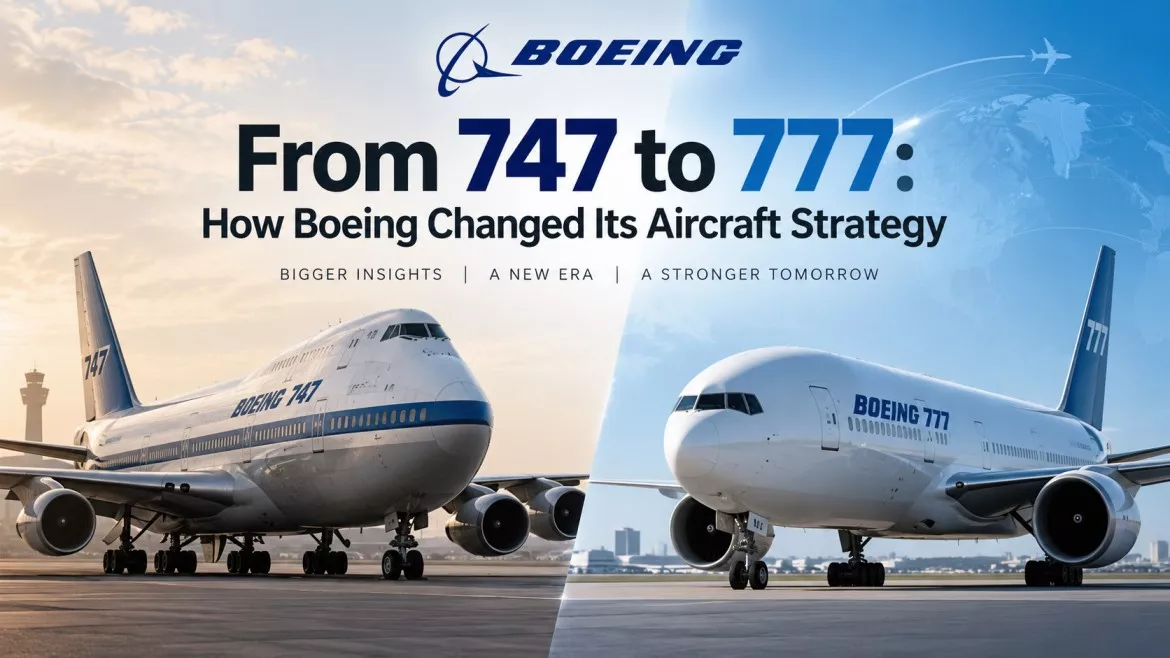
For decades, the Boeing 747 represented the future of long-haul aviation. Its four engines, enormous size, and double-deck design helped airlines move hundreds of passengers across continents. However, the commercial aviation market eventually moved in a different direction.
Boeing responded by shifting its focus from four-engine “jumbo jets” toward large, efficient twin-engine aircraft. The Boeing 777 became the centerpiece of that strategy. Instead of depending on sheer size and passenger capacity, Boeing increasingly competed through fuel efficiency, operating economics, range, reliability, and route flexibility.
So, how did Boeing’s aircraft strategy change from the 747 to the 777?
The answer comes down to one major industry shift: airlines increasingly preferred smaller, more efficient aircraft that could fly long distances nonstop rather than very large aircraft that needed to fill hundreds of seats on major hub-to-hub routes.
The Boeing 747 Strategy: Bigger Was Better
When Boeing introduced the 747, commercial aviation looked very different.
The aircraft entered service with Pan Am in 1970 and quickly became an icon. Its enormous capacity allowed airlines to move large numbers of passengers between major international hubs.
At the time, the strategy made sense.
Air travel demand continued to rise, airports increasingly depended on hub systems, and airlines wanted aircraft capable of carrying hundreds of passengers on heavily traveled routes.
The 747 therefore offered several advantages:
- Huge passenger capacity
- Long-range international operations
- Significant cargo capacity
- Strong brand recognition
- Economies of scale on high-demand routes
Most importantly, the 747 helped Boeing define the widebody market.
However, the same characteristics that made the 747 revolutionary eventually created challenges.
Four engines consumed more fuel than two engines. The aircraft also required substantial airport infrastructure and worked best when airlines could consistently fill its large cabin.
As airline economics changed, those disadvantages became increasingly important.
Why Four Engines Became Less Attractive
The biggest problem for the 747 wasn’t simply its size. Instead, it was the economics of operating four engines.
An aircraft with four engines generally requires more fuel and more engine maintenance than a comparable twin-engine aircraft. Consequently, airlines began looking closely at the cost of every flight.
Fuel prices made that calculation even more important.
Furthermore, airlines did not always want to operate massive aircraft between major hubs. Passengers increasingly wanted direct flights between secondary cities, while airlines wanted to match capacity more closely with demand.
That created a powerful alternative:
Fly a slightly smaller aircraft more frequently rather than a giant aircraft less frequently.
The Boeing 777 arrived at exactly the right moment for that strategy.
The Boeing 777 Changed the Equation
Boeing introduced the 777 in the 1990s as a new-generation widebody twin.
The first 777-200 flew on June 12, 1994. Boeing designed the aircraft around long-range performance, lower operating costs, and greater route flexibility.
Instead of simply building another jumbo jet, Boeing created an aircraft that could carry hundreds of passengers while using only two engines.
That change was significant.
Modern engine technology had become powerful and reliable enough to make twin-engine long-haul operations increasingly practical. At the same time, regulatory developments surrounding ETOPS expanded the routes that approved twin-engine aircraft could operate.
Boeing highlighted the 777’s ability to serve long-distance routes with twin-engine efficiency and operational flexibility.
As a result, the 777 didn’t merely replace capacity. It changed what airlines expected from a large widebody aircraft.
Efficiency Became More Important Than Sheer Size
The 747 strategy focused heavily on capacity.
The 777 strategy focused more heavily on economics.
That distinction explains Boeing’s strategic transition.
The 777 delivered enough passenger and cargo capacity for long-haul missions without requiring four engines. For airlines, that could mean lower fuel consumption, lower maintenance requirements, and greater flexibility in matching aircraft size to demand.
Boeing also emphasized the aircraft’s advanced aerodynamics, lightweight materials, digitally designed structure, and engine integration.
In other words, Boeing started selling airlines something different.
Instead of saying, “Buy a bigger airplane,” the strategy increasingly became:
“Buy an airplane that can make your network more profitable.”
ETOPS Helped Make the Twin-Engine Strategy Work
One of the most important developments behind the 777’s success was ETOPS, or Extended Operations.
Historically, airlines faced restrictions on how far twin-engine aircraft could operate from suitable diversion airports. As aircraft reliability improved and regulators expanded approved operations, those restrictions became less limiting.
The Boeing 777 benefited enormously from that evolution.
Boeing says the 777 became a major aircraft for long-distance ETOPS operations and was designed to support extended operations from delivery.
That meant airlines could confidently use a twin-engine aircraft on routes that once favored four-engine aircraft.
Consequently, the 777 could challenge the 747 on a part of the market that had traditionally belonged to large four-engine jets.
Point-to-Point Flying Changed Airline Demand
The 747 was perfectly suited to the hub-and-spoke era.
Large international hubs could concentrate passengers from different cities onto one enormous aircraft. However, as airline networks evolved, nonstop point-to-point flying became increasingly attractive.
Passengers preferred fewer connections.
Airlines wanted to open new international routes without needing enough passengers to fill a 747.
The 777 offered that flexibility.
Its combination of capacity and range allowed airlines to serve long-distance markets that did not necessarily require 400-plus seats.
Therefore, the 777 became particularly valuable as airlines expanded international networks.
Boeing specifically marketed later 777 variants around nonstop long-haul capability, including routes connecting major markets across the Pacific and other regions.
The 777-300ER Took Boeing’s Strategy Even Further
The strategic shift became even clearer with the Boeing 777-300ER.
This aircraft pushed the 777 into territory traditionally associated with very large widebodies.
Boeing lists the 777-300ER with two-class seating for roughly 350–425 passengers and a range of up to 7,500 nautical miles.
That capability made the aircraft an attractive alternative for airlines that wanted substantial capacity without moving to a four-engine aircraft.
The result was a major strategic advantage for Boeing.
The company could offer airlines a large long-haul airplane while maintaining the fundamental economic appeal of a twin-engine design.
Boeing Gradually Reduced Its Dependence on the 747
The shift did not happen overnight.
Boeing continued developing the 747 long after the 777 entered service. The company launched updated versions, including the 747-8, which incorporated new technology and improved efficiency.
However, market demand increasingly favored twin-engine aircraft.
Eventually, Boeing ended 747 production.
On January 31, 2023, Boeing and Atlas Air celebrated delivery of the final 747, marking the end of more than half a century of production. Boeing produced 1,574 aircraft during the program’s lifetime.
The end of production represented more than the retirement of an iconic airplane.
It symbolized a broader transformation in commercial aviation.
Why Airlines Preferred the 777
Several factors helped make the 777 strategically attractive.
1. Lower Operating Costs
Two engines can offer an important operating-cost advantage over four-engine aircraft, particularly on long-haul routes where fuel represents a major expense.
The 777’s design also focused heavily on maintenance economics and operational efficiency.
2. More Route Flexibility
A 747 generally worked best when an airline had enough demand for its large capacity.
The 777 could support a wider variety of routes.
That flexibility allowed airlines to experiment with new international markets while reducing the risk of putting too many seats into one flight.
3. Strong Cargo Capability
Boeing also turned the 777 into a major freighter platform.
The 777 Freighter entered service in 2009 and became a major player in the widebody cargo market. Boeing says its payload, range, and operating economics enable more long-haul nonstop cargo services.
Thus, Boeing’s twin-engine strategy worked for cargo as well as passengers.
4. Fleet Commonality
The 777 family gave airlines multiple variants built around a common platform.
That approach could simplify pilot training, maintenance, spare-parts planning, and fleet management.
Therefore, Boeing wasn’t merely selling one airplane. It was creating an aircraft family.
The 747 and 777 Represent Two Different Aviation Eras
The difference between the aircraft becomes clearer when comparing their underlying philosophies.
| Boeing 747 | Boeing 777 |
|---|---|
| Four engines | Two engines |
| Extremely high capacity | High capacity with greater flexibility |
| Strong hub-to-hub role | Strong point-to-point role |
| Jumbo-jet economics | Twin-engine efficiency |
| Designed around huge passenger volumes | Designed around network flexibility |
| Iconic flagship | Flexible long-haul workhorse |
The 747 effectively asked airlines to build routes around the aircraft.
The 777 increasingly allowed airlines to build the aircraft around the route.
That distinction captures Boeing’s strategic transformation.
What Happened to the 747 After the 777?
The 747 did not suddenly become useless.
Instead, its strongest roles narrowed.
The aircraft remained valuable for cargo, specialized operations, and routes where airlines could justify its enormous capacity. Boeing’s final 747 was also a freighter, reinforcing the aircraft’s continuing importance in air cargo.
However, passenger airlines increasingly favored twin-engine widebodies.
As a result, Boeing shifted its commercial-aircraft priorities toward aircraft such as the 777 and later the 787 Dreamliner.
Boeing’s Strategy Today: Efficiency Still Leads
Boeing’s modern widebody strategy builds directly on lessons learned from the 777.
The company continues to develop the 777X family, including the 777-9 and 777-8 Freighter.
Boeing describes the 777X as a next-generation large twin-engine aircraft focused on efficiency, range, operating economics, and fleet flexibility. The company claims the 777-9 will use 20% less fuel and produce 20% lower emissions than the aircraft it replaces, alongside a smaller noise footprint.
As of July 2026, Boeing said the 777-9 had reached major certification milestones and continued to target first delivery in 2027.
Boeing also continues development of the 777-8 Freighter, demonstrating that the basic 777 philosophy extends beyond passenger aviation.
So, although the 747 production line has closed, its successor in Boeing’s strategic thinking isn’t a single airplane.
It is a broader philosophy:
maximize range and capacity while minimizing operating costs.
Why Boeing Moved From the 747 to the 777
Ultimately, Boeing changed strategy because the airline industry’s priorities changed.
The 747 was born when airlines wanted huge aircraft to handle concentrated passenger demand between major hubs.
The 777 emerged when airlines wanted something different.
They wanted:
- Better fuel efficiency
- Lower operating costs
- Long range
- Greater route flexibility
- Reliable twin-engine operation
- Strong passenger and cargo economics
The 777 delivered that combination.
Consequently, Boeing’s move from the 747 to the 777 was not simply about replacing an old aircraft with a newer one. It represented a fundamental shift from maximum size to maximum efficiency and flexibility.
Final Takeaway
The Boeing 747 changed aviation by making mass international air travel possible at a new scale. However, the Boeing 777 changed Boeing’s strategy by proving that airlines could achieve long-range, high-capacity operations with two engines.
The transition reflected the changing economics of aviation.
First, fuel efficiency became more important. Then, ETOPS made long-haul twin-engine operations increasingly practical. Next, airlines embraced point-to-point routes and demanded more flexibility. Finally, the 777 became capable enough to serve markets once dominated by four-engine aircraft.
That evolution explains why the 747 became an icon while the 777 became a strategic workhorse.
From the 747 to the 777, Boeing moved from building the biggest aircraft airlines could operate to building the aircraft airlines could operate most efficiently.


