


4-Seater Golf Cart With Rear Flip Seat: Is It Worth It?
Quick Answer
A 4-seater golf cart with a rear flip seat is worth it for most buyers. It adds passenger space, keeps cargo hauling possible, and often pays back part of its cost at resale. However, it may not fit every driver, especially if maximum electric range matters most. This guide breaks down the real costs, safety factors, and trade-offs so you can decide with confidence.
Key takeaways:
- A rear flip seat turns two extra passenger seats into a cargo bed, and back again, in seconds.
- New 4-seater carts with a factory rear seat cost $9,000 to $20,000+. Retrofitting your own cart costs $130 to $2,300.
- Flip seats add 200 to 400 pounds, which can cut electric range by roughly 10% to 20%.
- A 4-seat layout and a quality flip seat kit can each add resale value on their own. Combined, that often means several hundred dollars or more.
- Add a grab bar and seat belts for extra safety, especially with kids on board.
Maybe you’re eyeing an upgrade for your two-seat cart. Or maybe you’re comparing 4-seater models at the dealership. Either way, you’ve probably run into the rear flip seat option.
It promises extra seats when you need them and cargo space when you don’t. But does that flexibility actually earn its price tag? Let’s break it down.
What Is a Rear Flip Seat, Exactly?
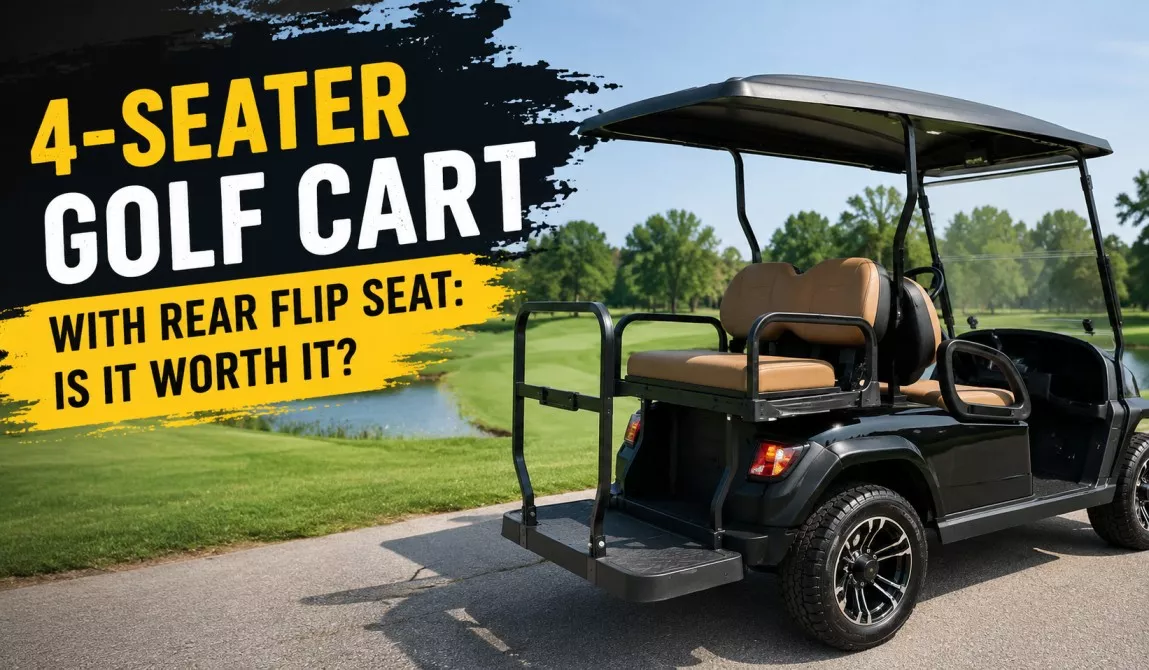
A rear flip seat is a fold-down bench that attaches to the back of a golf cart. Flip it up, and it seats two extra passengers. Flip it down, and it turns into a flat cargo bed.
Because of this dual function, flip seats have become one of the most popular golf cart upgrades on the market. In fact, most 4-seater carts on the market today use this design instead of a fixed bench.
Flip Seat vs. Flip-Flop Seat vs. Rumble Seat
You’ll hear several names for the same feature. “Flip seat,” “flip-flop seat,” “rumble seat,” and “kicker seat” all describe one thing: a rear-facing, fold-down bench.
These terms are regional, not technical. So don’t let the naming confuse your search once you start shopping.
How a 4-Seater Flip Seat Golf Cart Works
The mechanism stays simple. A steel or aluminum frame bolts to the rear chassis, and a cushioned bench sits on top.
Need passenger space? Lift the bench up and lock it in place. Need cargo space instead? Flip the bench down flat, and it becomes a small truck bed with side rails.
Most kits also include a grab bar behind the seat. This gives rear passengers something to hold, and it adds light structural support too.
Key Benefits of a Rear Flip Seat
1. More Seating Without Losing Utility
A fixed rear bench only seats people. A flip seat handles both jobs, so you get four-passenger capacity on weekends and a cargo hauler during the week.
2. Lower Cost Than a Factory 4-Seater
Do you already own a 2-seat cart? Adding a flip seat kit usually costs far less than trading in for a new 4-passenger model. Basic kits start around $130 to $400. Premium, factory-matched kits run $1,400 to $2,300, depending on the brand.
3. A Resale Value Boost
Rear flip seats typically add $300 to $700 to a cart’s resale price. Meanwhile, a used 4-seater generally sells for $500 to $1,500 more than a comparable 2-seater.
4. Flexibility for Different Occasions
You might drive solo most days but need four seats for weekend trips. A flip seat adapts to both situations instead of locking you into one layout.
Drawbacks You Should Consider First
1. Reduced Range on Electric Carts
Extra passengers and hardware add weight. That usually means 200 to 400 pounds once you count the seat, frame, and two riders. On electric carts, this can cut your range by roughly 10% to 20% per charge.
2. A Shift in Handling
The added weight sits behind the rear axle. As a result, the cart’s center of gravity moves backward. So slow down through tight turns and steep hills, especially with a full load.
3. Quality Varies by Kit
Manufacturers don’t build every flip seat kit to the same standard. Cheap, off-brand kits can sag or loosen within months. So check reviews and weight ratings before you buy one.
4. Extra Costs Add Up
The seat itself is only the starting point. Seat belts, a grab bar upgrade, and heavy-duty leaf springs can add another $100 to $300 to your total.
How Much Does a 4-Seater Golf Cart With a Flip Seat Cost?
Pricing depends on whether you buy a factory-built cart or retrofit an existing one.
| Option | Typical Price Range |
|---|---|
| New factory 4-seater (gas) | $9,000 – $12,000 |
| New factory 4-seater (electric, lithium/street-legal) | $12,000 – $20,000+ |
| Used 4-seater | $3,500 – $8,000 |
| Economy flip seat kit (retrofit) | $130 – $400 |
| Premium, factory-matched flip seat kit | $1,400 – $2,300 |
| Seat belt kit (pair) | $25 – $40 |
| Grab bar or safety bar upgrade | $40 – $300 |
Prices swing widely by brand and model. So get an exact quote before you commit to a number in your head.
Is a Rear Flip Seat Safe for Passengers?
Generally, yes, as long as you add the right safety gear. Here’s what to check:
- Grab bar: Gives rear-facing passengers something secure to hold.
- Seat belts: Not always required, but smart, especially for kids.
- Weight limits: Most kits cap out around 400 pounds. Don’t exceed the rating.
- Rear-facing awareness: Riders face backward and can’t see the road ahead. Warn them before sudden stops.
- Street-legal rules: If you register your cart as a low-speed vehicle (LSV), your state may add extra rules. These often include mirrors, a windshield, turn signals, and a horn once you carry passengers.
Some states also set age limits for unsupervised rear-seat riders. Therefore, check your local rules before kids ride back there alone.
Flip Seat vs. Fixed Forward-Facing Rear Seat
| Factor | Rear Flip Seat | Fixed Forward-Facing Seat |
|---|---|---|
| Cargo flexibility | High — folds into a flatbed | Low — seating only |
| Passenger view | Faces backward | Faces forward |
| Typical cost | Lower to moderate | Moderate to higher |
| Best for | Mixed use: people and cargo | Frequent full-time passengers |
| Resale appeal | Strong, especially with cargo use | Strong, especially for families |
Neither option wins outright. Instead, the right pick depends on how often you’ll use the cargo function versus the extra seats.
Who Gets the Most Value From a Flip Seat?
A rear flip seat tends to make sense for:
- Families who want extra seats on weekends but haul gear during the week
- Golfers who occasionally bring a guest but usually carry clubs and bags
- HOA or gated-community residents who run errands and take social trips alike
- Hunters, farmers, and landscapers who need a flatbed most days
- Resort, campus, or fleet operators juggling different seating needs across shifts
When You Might Want to Skip It
On the other hand, skip the flip seat if you almost always carry four people at once. A fixed forward-facing seat gives a smoother, more stable ride without the flip-down hardware.
Similarly, if maximum range matters more than extra capacity, stick with a 2-seater. The added weight of a rear seat will always cost you some range.
Does a Flip Seat Pay You Back at Resale?
Mostly, yes. Rear flip seats typically add $300 to $700 to resale value. A 4-seat layout alone can add another $500 to $1,500 over a comparable 2-seater.
Even so, no upgrade pays back 100% of its cost. Treat the resale bump as a bonus, not the main reason to buy.
Final Verdict: Is It Worth It?
For most everyday drivers, yes, a 4-seater golf cart with a rear flip seat earns its keep. It adds capacity, keeps cargo hauling possible, and helps at resale.
That said, it isn’t right for every buyer. Do you need maximum range or a rock-steady ride above all else? Then a fixed-seat model or a 2-seater might serve you better.
Ultimately, think about how often you’ll use each function: seating or cargo. Whichever one wins most weeks should guide your decision.
Frequently Asked Questions
How much does a golf cart flip seat kit cost?
Economy kits start around $130 to $400. Premium, factory-matched kits from major brands typically cost $1,400 to $2,300, including installation.
Is a rear flip seat safe for kids?
It can be, but add seat belts and a grab bar first. Because the seat faces backward, supervise young children closely and check your state’s age rules.
Does a flip seat reduce cargo space?
No, it actually adds cargo flexibility. Flip the bench down, and you get a flatbed instead of a fixed seat that only holds people.
Can I add a flip seat to any golf cart?
Most 2-seat Club Car, E-Z-GO, and Yamaha models offer a bolt-on flip seat kit. Still, confirm compatibility with your cart’s exact model and year first.
Does a rear flip seat hurt electric range?
Yes, somewhat. The added weight, usually 200 to 400 pounds, can lower range by 10% to 20% per charge.
Do flip seats need seat belts by law?
Not always. But many states require them once you register your cart as a street-legal LSV. Even without that rule, seat belts remain a smart, low-cost upgrade.


