


Does Your German Rental Have Air Conditioning? Here’s How to Check
German summers used to stay mild. That’s changing fast, though, and record-breaking heat waves now hit the country almost every year.
So if you’re renting — or about to sign a lease — one question matters more than ever. Does your apartment actually have air conditioning? Many tenants don’t find out until the first heat wave hits, and by then it’s too late to negotiate.
This guide shows you exactly how to check. You’ll also learn what German law allows, plus what to do if your rental has none.
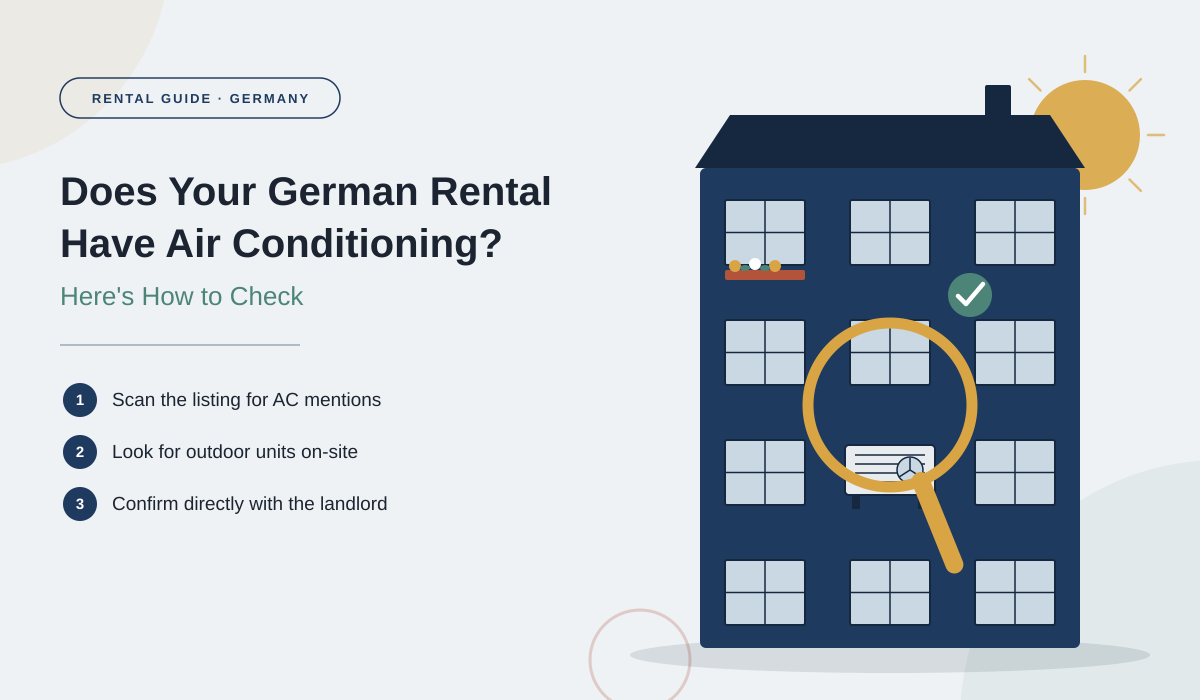
Quick answer: Search the listing for “Klimaanlage” (German for air conditioning) or “klimatisiert.” If the listing doesn’t mention it, ask your landlord or agent directly. Then check your rental contract, and look for a wall-mounted unit or outdoor condenser during the viewing. As of 2026, most German rentals still lack air conditioning, so never assume the apartment has one.
Why So Few German Rentals Have Air Conditioning
Germany never really needed air conditioning — historically speaking, anyway. Summers stayed mild for decades, so builders relied on thick masonry walls, external roller shutters (Rollläden), and cross-ventilation instead of mechanical cooling.
That approach worked fine until recently. Heat waves have grown longer and more intense across Europe, though, and Germany hasn’t been spared. Demand for cooling has climbed as a result.
Supply still hasn’t caught up, however. About one in five German households now own an air conditioner, according to the International Energy Agency. That’s a sharp jump from just a few years ago. A Verivox survey found only 13% of households used AC in 2023, and that figure climbed to 19% by 2024.
Meanwhile, Destatis (Germany’s Federal Statistical Office) reports that only 4.3% of new residential builds included air conditioning in 2025. That’s more than double the 2015 figure of 1.9%, yet it’s still a small slice of the housing market.
In short, most German rentals still don’t have AC. If yours does, count yourself lucky.
How to Check If Your German Rental Has Air Conditioning
Ready to find out for sure? Here are six reliable ways to check before you sign anything.
1. Read the Listing Description Carefully
Start with the basics. Scan the listing for “Klimaanlage” (air conditioning), “klimatisiert” (air-conditioned), or “Kühlung” (cooling).
These terms often sit in the amenities section, right alongside “Balkon” or “Einbauküche.” English-language listings for expats might simply say “AC” or “air conditioning” instead.
Keep in mind, though, that a missing mention doesn’t always mean a missing unit. Some listings stay incomplete, so treat this step as a starting point, not the final word.
2. Filter Your Search on Rental Portals
Major portals like ImmoScout24 let you filter results specifically for listings with air conditioning. This saves time, especially in hotter cities like Frankfurt or Munich, where more units now include cooling.
Try this filter first. Then read each shortlisted listing closely to confirm the details before you reach out.
3. Ask the Landlord or Estate Agent (Makler) Directly
If the listing stays silent on the topic, just ask. A short message works fine: “Gibt es eine Klimaanlage in der Wohnung?” (Is there air conditioning in the apartment?)
Always get the answer in writing. That way, you’ll have proof to point to later if the question ever comes up again.
4. Look for Physical Clues During the Viewing
Nothing beats seeing the apartment in person. Walk through every room with your eyes open during the Besichtigung (viewing).
Check the walls for a rectangular, wall-mounted indoor unit, usually placed high near the ceiling. Then step outside and check the balcony, terrace, or exterior wall for a condenser — the noisy outdoor component of a fixed system.
Also look around for a portable unit or a window vent kit tucked in a corner. If you spot one, ask whether it stays with the apartment or leaves with the current tenant.
5. Review the Mietvertrag and Handover Protocol
Your rental contract (Mietvertrag) and handover protocol (Übergabeprotokoll) should list every fixture and included appliance. A built-in AC unit typically shows up here, along with details about who handles maintenance.
Read this section closely before you sign. It clarifies your rights if the unit ever breaks down.
6. Don’t Rely on the Energieausweis
Here’s a common mix-up: many renters assume the Energieausweis (energy performance certificate) will mention air conditioning. It won’t.
German law only requires this document to disclose heating-related information. That means energy source, consumption or demand values, efficiency class, and the building’s construction year. Cooling equipment simply isn’t part of it.
So skip the Energieausweis when you’re hunting for AC clues. Use it for other purposes instead, like judging a building’s overall energy efficiency.
What to Do If Your Rental Doesn’t Have AC
No air conditioning? You still have options. Here’s what German tenancy law actually allows.
Portable Air Conditioners: The Simple Fix
Portable, or “monoblock,” units are by far the most popular cooling solution among German renters. In fact, nearly three-quarters of renters with an AC unit use a portable model instead of a fixed system. That’s according to a Verivox survey.
These units need no drilling and no permanent installation. As a result, most landlords can’t stop you from using one.
Still, check your rental agreement first. Some contracts include specific rules about exhaust hoses through windows or extra electrical load. So it pays to look before you buy.
Fixed Split Systems: You’ll Need Permission
A permanent split-system unit works differently. Installing one means drilling through an exterior wall to route pipes and cables to an outdoor condenser.
Under German tenancy law, this counts as a structural modification — a bauliche Veränderung. Therefore, you must get written consent from your landlord before installing anything permanent.
Landlords can refuse, and they often do. This holds especially true for older or heritage-protected buildings (denkmalgeschützt), where any change to the exterior faces extra scrutiny.
What German Law Actually Says About Heat
German tenancy law requires landlords to keep a rental warm enough during winter. However, no equivalent legal standard exists for summer cooling.
In fact, heat rarely counts as a legal defect (Mangel) that would justify a rent reduction. That said, newer buildings must meet passive heat-protection standards under Germany’s building energy law, the Gebäudeenergiegesetz (GEG).
These rules focus on shading, insulation, and ventilation — not mechanical cooling. So even a brand-new rental might handle heat through smart design rather than an actual AC unit.
Bottom line: don’t expect a legal fix for a hot apartment. Your best bet is a portable unit or a clear, written agreement with your landlord.
Who Pays for Installation?
If installing AC is your idea, you’ll likely cover the costs yourself, including the unit and professional installation. Occasionally, landlords cover costs when they initiate the upgrade, but don’t count on it.
Also, clarify the removal terms before you install anything fixed. Most tenants must restore the apartment to its original condition when they move out, unless the contract says otherwise.
Cooling Alternatives Common in German Homes
Since AC still isn’t standard, most German households lean on passive cooling instead. These methods cost little, work well, and already exist in most rentals.
- Rollläden (external roller shutters): Close them during the day to block heat before it enters.
- Stoßlüften (burst ventilation): Open your windows wide early in the morning or late at night, then close them once it warms up outside.
- Fans: Run one during peak heat hours for quick, affordable relief.
- Thick walls (Altbau construction): Older buildings often stay naturally cooler thanks to dense masonry walls.
- Markisen (awnings): Mount one on your balcony or terrace to block direct sunlight before it heats up the room.
Combine a few of these methods, and you can often avoid needing AC altogether — at least on all but the hottest days.
Frequently Asked Questions
Do German apartments usually have air conditioning?
No. Roughly one in five German households had some form of air conditioning as of the latest estimates. That number is likely even lower among rentals specifically, since renters face more barriers to installing fixed systems.
Can my landlord refuse to let me install air conditioning?
Yes, for permanent installations. Since a fixed split system requires drilling into the building’s exterior, it counts as a structural change under German law. Landlords can refuse permission, particularly in older or protected buildings.
Do I need permission for a portable air conditioner?
Generally, no. Portable units don’t involve structural changes, so most landlords can’t block you from using one. Still, check your lease for specific restrictions before you buy one.
How do you say “air conditioning” in German?
The word is “Klimaanlage.” Listings and rental contracts also use “klimatisiert” (air-conditioned) or “Kühlung” (cooling).
Does the Energieausweis show whether a rental has air conditioning?
No. The energy certificate only covers heating-related data, such as energy source, consumption, and efficiency class. It won’t confirm or rule out air conditioning.
What can I do if my rental gets unbearably hot?
Start with passive fixes: close your shutters during the day, ventilate early and late, and run a fan. If that’s not enough, ask your landlord about a portable AC unit. Most rental agreements allow one without special permission.
Key Takeaways
- Most German rentals still lack air conditioning, though adoption is rising fast.
- Search listings for “Klimaanlage,” ask directly, and check your Mietvertrag to confirm what’s included.
- Skip the Energieausweis — it only covers heating data, not cooling.
- Portable units generally need no permission; fixed split systems require your landlord’s written consent.
- German law protects your right to warmth in winter, not coolness in summer. So don’t expect a legal fix for a hot apartment.
Before you sign anything, run through this checklist. A few extra questions now can save you a genuinely miserable summer later.


