


What Social Norms Do People Follow Without Questioning?
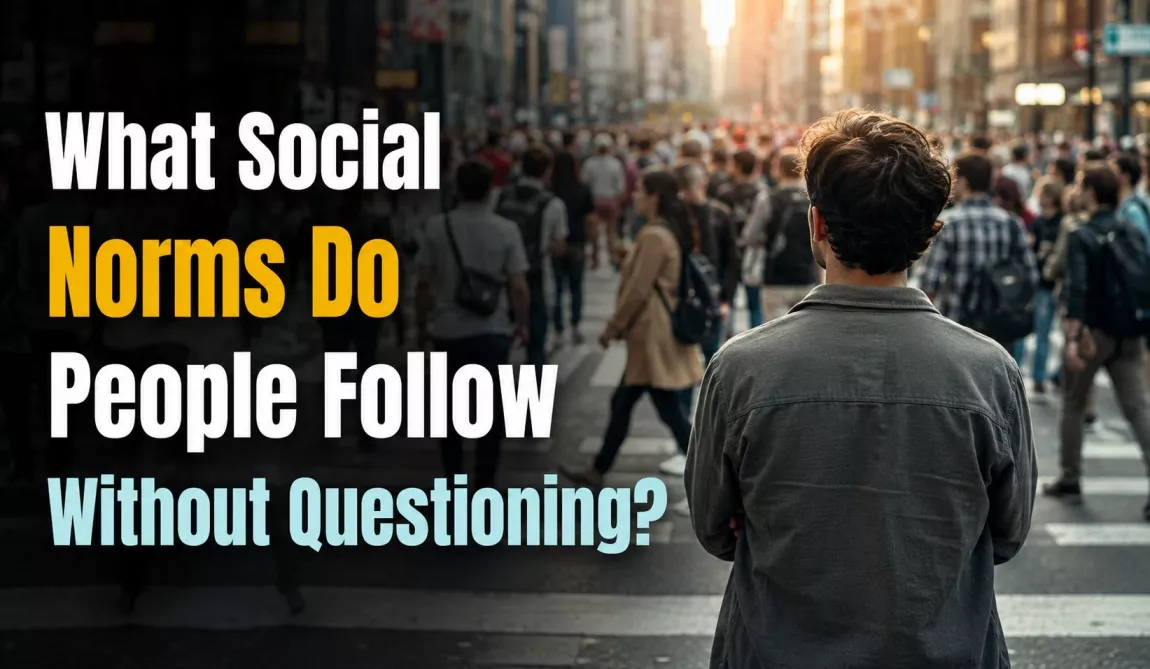
Have you ever stood in an elevator and faced the back wall instead of the doors? Probably not. If you did, you likely felt an overwhelming surge of discomfort.
Every day, we navigate a complex web of unspoken rules. We call these rules social norms. They dictate how we dress, talk, and interact. Most of the time, we follow them automatically. We never stop to ask who wrote the rules or why they exist.
Understanding these invisible scripts helps us see how deeply society shapes our minds. Here are the major social norms we follow without a second thought.
Why Do Humans Follow Social Norms?
Our tendency to adopt everyday social habits without a second thought is not a sign of weakness; it is a fundamental part of being human. Psychologists and sociologists point to several deep-seated reasons why we default to compliance.
1. Evolutionary Psychology and the Need to Belong
For 99% of human history, our ancestors lived in small hunter-gatherer bands. In those environments, social exclusion was a literal death sentence. If you were banished from the tribe, you had to hunt, forage, and defend yourself against predators completely alone.
To prevent this, our brains evolved powerful psychological mechanisms designed to keep us aligned with the group. We developed a deep fear of rejection and a strong drive for social identity. When we conform to the behaviors of those around us, our brains interpret it as safety.
2. Social Proof and Cognitive Biases
When we are uncertain about how to act, we look at the actions of others to determine the correct behavior. This psychological phenomenon is known as social proof.
If you walk into a quiet, upscale library, you naturally lower your voice to a whisper because everyone else is doing it. Your brain uses the crowd as an information shortcut, assuming that the collective group possesses accurate knowledge about the environment.
3. Childhood Social Conditioning
From the moment we are born, we absorb societal expectations through observation, mimicry, and direct instruction. Parents, teachers, and media constantly reinforce what is “normal.”
By the time we reach adulthood, these behaviors have transitioned from rules we must follow to unconscious habit formation. They require zero conscious thought.
1. The Laws of Public Space and Proximity
We might think we are free to move however we like in public. In reality, strict spatial rules govern our every move.
The Elevator Stare
When you step into an elevator, you immediately turn around and face the door. You look up at the floor numbers or down at your phone. You avoid eye contact with strangers at all costs. Society never gave us an official handbook on elevator behavior, yet we all memorize this script perfectly.
The Buffer Zone
Humans require a subconscious “buffer zone” in public settings.
- The Urinal Rule: Men will almost always leave an empty stall between themselves and the next person if space allows.
- The Empty Bus: If a public bus is mostly empty, you do not sit directly next to the only other passenger. Doing so signals aggression or strange behavior, even though it is just a seat.
2. The Architecture of Modern Time
Our relationship with time feels natural, but it is actually a highly engineered social construct.
The 9-to-5 Grind and the Weekend
Why do we work five days and rest for two? Why is a standard workday eight hours? The modern five-day workweek was largely popularized by Henry Ford in 1926 to boost factory productivity. A century later, billions of people still structure their entire lives, sleep schedules, and family time around this exact rhythm without questioning its relevance to modern knowledge work.
The Linear Life Timeline
Society hands us a pre-packaged timeline at birth:
- Go to school.
- Get a degree.
- Find a stable job.
- Buy a house.
- Get married and have children.
- Retire at 65.
When someone deviates from this timeline—perhaps by changing careers at 40 or choosing not to have children—they face immense social friction. We treat this specific sequence as the default setting for a successful human life.
3. Digital Etiquette and Unwritten Communication Rules
As our lives moved online, we rapidly developed a whole new set of unspoken laws. Technology changes, but our need for social conformity remains identical.
The Anxiety of the Phone Call
In the modern era, calling someone without texting first feels like an ambush. A sudden voice call now signals an emergency. We collectively agreed on this shift over the last decade, transforming the telephone from a tool of casual connection into an instrument of mild panic.
Punctuation and Emotional Tone
The way we format a text message carries massive emotional weight.
Sending a text that reads “Sure.” with a period feels cold, angry, or passive-aggressive. Conversely, sending “Sure” without a period feels casual and safe.
We never took a class on text-message linguistics. Instead, we absorbed these subtle emotional cues through sheer social immersion.
4. The Economics of Social Rituals
We frequently spend large sums of money on traditions simply because “that is how it is done.”
The Diamond Engagement Ring
For centuries, wedding rings were simple bands. Then, in 1938, the De Beers diamond cartel launched a massive marketing campaign. They successfully linked the size of a diamond to the depth of a man’s love. Today, spending two months’ salary on a specific compressed carbon rock remains an unquestioned milestone of romance.
The Reciprocity Loop (Gifts and Rounds)
If a friend buys you a coffee, you feel a psychological itch to buy the next one. If someone invites you to their party, you feel obligated to invite them to yours. This rule of reciprocity keeps communities glued together, but it also locks us into endless loops of forced spending and consumption.
Why Do We Follow Them?
We conform because our brains evolved in small tribal environments. In ancient history, social exclusion meant physical death. Following the tribe’s unspoken rules kept you safe inside the campfire’s glow.
Today, we no longer face wild predators, but our brains still treat social awkwardness like a mortal threat. We follow the invisible scripts because, ultimately, the comfort of fitting in outweighs the exhaustion of questioning everything.
5. The Rituals of Consumption and Dining
Our relationship with food goes far beyond basic survival. A complex architecture of social rules governs how, what, and when we eat.
The Arbitrary Separation of Breakfast
We have collectively agreed that certain foods belong exclusively to the morning. Eating eggs, bacon, or pancakes at 8:00 AM is normal. Conversely, eating a bowl of cold cereal or a pop-tart at 8:00 PM signals that you have given up on the day. Similarly, eating a garlic-heavy pasta dish for breakfast feels wrong to most people, even though the nutritional value remains identical regardless of the hour.
The Tyranny of Tipping Cultures
In countries like the United States, tipping is legally optional but socially mandatory. Customers regularly pay an extra 15% to 20% directly to service staff to compensate for low base wages. We participate in this economic workaround during every meal, shifting the responsibility of fair compensation from the employer to the consumer without a second thought.
6. Professional Identity and Executive Presence
The corporate world enforces a strict set of behavioral rules that have very little to do with actual job performance.
The Performance of Busyness
In the modern workplace, looking busy is often more important than being productive.
- The Email Delay: Replying to a manager’s email within two minutes can signal that you have nothing else to do.
- The Late-Night Send: Scheduling an email to send at 11:45 PM subtly communicates intense dedication, even if you wrote the message during lunch.
We participate in this corporate theater because society equates constant motion with high status.
The Uniform of Authority
We still wear highly uncomfortable clothing to signal professional competence. Men squeeze their necks into ties, while women walk in spine-aligning high heels. These garments serve no functional purpose in an air-conditioned office. However, we accept the physical discomfort because the costume buys us immediate psychological credibility.
How to Navigate the Invisible Scripts
Recognizing these norms does not mean you need to break all of them. Many unspoken rules, like waiting your turn in line, keep society functioning smoothly. They prevent chaos and reduce the mental energy required to interact with strangers.
However, blind compliance becomes dangerous when it limits your personal freedom or happiness.
Next time you feel compelled to buy something expensive, choose a specific career path, or send a panicked text apology, pause for a moment. Ask yourself: Am I doing this because I genuinely want to, or am I just following the script? Embracing that brief pause is the first step toward living an intentional life.
Myth vs. Fact
- Myth: Everyone follows the exact same social norms. Fact: Norms vary widely by culture, geography, generation, and socio-economic background.
- Myth: Social norms carry the same weight as laws. Fact: Most are completely informal expectations enforced entirely by peer approval or subtle awkwardness.
- Myth: Questioning social expectations is inherently disrespectful. Fact: Thoughtful, constructive questioning is the exact mechanism by which civilizations eliminate harmful traditions and improve.
- Myth: Conformity is always a sign of cognitive weakness. Fact: Conformity is a highly evolved survival shortcut that reduces brain strain and enables complex social cooperation.
- Myth: Digital norms are less powerful than physical ones. Fact: Digital validation, online etiquette, and algorithmic trends shape modern human behavior just as intensely as physical proximity.
Frequently Asked Questions
What are social norms?
Social norms are the unwritten rules, expectations, and behavioral guidelines that a group or society uses to regulate everyday interactions without relying on formal laws.
Why do people follow social norms?
Humans follow norms because our brains evolved to prioritize group belonging for survival. We use social proof as an informational shortcut, and we instinctively fear the social costs of exclusion and reputation damage.
Are social norms different from laws?
Yes. Laws are formal, written codes enforced by legal institutions like courts and police with official punishments. Social norms are informal, unwritten expectations enforced through social approval, peer pressure, or exclusion.
Can social norms change?
Absolutely. Norms evolve constantly alongside shifts in technology, economic realities, and generations. Modern remote work, delayed marriage ages, and destigmatized mental health discussions are clear examples of rapidly changing norms.
What are examples of unwritten rules?
Common unwritten rules include facing the door in an elevator, lowering your voice in a library, letting people exit a train before you step on, and sending a text message before calling someone out of the blue.
Why do cultures have completely different norms?
Cultures develop distinct norms based on their unique geography, history, religious roots, and survival strategies. For example, some societies value individual autonomy (monochronic/Western), while others prioritize collective harmony (polychronic/Eastern).
Is questioning social norms healthy?
Yes. Gentle, critical evaluation of social expectations is vital for human progress. It allows us to dismantle harmful traditions—like toxic productivity or restrictive gender stereotypes—while retaining positive cultural values.
How does social media influence modern norms?
Social media accelerates the formation of norms through algorithmic validation loops. It has created new digital expectations around instant message response times, public surveillance, and constant peer comparison.
What happens when people break social norms?
When an individual breaks a minor norm (a folkway), they typically experience informal social sanctions like awkward silence, weird looks, or minor embarrassment. Breaking major moral norms (mores) can lead to severe reputational damage or exile.
Are social norms necessary for a functioning society?
Yes. Without social norms, everyday life would require endless negotiation over every single interaction. Norms reduce cognitive strain, build foundational social trust, and make human behavior predictable enough for large-scale cooperation.


