


How Rising Healthcare Costs Hide Real Wage Growth in the US?
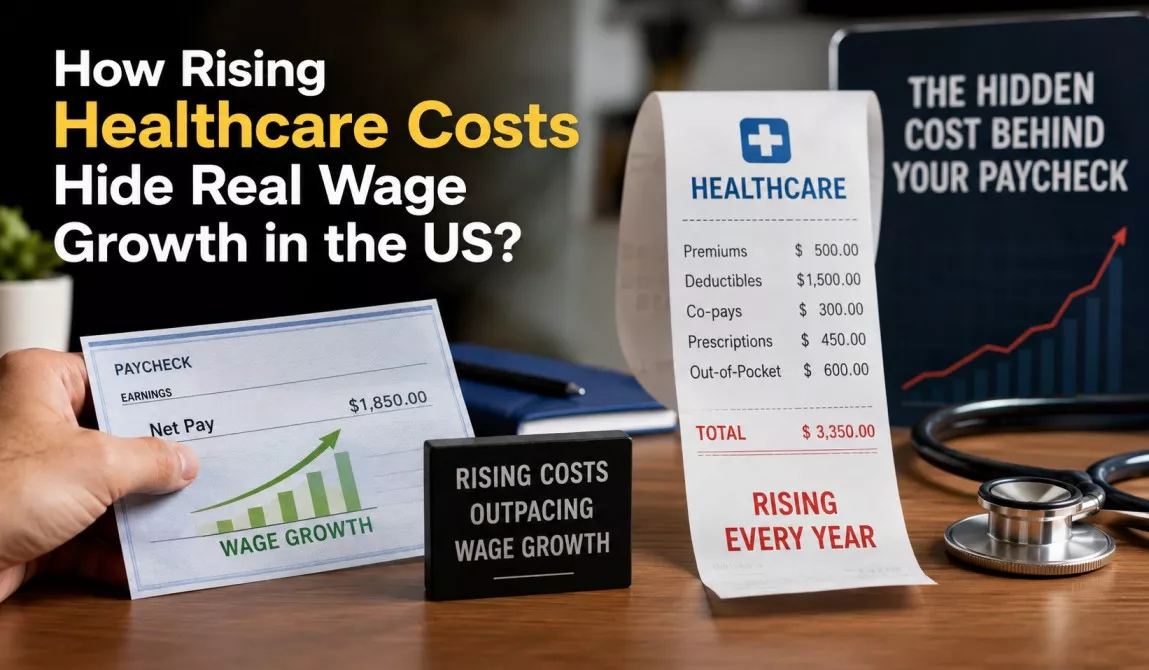
When most people think of inflation, they look at highly visible, frequent purchases: gas prices, groceries, utility bills, and rent. Healthcare costs operate differently. They are often quietly deducted from paychecks or sit in the background as high deductibles until an unexpected medical event occurs. Yet, healthcare constitutes nearly 17-18% of the entire US Gross Domestic Product (GDP), making it a massive structural component of the domestic economy.
The financial burden of healthcare on an individual worker is comprised of several interlocking factors:
- Insurance Premiums: The baseline cost of maintaining a health insurance policy. For employer-sponsored plans, this cost is split between the employer and the employee, though both portions ultimately impact the worker’s earning potential.
- Deductibles: The amount a worker must pay out of pocket for medical services before their insurance coverage kicks in. Over the last two decades, deductibles have spiked dramatically, shifting significant financial risk onto the consumer.
- Copayments and Coinsurance: Fixed fees (copays) or percentages of costs (coinsurance) paid at the time of service, whether for a primary care visit, a specialist, or emergency care.
- Prescription Drug Costs: The rapidly rising price of maintenance medications and specialty therapeutics, which often carry separate tier-based pricing structures within health plans.
Why Healthcare Inflation Outpaces General Inflation
Historically, healthcare inflation (often tracked via the Medical Care Consumer Price Index) outpaces general inflation. There are several systemic reasons for this:
- Third-Party Payment Systems: Because insurance companies and employers negotiate prices behind closed doors, consumers lack the price transparency needed to shop around, neutralizing normal market pressures that drive costs down.
- Technological Advancements: While technology makes items like televisions and computers cheaper over time, medical technology (advanced imaging, robotics, gene therapies) introduces highly expensive new treatments that increase overall spending.
- An Aging Demography: The massive Baby Boomer generation entering retirement requires more medical infrastructure and chronic disease management, driving aggregate demand and prices upward.
How Employer-Sponsored Health Insurance Affects Compensation
To understand where your missing wage growth went, you have to look at how businesses view labor costs. When an employer creates a budget for a position, they do not just look at your salary. They calculate total compensation.
Total Compensation = Base Salary + Bonuses + Employer-Paid Taxes + Value of Benefits
The value of benefits includes retirement matching, paid time off, and—most critically—the employer’s share of health insurance premiums.
How Rising Healthcare Costs Affect Total Compensation
| TOTAL COMPENSATION | BASE SALARY | EMPLOYEE BENEFITS |
|---|---|---|
| What It Includes | Direct wages or salary paid to the employee. | Employer-paid benefits such as health insurance, 401(k) contributions, paid leave, life insurance, and other benefits. |
| Recent Trend | Typically grows slowly and may lag behind inflation. | Healthcare premiums and medical benefit costs have increased much faster than wages over time. |
| Employer Budget Impact | Smaller share of compensation budget available for salary increases. | A growing share of the compensation budget is consumed by rising healthcare expenses. |
| Employee Perspective | Determines monthly take-home pay and purchasing power. | Offers valuable coverage, but higher healthcare costs can limit future wage increases. |
| Key Challenge | Workers often perceive wage growth as stagnant. | Rising healthcare costs reduce employers’ ability to increase cash compensation. |
The Hidden Wage Tradeoff
According to data compiled by organizations like the Kaiser Family Foundation (KFF), the average cost of an employer-sponsored family health insurance premium has surged to well over $24,000 per year, with employers picking up roughly 70% to 75% of that tab.
If an employer’s total budget for an employee’s annual compensation increase is $4,000, and the employer’s share of that worker’s health insurance premium spikes by $3,000 during renewal season, the employer only has $1,000 left for a direct merit raise.
To the employee, it looks like they received a measly, disappointing 1.5% salary bump. In reality, the employer spent the full $4,000 on them—but $3,000 of it was immediately captured by the healthcare system. The worker never sees this money in their bank account, yet it represents actual expenditures made on their behalf.
The Hidden Relationship Between Healthcare Inflation and Wage Stagnation
This structural diversion of money from salaries to health insurance premiums is a primary driver of decades-long American wage stagnation.
When healthcare inflation ticks upward, employers must make structural budgeting decisions to protect their profit margins. They balance these rising benefit liabilities by suppressing wage growth, implementing hiring freezes, reducing matching contributions to 401(k) plans, or turning to automation and contract labor to bypass benefit requirements altogether.
Scenario-Based Explanation: The Tale of Two Firms
To see this relationship clearly, let’s observe two identical mid-sized manufacturing firms operating under different healthcare realities over a five-year period.
- Firm A (Standard Plan): Offers a traditional, comprehensive PPO plan. Every year, their health insurance broker delivers a 7% premium increase. To absorb this cost without firing staff, Firm A limits across-the-board annual salary raises to a strict 2%.
- Firm B (Self-Funded / High-Efficiency): Partners with a direct-primary-care network, implements reference-based pricing, and manages to hold its healthcare cost increases flat at 1% per year. Because their healthcare costs are contained, Firm A can comfortably offer annual salary raises of 4.5% to retain top talent.
After five years, a worker at Firm B has significantly higher take-home pay and greater disposable income than an identical worker at Firm A, simply because Firm B didn’t have to surrender its labor budget to health insurance companies.
Why Workers Feel Poorer Even During Strong Labor Markets
During periods of low unemployment and high job creation, traditional economic theory suggests that workers should enjoy immense leverage, forcing employers to bid up wages. While nominal wages do rise during these hot labor markets, many workers still feel an acute financial squeeze.
The reason is a compounding cost-of-living stack, where healthcare costs act as the anchor keeping workers under water. When fixed, non-discretionary expenses rise faster than income, a family’s discretionary spending power contracts.
Gross Salary (Rising)
  │
  ├───► Minus: Income Taxes
  │
  ├───► Minus: Rising Health Insurance Premiums (Deducted directly)
  │
  ├───► Minus: Essential Housing Costs (Mortgage/Rent)
  │
  ├───► Minus: Non-Discretionary Medical Out-of-Pocket (Deductibles, Copays)
  │
  └───► EQUALS: Shrunk Disposable Income (What you actually feel)
When a worker faces an unexpected $2,500 medical deductible early in the year due to an illness or injury, that expense wipes out the economic benefit of an entire year’s worth of modest salary raises. This uncertainty creates a psychological drag; workers feel fundamentally insecure because a single medical emergency could entirely upend their household finances.
Data Trends Over the Past Decade
To prove that this isn’t just an abstract theory, we can look at the long-term macroeconomic data compiled by authoritative federal and private research bodies.
Data spanning several decades from the Bureau of Labor Statistics (BLS) and the Kaiser Family Foundation (KFF) demonstrates a clear, widening divergence: the cost of health insurance premiums has grown at more than double the rate of both worker earnings and general inflation.
A Comparison of Cumulative Growth Rates
Consider the historical baseline of cumulative growth across key economic indicators over a representative multi-decade timeline:
| Economic Indicator | Cumulative Growth Rate (Approx. 20-Year Horizon) | Primary Data Source |
| General Inflation (CPI-U) | ~65% | Bureau of Labor Statistics (BLS) |
| Workers’ Workers Earnings (Nominal) | ~80% | Bureau of Labor Statistics (BLS) |
| Employee Contribution to Premiums | ~140% | Kaiser Family Foundation (KFF) |
| Total Family Health Insurance Premium | ~165% | Kaiser Family Foundation (KFF) |
This data explains the exact mechanism of hidden wage growth. While nominal earnings outpaced general inflation by roughly 15 percentage points, the cost of health insurance premiums grew more than twice as fast. The net gain workers should have experienced from rising productivity and economic growth was entirely cannibalized by medical system inflation.
Industries Most Affected
The pressure of rising healthcare costs on wage growth is not distributed evenly across the US economy. The severity of the wage-suppression effect depends heavily on margins, labor structures, and industry standards.
Low-Margin, Labor-Intensive Sectors (Retail and Hospitality)
In industries like retail, food services, and hospitality, profit margins are thin, and labor represents the largest operational expense. Because these businesses cannot easily absorb premium increases, they often respond by limiting employee hours to under 30 per week to exempt themselves from the Affordable Care Act’s employer mandate, or they offer bare-minimum plans with incredibly high deductibles that shift the entire financial burden onto the worker.
Highly Capital-Intensive Sectors (Manufacturing)
Manufacturing firms traditionally feature heavily unionized or highly skilled workforces with robust, legacy health benefit packages. When premiums spike, contract negotiations frequently stall. Unions are forced to make a difficult strategic choice: accept flat or reduced hourly wage growth in order to protect their premium-free or low-deductible health plans.
High-Margin Sectors (Technology and Professional Services)
Silicon Valley and elite professional service firms operate on immense profit margins and compete intensely for scarce, highly specialized talent. These companies easily absorb healthcare premium increases and continue to offer top-tier salaries. Consequently, workers in these fields are largely insulated from the wage-hiding effects of healthcare inflation, widening the wealth gap between high-skilled and lower-skilled sectors.
Impact on Employers
Rising healthcare costs do not just punish workers; they create a structural headwind for American businesses trying to compete on a global stage where foreign competitors benefit from state-subsidized healthcare systems.
- Hiring Friction: Every dollar an employer must commit to securing health insurance is a dollar that cannot be used to fund a new headcount. High premium costs artificially raise the cost of adding a full-time worker, leading to systematic under-hiring or an over-reliance on temporary, contract, or gig-economy workers.
- Retention Crises: When companies pass premium increases onto their staff to preserve cash flow, employee morale drops. Workers rarely look at the total compensation statement; they look at their take-home pay. A net drop in take-home pay due to higher health insurance deductions triggers turnover.
- The Shift to Automation: As human benefits become more expensive and unpredictable, the return on investment (ROI) for automating repetitive tasks becomes far more attractive. Capital investments in software, robotics, and self-service kiosks accelerate as direct labor benefits scale upward.
Impact on Employees
The downstream effects on the individual worker stretch far beyond a smaller paycheck. The systematic eating-away of wages by healthcare creates a cascading cycle of financial vulnerability.
Delayed Milestones and Reduced Savings
When disposable income is choked off by healthcare premiums and out-of-pocket medical bills, workers are forced to compromise on long-term wealth accumulation. Contributions to 401(k) plans are reduced or stopped entirely, down payments for houses take years longer to amass, and families delay major life milestones like getting married or having children.
Medical Debt and Credit Degradation
According to data from the Consumer Financial Protection Bureau (CFPB), medical debt is the single largest cause of personal bankruptcy filings in the United States. Even workers with employer-provided insurance frequently find themselves unable to pay a $4,000 or $5,000 deductible following an unexpected emergency room visit, leading to accounts being sent to collections and permanently damaging their credit profiles.
Job Lock
One of the most insidious labor market distortions caused by this system is “job lock.” This occurs when a worker remains trapped at an unfulfilling, low-growth job simply because that employer offers an excellent health insurance policy necessary to cover a spouse or child’s chronic medical condition. Job lock stifles economic dynamism by preventing workers from shifting into entrepreneurial roles or moving to higher-productivity startups that lack robust benefits infrastructure.
How Healthcare Costs Influence Economic Growth
On a macro level, when healthcare costs capture a disproportionate share of national income, it alters the fundamental composition of the United States economy.
The Consumer Spending Drag
The US economy is consumer-driven, with personal consumption expenditures accounting for approximately 70% of total economic activity. When a worker’s money goes toward a health insurance company or a hospital system, that capital is spent on a non-discretionary service. That same money is no longer circulating through retail, travel, entertainment, housing, or consumer goods—sectors that traditionally drive broad-based, vibrant economic expansions.
Productivity and Absenteeism
Paradoxically, despite spending more on healthcare than any nation on earth, the US does not consistently achieve superior health outcomes. High out-of-pocket costs cause many workers to skip preventive care visits, delay filling essential maintenance prescriptions, or avoid physical therapy. This deferred care ultimately manifests as higher rates of chronic illness, increased workplace absenteeism, and reduced on-the-job productivity (presenteeism).
Common Misconceptions
To have a clear, honest discussion about labor economics, we have to dismantle a few widespread myths that blur the public’s understanding of healthcare and wages.
Myth 1: “If my nominal hourly wage goes up, my standard of living is improving.”
- Reality: This completely ignores both general price inflation and benefit-cost shifting. If your salary increases by 3%, but your health insurance premium share increases by 15% and your deductible doubles, your actual standard of living has regressed.
Myth 2: “My employer-sponsored health insurance is essentially free or cheap because my employer pays for most of it.”
- Reality: There is no free lunch in labor economics. Every dollar your employer pays toward your healthcare premium is part of your total labor cost. If they weren’t sending that money to an insurance carrier, market competition would force them to distribute a significant portion of it directly to you as a higher base salary. You are paying for that insurance via forgone wages.
Myth 3: “Rising healthcare costs only harm people who are actively sick or have chronic illnesses.”
- Reality: Healthcare inflation acts as a structural tax on everyone inside an employer’s insurance pool. Even if you are perfectly healthy and haven’t visited a doctor in years, your annual salary raises are suppressed because your employer’s aggregate premium cost for the entire company rose.
What Can Workers Do?
While structural labor market forces can feel overwhelming, individual employees can take proactive strategic actions to optimize their compensation packages and protect their household income.
- Analyze the “Total Compensation Summary”: During open enrollment or salary reviews, explicitly request a total compensation statement from HR. Knowing the exact dollar value your employer spends on your benefits gives you immense leverage during salary negotiations, allowing you to treat benefits as real currency.
- Strategically Deploy Health Savings Accounts (HSAs): If your company offers a High-Deductible Health Plan (HDHP) paired with an HSA, and you are relatively healthy, maximize your contributions. HSAs offer a unique triple-tax advantage: contributions are tax-deductible, funds grow completely tax-free, and withdrawals for qualified medical expenses are never taxed. This acts as an auxiliary investment account to offset future medical costs.
- Audit Open Enrollment Plans Annually: Many workers blindly auto-renew the exact same health plan year after year out of habit. Take two hours every open enrollment period to contrast premium differences against your family’s actual medical utilization over the past 12 months. Shifting plans can instantly unlock hundreds of dollars in monthly take-home pay.
What Employers Can Do
Forward-thinking businesses are beginning to realize that relying on traditional, legacy insurance brokers who pass along massive annual premium hikes is an unsustainable strategy that degrades their competitive edge.
- Explore Self-Funding with Stop-Loss Protection: Rather than paying fixed, high premiums to a massive commercial insurance carrier, mid-sized and large employers can self-insure their employee medical claims while purchasing private “stop-loss” policies to insulate themselves from catastrophic claims. This allows businesses to capture the direct financial savings during years when claims are low.
- Incentivize Direct Primary Care (DPC): Some innovative firms partner with local DPC clinics, paying a fixed monthly membership fee for each employee. This grants workers unlimited, zero-copay access to primary care physicians, catching medical issues early before they escalate into incredibly expensive emergency room visits or specialist consultations that drive up insurance claims.
- Implement Reference-Based Pricing: Instead of accepting an insurance company’s negotiated rate (which can easily be 400% to 500% of Medicare rates for certain procedures), employers can design plans that pay hospitals a transparent, fixed multiple of the Medicare reimbursement rate plus a fair profit margin, drastically lowering corporate healthcare expenditures.
Future Outlook
As we look toward the horizon of the American labor market, the collision course between healthcare inflation and wage growth will require structural and technological evolution.
The Integration of AI and Automation in Administration
A massive percentage of every healthcare dollar in the United States is wasted on administrative overhead—billing networks, coding errors, prior authorization friction, and bureaucratic documentation. The deployment of specialized AI models capable of streamlining hospital billing operations and automating claims processing could systematically shave billions of dollars in waste out of the medical system, potentially easing premium pressures.
The Transition to Value-Based Care
The traditional American medical model relies on a “fee-for-service” framework, which financially rewards health systems based on the volume of tests, procedures, and scans performed, rather than the quality of the patient outcome. Public payers (Medicare) and large private employer coalitions are aggressively pushing a transition toward value-based care, where provider networks are compensated based on their ability to keep a population healthy and manage chronic illnesses efficiently.
Macroeconomic Pressures
If healthcare costs continue their historical trajectory unchecked, the American middle-class wage squeeze will intensify. This reality will likely force a major re-evaluation of how health insurance is tied to employment, accelerating interest in decoupled benefits models, portable individual coverage options (like ICHRAs), and broader structural healthcare reforms.
Frequently Asked Questions (FAQ)
What is real wage growth?
Real wage growth is the increase in an employee’s pay after adjusting for the rate of inflation. It measures the change in a worker’s actual purchasing power rather than just the raw dollar amount written on their paycheck.
Why doesn’t a nominal pay raise always improve my living standards?
If you receive a 3% pay raise, but the cost of your housing, food, and health insurance premiums increases by 5% over that same period, your real purchasing power has decreased. You have more dollars, but those dollars buy fewer total goods and services.
Are health insurance premiums included in wage statistics?
No. Standard wage statistics published by federal agencies like the Bureau of Labor Statistics (BLS) generally track hourly earnings or salaries. They do not account for non-cash benefits, which is why official wage growth data often looks healthier than what workers experience in reality.
What is total compensation?
Total compensation is the complete financial investment an employer makes in an employee. It includes base salary, bonuses, commissions, employer-paid payroll taxes, retirement plan matches, and the employer’s cash contributions to health insurance premiums.
Why do employers pay for healthcare instead of just giving workers that cash?
This is a legacy of World War II-era wage caps. To attract scarce labor without breaking federal wage laws, companies began offering health benefits, which were later made entirely tax-deductible for corporations. Today, providing group health insurance remains a primary structural method for recruiting and retaining talent.
How do rising deductibles affect my take-home pay?
Even if your premium deductions stay flat, a rising deductible means you must spend thousands of your own post-tax dollars out of pocket before your insurance pays for care. This acts as a direct, un-deducted drain on your net disposable income when you seek medical treatment.
Can healthcare reform directly improve wage growth?
Yes. If structural reforms, price transparency laws, or administrative technologies successfully slow the rate of healthcare inflation, employers will no longer need to allocate massive portions of their labor budgets to cover premium increases, opening up significant room for direct salary raises.
What is “job lock”?
Job lock is an economic phenomenon where an employee remains stuck at a company they wish to leave solely because they cannot risk losing their specific employer-sponsored health insurance policy, usually due to a pre-existing medical condition within their family.
What should I look for during job offers besides the base salary number?
You should carefully analyze the employer’s health insurance premium cost split, the plan’s annual deductible limits, maximum out-of-pocket thresholds, and whether they offer an HSA match or robust retirement contributions. A lower-salary job with an elite, zero-deductible health plan can often net out to higher disposable income than a higher-salary job with a terrible, expensive health plan.


