


How Beach Tennis Is Transforming Inland City Public Parks?
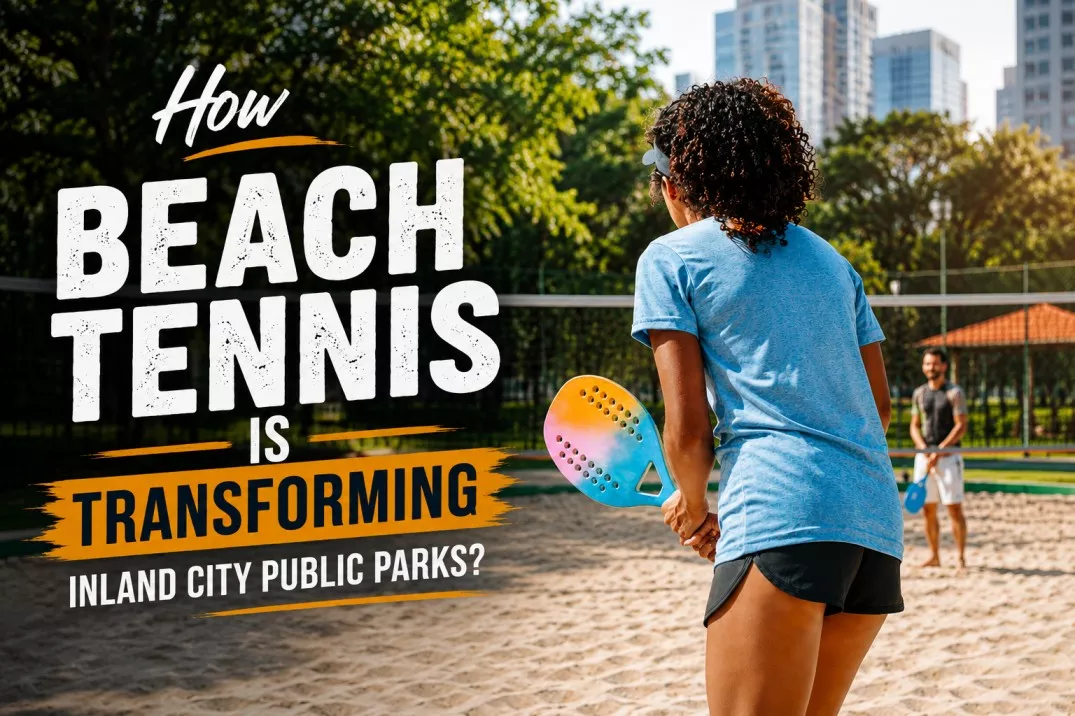
The sights and sounds of public parks are shifting dynamically. For decades, urban green spaces were dominated by the rhythmic thud of tennis balls on asphalt. Meanwhile, sneakers screeched on basketball courts, and lawnmowers hummed across open fields. Today, however, a completely new soundscape is emerging in landlocked cities hundreds of miles from the nearest coastline. This change features the crisp pop of paddle meeting ball, the gentle rustle of deep sand, and the energetic rhythm of upbeat music.
Once considered an exclusive coastal pastime, beach tennis originally grew on the shores of Europe and South America. Recently, the sport has rapidly migrated inland. Municipalities from the American Midwest to central Europe are actively replacing underutilized park space with deep-sand courts. Furthermore, this structural pivot is not merely a short-term response to a passing fad. Instead, it represents a fundamental shift in how urban planners, recreation directors, and local communities view public space.
By blending elements of traditional tennis, volleyball, and badminton, this sand sport directly addresses modern urban challenges. For instance, it maximizes underused land while offering a highly accessible fitness outlet. Consequently, it builds deep social connections across diverse populations.
In this comprehensive analysis, we will explore how beach tennis is transforming inland city public parks. Specifically, we will examine its structural impact on urban planning, municipal budgets, community health, and the future of public recreation infrastructure.
What Is Beach Tennis?
Beach tennis is a high-energy, fast-paced sport that combines the strategic depth of tennis with the quick reflexes of badminton. Additionally, it incorporates the dynamic movement of beach volleyball. The sport is played on a standard beach volleyball court ($16 \times 8 \text{ meters}$ for doubles) filled with roughly 30 cm of clean sand. To separate the sides, the setup utilizes a net set precisely at a height of 1.7 meters.
Unlike traditional tennis, the ball cannot bounce on the ground. Instead, players use specialized, non-stringed composite paddles made of carbon fiber or fiberglass. They use these paddles to strike a de-pressurized Stage 2 orange tennis ball back and forth entirely in the air. Scoring follows the traditional tennis structure of $15, 30, \text{ and } 40$. However, there is one critical exception. At deuce, there is no advantage score, meaning the next point wins the game and keeps the match pacing exceptionally fast.
Distinctions from Tennis and Pickleball
While beach tennis shares a linguistic root with traditional court sports, its mechanics and physical demands are entirely distinct:
- Zero Ground Bounce: In traditional tennis and pickleball, the ground bounce dictates the rhythm and positioning of the rally. Conversely, the ball remains entirely aerial in beach tennis. If the ball touches the sand, the point ends immediately.
- The Sand Surface: Hard courts often cause significant joint stress on a player’s knees, ankles, and lower back. Fortunately, the thick sand of a beach tennis court acts as a natural shock absorber. As a result, it dramatically reduces impact injuries while providing an intense lower-body workout.
- Equipment Simplicity: Players do not have to maintain complex string tensions like traditional tennis players do. Furthermore, sand paddles lack the harsh, noisy “pop” characteristic of composite pickleball paddles. Therefore, beach tennis is highly attractive for noise-sensitive community parks.
Why It Demolishes Barriers to Entry for Beginners
For a beginner, traditional tennis can be deeply frustrating. It requires years of mechanical practice to master ball control, spin, and court positioning. Pickleball eased this learning curve significantly, which accounts for its explosive growth. However, beach tennis simplifies the entry point even further.
Because the paddle is short, hand-eye coordination feels highly intuitive. The soft, depressurized ball moves slower through the air, giving players more time to react. Furthermore, diving for a ball on sand is a pain-free, joyful experience rather than a dangerous hard-court hazard. Consequently, beginners can achieve sustained, thrilling rallies within their first thirty minutes of play. This provides immediate gratification and encourages an active lifestyle.
Why Inland Cities Are Embracing Beach Tennis
The rise of beach tennis popularity in landlocked urban centers is driven by a perfect alignment of demographic demand, economic reality, and health trends. Municipal parks departments face a constant challenge. Specifically, they must maximize the utility of public land while keeping capital expenditures and long-term maintenance costs manageable.
Low-Cost, Highly Flexible Infrastructure
Building a modern, high-quality concrete tennis court requires a substantial capital investment. This often ranges from $60,000 to over $100,000 per court, excluding lighting. Moreover, these hard courts are highly vulnerable to shifting soils, freeze-thaw cycles, and surface cracking. Consequently, they require expensive resurfacing every few years.
In contrast, beach tennis courts are remarkably inexpensive to construct. The primary engineering requirements include:
- Excavation to a depth of roughly 30 to 40 cm.
- A proper geotextile drainage layer.
- Sub-base plumbing using perforated pipes.
- High-quality, washed, sub-angular silica sand.
Because there is no concrete to pour or specialized acrylic surfacing to apply, an inland city park can construct a multi-court beach tennis hub for a fraction of the cost of a traditional hard-court facility. Furthermore, sand courts remain highly adaptable. If urban recreation priorities shift in a decade, a sand matrix can easily be repurposed for beach volleyball or footvolley. Alternatively, it can be returned to green space without breaking up heavy concrete slabs.
Multi-Generational Appeal and Universal Accessibility
Inland city parks often struggle with demographic fragmentation. For example, playgrounds serve young families, while skateparks serve teenagers, and walking paths serve seniors. It is rare for a single public park sports facility to actively engage all these groups simultaneously.
Happily, beach tennis bridges these age gaps seamlessly. The low-impact nature of sand play allows seniors to enjoy a high-intensity sport without risking joint degradation. At the same time, the trendy, music-filled nature of sand sports appeals directly to teenagers and young adults. Historically, this demographic drifts away from organized park activities. Now, it is common to see mixed-doubles leagues featuring teenagers playing alongside fifty-year-olds, fostering deep intergenerational community bonds.
How Public Parks Are Being Redesigned
The integration of beach tennis is fundamentally altering the blueprint of the modern municipal park renovation. For decades, park master plans relied on rigid, single-purpose geometries. Today, however, city planners view the city park redevelopment process through the lens of multi-use, highly integrated recreation zones.
Anatomy of a Modern Urban Beach Tennis Hub
A successful beach tennis installation involves much more than dumping sand into an empty field. Instead, modern urban parks are deploying sophisticated engineering and architectural layouts to maximize these spaces:
- Advanced Drainage Systems: To prevent a sand court from turning into a muddy basin during heavy rains, parks utilize a multi-tier drainage layout. Beneath the sand lies a heavy-duty geotextile fabric that allows water to pass through while keeping sand out. This fabric is laid over a bed of coarse gravel containing perforated PVC drain pipes that channel water away into municipal storm systems or bioswales.
- Strategic Sand Sourcing: Cities must use washed, sub-angular silica sand that is completely free of silt and clay. This specific grain shape ensures that the sand does not pack down into a hard crust over time. Meanwhile, it prevents the sand from being so fine that it creates blinding dust storms on windy days.
- Integrated Shaded Viewing Zones: Because beach tennis is deeply social, the surrounding infrastructure is critical. Redesigned parks feature wide perimeter boardwalks, permanent shaded pergolas, tiered amphitheater seating, and integrated charging stations. These elements transform the courts from a simple sports facility into a vibrant community gathering hub.
- Smart LED Lighting Networks: To maximize court utilization during hot summer months, cities install directional, low-glare LED lighting. These smart systems can be activated via mobile apps by residents who have reserved the courts. Consequently, this minimizes light pollution for surrounding residential areas while extending the park’s usable hours well into the evening.
Urban Planning Benefits
For urban planners, managing inland city parks requires optimizing land use efficiency, advancing public health initiatives, and ensuring long-term environmental sustainability. Beach tennis facilities align perfectly with these modern urban planning paradigms.
Activating Vacant and Underutilized Park Land
Every inland city has parks with “dead zones.” These include neglected corners, poorly drained open turf fields that stay muddy, or cracked, abandoned horseshoe pits built during previous generations. Typically, these spaces contribute little to the community. Furthermore, they require ongoing mowing and weed mitigation costs.
Converting these spaces into a sand sports matrix actively rejuvenates the area. Because beach tennis courts are compact, a standard, underutilized plot of land can easily hold four to six sand courts. This high-density recreational layout dramatically increases the “carrying capacity” of the park. Consequently, it packs far more active residents into a smaller geographic footprint than a traditional open grass field or a baseball diamond would allow.
Promoting an Active Lifestyle and Sustainable Foot Traffic
Urban planners use the term “eyes on the street” to describe how active, populated public spaces naturally deter crime and vandalism. By drawing a consistent stream of players, spectators, and league organizers from early morning until late at night, beach tennis hubs create a self-policing environment through high foot traffic.
In addition, playing on sand increases caloric burn by up to 30% compared to playing on hard surfaces. This occurs due to the constant stabilization required by minor muscle groups. Therefore, cities are leveraging these facilities as key assets in their public health arsenals to combat urban sedentary lifestyles and cardiovascular disease.
Community Impact
The true value of a public park asset is measured by its social return on investment. Ultimately, success depends on how effectively it brings diverse groups of people together.
Fostering a Vibrant Beach Tennis Community
The culture surrounding beach tennis is uniquely laid-back, inclusive, and community-oriented. Unlike traditional tennis, which historically carries an aura of country-club exclusivity, beach tennis embraces a welcoming beachside subculture. Music is a core element of the sport. For example, it is standard practice to have low-volume, upbeat music playing during casual matches and league nights.
This relaxed atmosphere lowers the psychological barrier to entry for intimidated residents. Community parks that install beach tennis courts see a rapid organic growth of self-governing local clubs. These grassroots organizations use free messaging apps to organize weekend “mixers,” where players rotate partners constantly. As a result, this format breaks down social isolation, allowing newcomers to quickly build friendships and embed themselves into a supportive local subculture.
Inclusive Youth and Senior Engagement
- Youth Development: School districts and municipal youth groups are increasingly adopting beach tennis for physical education. The lack of harsh physical contact minimizes injury risk. At the same time, the rapid learning curve prevents children from becoming discouraged, promoting early-stage athletic confidence.
- Active Aging for Seniors: Balance and falls are primary health concerns for aging populations. Exercising on soft sand strengthens the stabilizing muscles around the ankles, knees, and hips while training proprioception. Furthermore, if a senior loses their balance during a play, falling into deep sand carries virtually zero risk of bone fractures or joint dislocations compared to tripping on asphalt or hardwood.
Economic Benefits for Cities
Investing in sports infrastructure must make sense on a municipal balance sheet. While public parks are primarily social goods, beach tennis facilities act as surprisingly potent drivers of local economic development.
The Microeconomics of Weekend Tournaments
A cluster of 6 to 12 sand courts allows an inland city to become a regional destination for amateur and professional beach tennis tournaments. These multi-day events draw hundreds of players and spectators from surrounding cities and states. Consequently, they trigger a wave of local economic activity:
- Hospitality Boost: Visiting players fill local hotels and short-term rentals during typically slow weekend blocks.
- Food and Beverage Impact: Restaurants, cafes, and breweries adjacent to the park experience a major surge in foot traffic and revenue.
- Local Job Creation: Tournaments create short-term employment for event coordinators, court maintenance crews, line judges, and local food truck vendors.
Long-Term Revenue Generation Pathways
- Municipal Leagues: Structured evening corporate and recreational leagues managed by the city park staff target local corporations, young professionals, and social clubs.
- Permitted Coaching: Issuing paid permits to certified beach tennis pros to run private clinics and group camps for beginners, intermediate players, and youth programs.
- Court Reservations: Nominal hourly booking fees managed via a centralized smartphone app for the general public and private parties.
- Corporate Sponsorships: Selling banner space on perimeter fencing and windbreaks to local businesses and regional brands.
Environmental Considerations
A modern recreational facilities assessment is incomplete without evaluating its environmental footprint. Constructing and managing sand courts in inland urban environments presents distinct ecological advantages alongside clear challenges that require careful management.
The Sustainability Matrix: Sand vs. Asphalt
From a climate perspective, hard courts contribute significantly to the “urban heat island effect.” Large expanses of dark asphalt or concrete absorb solar radiation during the day. Subsequently, they radiate that heat back into the surrounding neighborhood at night. Sand, while it can get hot to the touch on summer afternoons, has a significantly lower thermal mass and does not retain heat overnight in the same manner.
Furthermore, sand courts act as excellent permeable surfaces. When heavy downpours hit an asphalt court, 100% of the water becomes immediate surface runoff, overwhelming city storm sewers and washing pollutants into local waterways. In contrast, a properly engineered beach tennis sand matrix acts as a massive natural water filter. It absorbs rainfall instantly, filtering it through the gravel sub-base, and slowly recharges the local water table or discharges clean water into park bioswales.
Key Environmental Challenges and Solutions
- Sand Sourcing and Transport: Shipping tons of specialized silica sand across long distances creates a carbon footprint. Forward-thinking cities mitigate this by partnering with regional geologists to source locally available washed river sand that meets the required grain shape and purity standards.
- Dust and Wind Management: In arid inland regions, fine sand particles can blow into surrounding areas. Parks counter this by planting thick, native vegetative windbreaks around the perimeter of the courts. In addition, they utilize automated, low-volume misting systems that keep the sand damp, cool, and stable during windy peak hours.
Challenges Cities Face
While the transformation of community parks through beach tennis offers immense value, municipal leaders must navigate practical hurdles to ensure long-term operational success.
Maintenance Realities
A common misconception is that sand courts require zero upkeep. Without proper care, sand facilities can rapidly degrade. Debris, leaves, and twigs accumulate on the surface. Local wildlife or stray animals may try to use the sand as litter boxes. Over time, heavy rain can displace sand toward the court edges, causing uneven playing depths.
To mitigate this, cities must invest in specialized maintenance equipment, such as mechanical sand rakes and sifters, to regularly remove debris and loosen compacted sections. Many parks install secure, heavy-duty perimeter fencing with lockable gates to prevent animal access overnight, alongside strict “no glass bottles” policies to protect players diving barefoot into the sand.
Managing Scheduling and Spatial Conflicts
Introducing a new sport to an existing urban park ecosystem can sometimes spark territorial friction. If a city decides to convert a basketball court or a portion of an open field into beach tennis courts, long-time users of those original spaces may feel displaced.
Planning Insight: Successful municipalities avoid these conflicts by conducting transparent, data-driven public comment periods. They prioritize the activation of genuinely vacant, non-functional land rather than stripping resources away from existing, highly active user groups.
Beach Tennis vs. Other Park Sports
To understand why city planners are prioritizing beach tennis in their modern park master plans, it is helpful to compare its spatial, economic, and social characteristics directly against other traditional public park sports options.
- Beach Tennis
- Space Required: Low ($16 \times 8\text{m}$)
- Capital Cost: Low to Moderate
- Joint Impact: Very Low (Soft Sand)
- Noise Level: Low (Soft Thud)
- Maintenance: Moderate (Raking/Sifting)
- Multi-Use Potential: High (Volleyball, Footvolley)
- Pickleball
- Space Required: Low ($13.4 \times 6.1\text{m}$)
- Capital Cost: Moderate to High
- Joint Impact: Moderate to High (Asphalt)
- Noise Level: High (Sharp Pop)
- Maintenance: Low (Sweeping)
- Multi-Use Potential: Low (Hard Court Only)
- Traditional Tennis
- Space Required: High ($23.8 \times 11\text{m}$)
- Capital Cost: High
- Joint Impact: High (Asphalt)
- Noise Level: Low
- Maintenance: Low to Moderate
- Multi-Use Potential: Low (Hard Court Only)
- Volleyball
- Space Required: Low ($16 \times 8\text{m}$)
- Capital Cost: Low
- Joint Impact: Very Low
- Noise Level: Low
- Maintenance: Moderate
- Multi-Use Potential: High (Beach Tennis)
- Basketball
- Space Required: Moderate
- Capital Cost: Moderate to High
- Joint Impact: High
- Noise Level: Moderate
- Maintenance: Low
- Multi-Use Potential: Moderate (Events)
Future of Beach Tennis in Urban Parks
The transformation of inland city public parks is evolving toward deeply integrated, technology-enabled, highly resilient recreational ecosystems.
The Rise of the Smart Sand Matrix
Looking forward, we will see the emergence of highly interconnected sand sport environments. Future facilities will feature automated maintenance tracking, where embedded weight sensors or camera arrays monitor sand depth and displacement, automatically alerting park maintenance crews when a court requires mechanical leveling or sifting.
Hybrid Multi-Sport Ecosystems
Urban land will only become more scarce and valuable. The future belongs to hybrid infrastructure. Rather than dedicating spaces purely to one sport, forward-looking cities are designing modular sand matrices.
By utilizing easily adjustable, multi-height net posts with quick-release ground sleeves, a single sand court layout can transform from a high-level beach tennis tournament court in the morning to a corporate beach volleyball league in the afternoon, and an open-play sand soccer or footvolley arena for youth programs on the weekend. This hyper-flexible approach ensures maximum community utility per square meter of public land.
Expert Insights: Operational Lessons for Cities
When implementing beach tennis into an inland municipal system, experience-based insights can mean the difference between a deserted white elephant and a thriving community hub. Here are four critical takeaways gathered from successful pilot projects across global inland cities:
- Avoid the “Single-Court” Trap: Building an isolated, single beach tennis court rarely succeeds. The sport is inherently social and league-driven. A single court means players must wait extensive periods between rotational games, stifling community formation. Municipalities should build sand facilities in clusters of at least two, and ideally four or more, courts to allow for sustainable league play, clinics, and tournament draw structures.
- Partner with a Local Anchor Club: The most successful public beach tennis installations are driven by a public-private partnership model. Cities should identify or help seed a local grassroots beach tennis club. By granting this club permitted access to run organized leagues and introductory clinics during specific hours, the city ensures a dedicated team of volunteers who will watch over the facility, report maintenance issues, and actively onboard beginners.
- Do Not Skimp on Sand Quality: Trying to save money by purchasing cheap, local construction-grade sand or coarse bank sand is a critical mistake. Coarse sand contains sharp pebbles that cut players’ feet, while sand with high clay or silt content packs down into a hard rock-like compound after the first rain storm. Investing upfront in premium, washed, sub-angular silica sand ensures a safe, perpetually soft, self-draining playing surface that lasts for years.
- Establish Clear Coexistence Rules: To avoid friction between beach tennis players and beach volleyball players sharing a new multi-use sand space, parks should establish clear, visual signage detailing scheduling allocations, net height adjustment protocols, and online court reservation rules. Transparency removes ambiguity and fosters shared stewardship of the space.
Practical Takeaways
Whether you are a resident looking to try a new sport, a city official managing a budget, or a community leader looking to spark change, here is your actionable roadmap:
For Local Residents
- Get Involved: Search social media platforms and local recreation guides for terms like “Inland Beach Tennis [Your City]” or check out national organizations like the United States Tennis Association (USTA) or the International Tennis Federation (ITF) for registered regional clubs.
- Acquire Basic Gear: You don’t need expensive equipment to start. Purchase a starter composite paddle (typically $40–$70) and a few Stage 2 orange low-compression tennis balls. Many community groups provide free loaner paddles for beginners during open-play mixers.
- Advocate for Space: If your local park doesn’t have sand courts, start a petition or attend your municipal parks board meeting to present data on how low-cost sand facilities can activate underutilized spaces.
For City Officials
- Assess Underused Land: Conduct a comprehensive spatial audit of your current park inventories to identify non-functional green spaces, cracked hard courts, or high-maintenance turf zones suitable for a sand sports matrix conversion.
- Plan for Proper Sub-Base Drainage: Ensure your engineering teams prioritize a robust sub-base layout (geotextile fabrics, perforated drain lines, and coarse gravel) to guarantee your facility remains playable immediately after heavy rain events.
- Build Scalable Budgets: Factor in both low initial capital expenditures and minor long-term operational costs, including automated court-booking apps and mechanical sand-grooming attachments for park tractors.
For Community Organizations
- Develop Inclusive Formats: When launching your first leagues, utilize “Up-the-River” or “King/Queen of the Beach” rotation formats where individual players switch partners constantly. This prevents insular cliques and welcomes newcomers.
- Partner with Local Schools: Work with school athletic directors to introduce beach tennis into middle and high school physical education programs, utilizing your public park facilities during otherwise quiet weekday morning hours.
- Coordinate Multi-Sport Coalitions: Jointly align your organization with local beach volleyball and footvolley groups to present a unified front to city hall when requesting multi-sport sand infrastructure funding.
FAQ Section
What is beach tennis?
Beach tennis is an energetic sport played on a $16 \times 8 \text{ meter}$ sand court. It combines elements of tennis, badminton, and beach volleyball, using specialized composite paddles and a depressurized tennis ball. Because the ball cannot bounce, gameplay is fast-paced, dynamic, and entirely aerial.
Why are inland cities building beach tennis courts?
Inland municipalities are rapidly adopting beach tennis because it provides a highly cost-effective, durable alternative to expensive hard-surface courts. Sand courts are less susceptible to cracking from weather extremes, maximize underutilized park spaces, and address a growing public demand for low-impact, highly social recreational activities.
Is beach tennis suitable for beginners?
Yes, beach tennis features an exceptionally gentle learning curve. The paddle is short and intuitive to control, the low-compression ball moves slower through the air, and there are no complex string responses or spin mechanics to master, allowing absolute beginners to sustain fun rallies almost immediately.
How much space is required for a beach tennis court?
A standard doubles court requires a playing footprint of $16 \text{ meters}$ in length by $8 \text{ meters}$ in width. However, when factoring in safe runoff zones and perimeter safety buffers, a total area of roughly $22 \times 14 \text{ meters}$ per court is recommended by planning guidelines.
Are beach tennis courts expensive to construct?
No. Compared to traditional concrete tennis courts or asphalt pickleball courts—which can cost upwards of $60,000–$100,000—a beach tennis court is highly economical. It requires simple ground excavation, a proper geotextile drainage layer, and washed silica sand, resulting in substantially lower construction costs.
Can existing park hard courts be converted into beach tennis courts?
Yes. If an asphalt tennis or basketball court has suffered severe structural cracking beyond reasonable repair, cities can install perimeter containment retaining walls directly over the slab, configure drainage outlets, and overlay the surface with 30–40 cm of specialized sand, avoiding expensive concrete removal costs.
What are the maintenance requirements for a sand court?
Routine maintenance involves daily or weekly trash removal, surface raking to level displaced sand, and regular deep mechanical sifting to clear out buried leaves, organic debris, or pebbles. Keeping the sand free of debris ensures player safety during barefoot play and preserves optimal drainage.
Is beach tennis safer than traditional tennis?
Yes, beach tennis is significantly gentler on the human body. Playing on deep, soft sand absorbs structural impact shocks, dramatically reducing chronic stress injuries to the knees, lower back, and ankles. Falling on sand also eliminates the scrapes and fractures common to hard courts.
How does beach tennis benefit local urban communities?
Beach tennis creates highly vibrant, inclusive neighborhood micro-communities. The sport’s casual, music-friendly culture lowers social anxiety barriers, encouraging cross-generational interaction where youth, working professionals, and active seniors play alongside one another in a shared, accessible environment.
Will beach tennis continue growing in inland public parks?
Yes. As urban centers continue to prioritize flexible, sustainable, and health-focused public spaces, the demand for low-cost, multi-use sand facilities will intensify. Its unique combination of easy accessibility, intense fitness benefits, and strong social appeal ensures its position as a staple of modern urban park design.
Conclusion
The rapid proliferation of beach tennis within inland city public parks marks a significant evolution in modern urban recreation. By transforming neglected, non-functional park spaces into vibrant, sand-filled community hubs, municipalities are successfully addressing the changing needs of their residents.
This transformation proves that beach culture is not a matter of geography—it is a state of mind. Through thoughtful master planning, smart infrastructure investment, and inclusive community engagement, inland cities are successfully utilizing beach tennis to build healthier, more connected, and highly resilient urban environments for generations to come.
Recommended Authoritative References
- International Tennis Federation (ITF) – Beach Tennis World Tour Regulations
- National Recreation and Park Association (NRPA) – Urban Park Design Guidelines
- American Planning Association (APA) – Activating Public Spaces Research


