


Why Are German Last Names So Easy to Recognize?
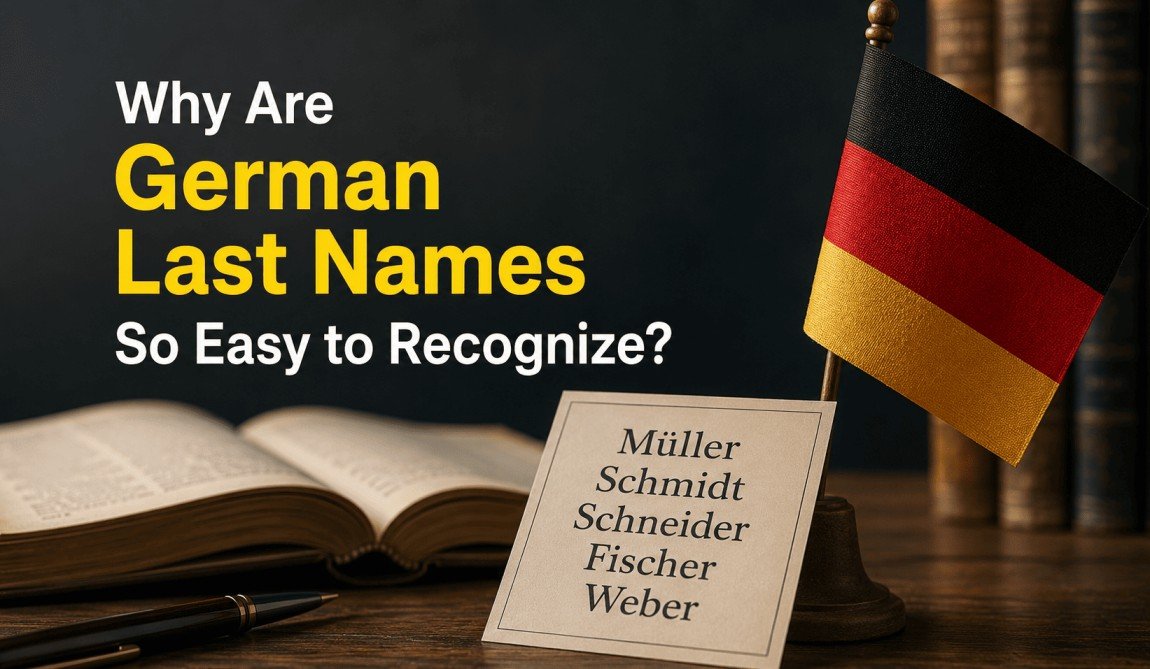
German last names stand out fast. A name like Schmidt, Müller, or Hoffmann looks and sounds different from a French, Italian, or Spanish surname within seconds. This recognizability comes from three forces working together: sharp consonant sounds, meaningful compound structures, and a naming history rooted in medieval jobs and villages.
This guide walks through exactly why German surnames feel so distinct, how they developed, and which patterns give them away every time.
Quick Answer
German last names are easy to recognize because of five clear signals:
- Consonant clusters like “sch,” “tz,” and “pf”
- Umlauts (ä, ö, ü) or their English spellings (ae, oe, ue)
- Meaningful suffixes such as “-mann,” “-berg,” and “-stein”
- Transparent meanings tied to jobs, places, or personal traits
- Compound structures that fuse two root words into one name
Once you spot two or three of these signals in a single name, you can usually confirm its German origin right away.
What Makes German Last Names So Distinctive?
Three features set German surnames apart from most other European naming traditions. First, German uses consonant combinations that rarely appear in English, French, or Spanish. Second, German surnames often preserve their original meaning instead of losing it to centuries of spelling drift. Third, German is a compounding language, so surnames frequently combine two meaningful words into one.
As a result, even someone with no German language training can often guess the rough meaning of a name like Schwarz (black) or Bergmann (mountain man). This transparency is rare among European surname traditions, and it explains much of their recognizability.
The Sounds and Spellings That Give German Names Away
Certain letter patterns show up again and again in German surnames. Once you notice them, you start spotting German names everywhere, from phone books to film credits.
Sharp Consonant Clusters
German surnames frequently use consonant clusters that sound harsh or clipped compared to Romance-language names. For example:
- Sch – Schmidt, Schneider, Schwarz, Schulz
- Tz – Fritz, Schultz, Metz
- Pf – Pfeiffer, Pfister, Krapf
- Ch – Koch, Bach, Albrecht
These clusters create a distinct rhythm. Consequently, native English speakers usually notice a German name before they even know why it sounds different.
Umlauts and Their English Substitutes
German relies on umlauts (ä, ö, ü) far more heavily than most European languages. Surnames like Müller, Böhm, and Köhler all include these marks in their original spelling.
However, families who moved to English-speaking countries usually could not keep the umlaut in official records. Therefore, Müller often became Mueller, and Böhm became Boehm. This substitution pattern remains one more strong clue that a name has German roots, even after the umlaut itself disappears.
Common Surname Suffixes
Several suffixes appear constantly across German surnames, and each one carries real meaning. The table below breaks down the most frequent examples.
| Suffix | Meaning | Example Surnames |
|---|---|---|
| -mann | man | Hoffmann, Neumann, Zimmermann |
| -er | one who does or comes from | Müller, Fischer, Schäfer |
| -berg | mountain | Rosenberg, Isenberg |
| -stein | stone | Bernstein, Lichtenstein |
| -bach | stream | Steinbach, Offenbach |
| -feld | field | Rosenfeld, Hirschfeld |
| -thal / -tal | valley | Rosenthal, Blumenthal |
Because these suffixes repeat so often, they function almost like fingerprints. Once you memorize even three or four of them, identifying a German-origin surname becomes nearly automatic.
The Four Main Categories of German Surnames
German surnames generally fall into four broad categories. Understanding these categories explains why the names feel both recognizable and meaningful at the same time.
1. Occupational Names
Occupational surnames form the largest single category in German naming history. Medieval towns organized life around guilds and trades, so a family’s surname often simply named its craft.
- Müller – miller
- Schmidt – smith
- Schneider – tailor
- Fischer – fisherman
- Weber – weaver
- Schäfer – shepherd
- Zimmermann – carpenter
2. Descriptive or Nickname Names
Other surnames describe a physical trait or personality quirk. These names likely began as informal nicknames, and they later became fixed, permanent family names.
- Klein – small
- Groß / Gross – tall or big
- Schwarz – black
- Braun – brown
- Kurz – short
- Lang – long or tall
3. Place and Landscape Names
Many families took their surname from a nearby geographic feature or from the town where they lived. This category explains why so many German surnames end in landscape-related suffixes.
- Berg – mountain
- Stein – stone
- Bach – stream
- Wald – forest
- Busch – bush
4. Names Based on a Personal Name
Some German surnames come directly from an ancestor’s first name, much like patronymic naming in other cultures. Names like Werner, Otto, and Hermann fit this pattern, since they started as a father’s given name before becoming a fixed family name.
Additionally, a marked patronymic style using “-sen” or an added “-s” shows up frequently in northern Germany, likely due to nearby Scandinavian and Frisian influence. Hansen, Jansen, and Petersen are common examples from this region.
A Short History of How Germans Got Their Last Names
German surnames did not appear overnight. Instead, they developed gradually across several centuries, starting in cities before slowly reaching the countryside.
Larger towns in German-speaking regions began adopting fixed surnames around the 12th and 13th centuries. Rural villages, meanwhile, held onto single names much longer, since a small community rarely needed extra names to tell neighbors apart.
The process later accelerated for Jewish families across German-speaking Europe. Austrian Emperor Joseph II first required Jewish households to register permanent surnames in 1787. Napoleon’s 1808 decree then extended similar requirements across territories under French control. Individual German states soon followed with their own laws, including Frankfurt in 1807, Baden in 1809, and Prussia in 1812.
By the mid-19th century, nearly every German-speaking region had adopted the fixed, hereditary surname system that families still use today.
The Most Common German Last Names Today
A surprisingly small set of surnames covers a large share of the German population. In fact, genealogists estimate that the ten most common German surnames are shared by several million people, or roughly one German in twenty. Exact rankings vary slightly by source, since Germany does not publish official nationwide surname statistics, but the same names consistently appear near the top.
| Rank | Surname | Original Meaning |
|---|---|---|
| 1 | Müller | Miller |
| 2 | Schmidt | Smith |
| 3 | Schneider | Tailor |
| 4 | Fischer | Fisherman |
| 5 | Weber | Weaver |
| 6 | Meyer | Estate steward or tenant farmer |
| 7 | Wagner | Wagon maker |
| 8 | Becker | Baker |
| 9 | Schulz | Village magistrate |
| 10 | Hoffmann | Farmstead manager |
Notice how nearly every name on this list traces back to a specific medieval job. This pattern is not a coincidence. Instead, it reflects how closely German surname history connects to occupation, craft, and village life.
Regional Differences Across German-Speaking Areas
Although German surnames share common patterns, real regional differences still exist across Germany, Austria, and Switzerland.
Bavarian and Austrian surnames often end in “-er” and reference a specific farm or village, since rural land ownership shaped naming customs there. Northern German surnames, on the other hand, show heavier patronymic influence from neighboring Scandinavian and Frisian traditions. Meanwhile, Swiss-German surnames frequently include double letters and distinct regional spellings that differ slightly from standard German.
These regional quirks add extra texture to an already distinctive naming system.
How German Surnames Compare to Other Naming Traditions
Compared to English, French, or Spanish surnames, German names tend to keep their original meaning far more clearly. English surnames like Smith or Baker also describe occupations. However, centuries of spelling drift have blurred the meaning of many other English names.
French surnames often use “de” to signal origin, as in de la Croix. Meanwhile, Spanish and Portuguese surnames frequently rely on patronymic endings like “-ez” or “-es,” as seen in Rodriguez or Fernandes. German surnames, in contrast, lean heavily on compound structures and direct occupational roots, which keeps their meaning transparent even centuries later.
Frequently Asked Questions
What is the most common German last name?
Müller is the most common German surname, shared by close to a million people. It means “miller,” and it reflects how central milling was to everyday village life in medieval Germany.
Why do so many German surnames end in “-er”?
The “-er” suffix usually marks an occupation or a place of origin, similar to how English uses “-er” in words like “baker” or “farmer.” Müller, Fischer, and Schäfer all follow this exact pattern.
Are German surnames always compound words?
Not always, but many are. Names like Rosenberg (rose plus mountain) or Blumenthal (flower plus valley) fuse two meaningful root words together. This compounding habit is a genuine hallmark of German surname structure.
Do all German last names still have a clear meaning?
Most do, although some meanings have faded through regional dialect shifts and centuries of spelling changes. Occupational and descriptive names tend to keep the clearest, most recognizable meanings today.
How can you tell if a surname is German just by looking at it?
Look for consonant clusters like “sch” or “tz,” along with umlauts (ä, ö, ü) or their English substitutes (ae, oe, ue). Suffixes like “-mann,” “-berg,” or “-stein” are strong clues too, and these features rarely appear together in non-German surnames.
Final Thoughts
German last names remain instantly recognizable because they combine distinct sounds, transparent meanings, and a naming history rooted in medieval occupation and geography. Whether a name describes a miller, a mountain, or a physical trait, it usually tells a small story about where a family came from.
Once you learn the key patterns, sharp consonant clusters, umlauts, and suffixes like “-mann” or “-stein”, spotting a German surname becomes almost effortless.


