


Does America’s Approach to Diversity Affect Its Global Image?
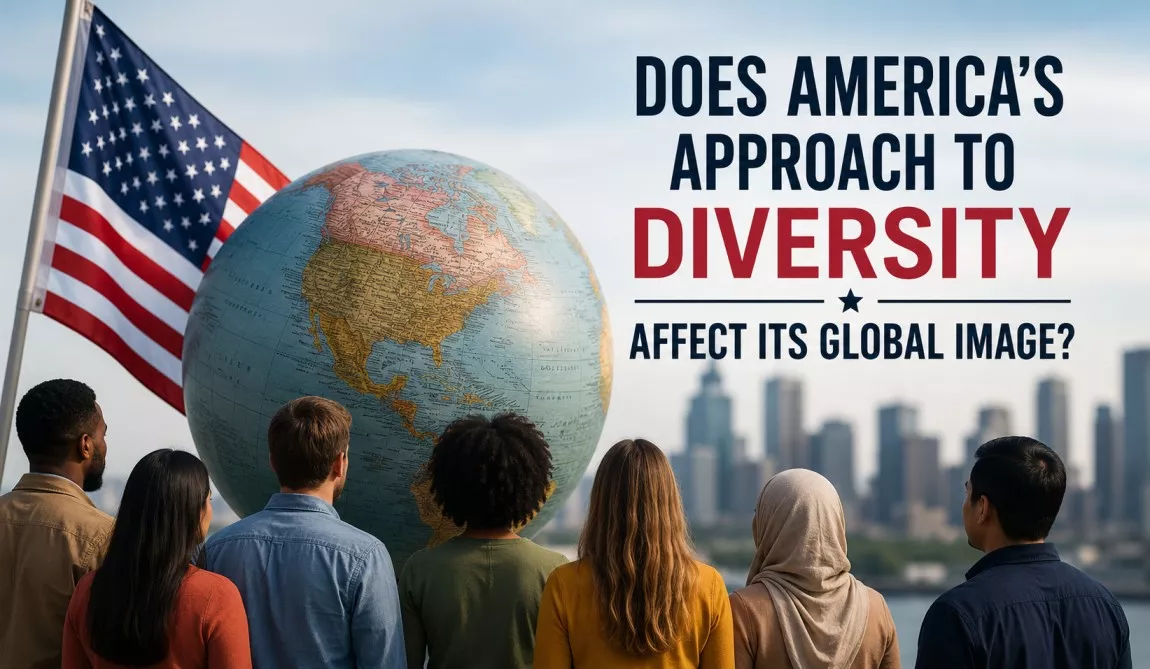
America is one of the most watched nations on Earth. Its politics, culture, and social debates reach every corner of the globe. And few topics draw more international attention than how the United States handles diversity.
People around the world hold strong opinions about multicultural America. Some see it as a model of openness and opportunity. Others point to racial tensions, political conflict, and policy contradictions. Both views contain truth.
So, does America’s approach to diversity affect its global image? The short answer is yes — significantly. The longer answer is complicated, and worth understanding fully.
What Does Diversity Mean in the American Context?
Diversity in America is not a single idea. It covers race, ethnicity, religion, language, national origin, gender, and sexual orientation. No other major economy contains quite this range within one national identity.
The U.S. Census Bureau projects that by 2045, no single racial group will form a majority of the American population. This shift reflects generations of immigration, cultural exchange, and changing family patterns.
American diversity includes several key dimensions:
- Ethnic and racial variety: Black, White, Hispanic, Asian, Native American, and multiracial communities all shape national life.
- Religious pluralism: Christianity, Islam, Judaism, Hinduism, and secular traditions coexist across the country.
- Immigration: The U.S. admits more legal immigrants annually than any other country in the world.
- Gender and inclusion: Ongoing efforts address pay gaps, LGBTQ+ rights, and workplace equity.
- Historical depth: From slavery and segregation to the Civil Rights Movement and affirmative action, America’s diversity story involves both hard-won progress and unresolved pain.
Understanding these dimensions is essential before assessing how diversity shapes America’s image abroad.
Why America’s Diversity Matters Internationally
America’s diversity doesn’t stay within its borders. It influences economies, cultures, and diplomatic relationships worldwide.
Universities draw global talent. Institutions like MIT, Harvard, and Stanford enroll students from over 180 countries. Many graduates stay, launch companies, or return home with professional networks that strengthen bilateral ties.
Cultural exports spread American diversity worldwide. Films, music, television series, and streaming platforms reach billions of people. When that content reflects multicultural casts and stories, it shapes how the world sees the United States — for better or worse.
Immigration fuels innovation. Research from the National Bureau of Economic Research shows that immigrants are disproportionately represented among U.S. patent holders and startup founders. That productivity signals to the world that America’s openness delivers economic results.
Diversity strengthens diplomacy. A State Department workforce that reflects global backgrounds builds credibility and trust with foreign partners. People engage more readily with those who understand their context.
In short, multicultural America is a strategic asset, not just a domestic value.
How Diversity Shapes America’s Global Image
Positive Perceptions
Many countries view America’s diversity as one of its most compelling features. The idea that people from any background can find opportunity in the United States carries real symbolic weight.
Innovation flows from diverse teams. Companies like Google, Yahoo, and eBay were co-founded or heavily shaped by immigrants. This connection between inclusion and economic performance is not lost on foreign investors or policy makers.
Cultural creativity emerges from multicultural influence. Jazz, hip-hop, and R&B all emerged from African American communities and now dominate global music. These art forms serve as powerful, living ambassadors for American culture.
Higher education earns global trust. Foreign students and families associate American universities with academic freedom, diverse perspectives, and world-class research. More than one million international students enroll in U.S. institutions each year.
Challenges That Complicate the Picture
America’s handling of diversity also creates friction internationally. High-profile events draw scrutiny and raise questions about America’s true values.
Political polarization sends mixed signals. When administrations adopt sharply opposing views on immigration and DEI in the United States, foreign governments struggle to understand what America actually stands for.
Race-related controversies attract intense coverage. The 2020 protests following George Floyd’s death were reported in virtually every country. They reinforced doubts about whether systemic inequality has genuinely been addressed.
Immigration debates reveal contradictions. America’s reputation for welcoming newcomers clashes with images of border barriers and family separations. This inconsistency confuses and sometimes alienates international audiences.
Acknowledging these challenges matters. America’s global reputation on diversity is not uniformly positive, and it would be misleading to suggest otherwise.
How Different Regions View America’s Diversity
Europe
European countries generally admire America’s multicultural identity. However, they also compare it critically to their own integration struggles. France, Germany, and the United Kingdom each wrestle with similar debates around immigration and national identity.
European audiences follow American race and diversity controversies closely — often because they see direct parallels at home. Admiration and skepticism tend to coexist.
Asia
Perceptions across Asia vary considerably. In countries like Japan, South Korea, and China, diversity is not always framed as a national strength in mainstream culture. Yet American popular culture — music, film, fashion — commands enormous followings.
Many Asian families view American universities and the promise of inclusion as strong reasons to send their children abroad. In practical terms, America’s reputation for openness carries significant economic weight across the region.
Latin America
Latin American countries maintain deep ties to the United States through immigration, trade, and cultural exchange. For many people in the region, America represents both aspiration and contradiction.
How the United States treats Latino and Hispanic communities — whether through immigration enforcement or political representation — directly shapes how governments and citizens across Latin America view American values.
Africa
African perceptions of America are strongly influenced by the African American experience. The Civil Rights Movement, Black cultural contributions, and leaders like Martin Luther King Jr. and Barack Obama carry genuine resonance across the continent.
At the same time, African audiences notice when American foreign policy contradicts its stated commitment to equality. That gap between rhetoric and action weakens America’s soft power in the region.
Middle East
The Middle East presents a complicated picture. Many people admire American freedoms and educational opportunities. Others are skeptical, seeing inconsistency between diversity rhetoric and actual foreign policy decisions.
The treatment of Muslim communities in America receives close attention across the Muslim world. Events like post-9/11 discrimination and more recent anti-Muslim political rhetoric have left impressions that take years to change.
The Role of Media and Social Media
Media shapes international perception more than almost any other force. Hollywood has long exported images of American life — sometimes as inspiring diversity, sometimes as shallow tokenism.
Streaming platforms like Netflix have raised expectations for authentic multicultural storytelling. A series with genuine representation reaches global audiences and shifts perceptions in ways traditional diplomacy cannot match.
Social media has changed the pace and scale of these dynamics entirely. Movements like Black Lives Matter and #MeToo went global through X (formerly Twitter), Instagram, and TikTok. They exposed real inequalities but also demonstrated something important: America’s willingness to publicly examine itself. Many governments around the world do not allow that kind of public reckoning.
However, social media also amplifies the worst moments. Viral videos of racial incidents and divisive political content create distorted impressions abroad. A single trending event can overshadow years of quiet progress.
Diversity, Innovation, and Economic Competitiveness
Research from multiple institutions supports a direct link between diversity and economic performance.
The data points to several consistent findings:
- According to the American Immigration Council, immigrant founders helped build more than 40% of today’s Fortune 500 companies.
- McKinsey research finds that companies with diverse leadership outperform less diverse peers across multiple financial measures.
- Diverse university environments produce more cross-disciplinary research and higher rates of patent activity.
Silicon Valley’s global dominance depends partly on its ability to attract engineers, designers, and entrepreneurs from India, China, Nigeria, Brazil, and dozens of other countries. That talent pool exists because America’s diversity policies signal openness to skilled people from all backgrounds.
When those signals weaken, talent looks elsewhere. Canada, Germany, and Australia have deliberately positioned themselves as welcoming alternatives. The competition for global talent is real, and America’s reputation for inclusion plays a direct role in that competition.
Public Diplomacy and America’s Soft Power
Soft power — the ability to influence through attraction rather than force — depends on image, values, and culture. Diversity sits at the center of all three.
U.S. exchange programs like the Fulbright scholarship deliberately connect international participants with American institutions and communities. These experiences build long-term goodwill that political agreements rarely produce alone.
Foreign students who study in the United States often return home with more favorable views of American society, regardless of what they have seen in the news. Personal experience tends to outweigh media narratives.
Tourism reinforces this dynamic. Visitors who experience New York, Los Angeles, Miami, or Chicago encounter multicultural America directly — and frequently leave with a more nuanced view than they arrived with.
When diversity is visible and genuinely embraced, it strengthens America’s international relationships. When internal debates become deeply divisive, that soft power erodes.
Common Criticisms and Misconceptions
Misconception 1: Diversity weakens national unity. Research does not support this claim. Countries with strong civic institutions and shared democratic values maintain national cohesion even across significant cultural differences. Diversity becomes a problem mainly when institutions fail to manage it fairly.
Misconception 2: Immigration causes economic harm. Economic data consistently shows that immigrants contribute to GDP, tax revenues, and entrepreneurship at high rates. Concerns about job displacement are generally overstated at the macroeconomic level.
Misconception 3: DEI policies are purely political. Diversity, Equity, and Inclusion initiatives developed as responses to documented inequalities in hiring, education, and pay. Whatever one’s view on specific policies, the underlying inequalities they address are measurable and well-documented.
Misconception 4: Foreign media provides an objective picture of America. Coverage of American diversity issues abroad can be selective. It often amplifies controversy over progress, producing perceptions that don’t always reflect what life in the United States actually looks like day to day.
Expert Insights
Political scientists who study American identity argue that diversity has historically been a source of national strength — precisely because it forces ongoing negotiation and democratic compromise.
Sociologists point to contact theory: sustained interaction between different groups tends to reduce prejudice over time. Diverse American cities and campuses demonstrate this dynamic at scale.
Economists at institutions like the Brookings Institution have found that metropolitan areas with greater demographic diversity consistently show stronger innovation output and higher rates of new business formation.
International relations scholars emphasize one key point: America’s credibility on diversity depends on alignment between what it says and what it does. At home and abroad, that alignment is watched closely and judged accordingly.
What the Future Could Look Like
Several trends will shape how America’s diversity influences its global image over the coming years.
Demographic change will continue. The United States will grow more racially and ethnically diverse regardless of policy choices. How the country manages this transition will be observed and debated worldwide.
Artificial intelligence raises equity questions. Which communities benefit from AI-driven economic growth? America’s answer to that question will matter to international audiences watching how technology intersects with inequality.
Competition for global talent will intensify. Skilled workers have options. America’s attractiveness depends directly on its reputation for openness, fairness, and stability.
Cultural exchange will deepen. Younger generations consume global media and build cross-border connections every day. America’s diversity story will increasingly be interpreted not just by American voices, but by international ones — with or without American input.
If America manages its internal debates with transparency and a genuine commitment to democratic values, its global image can remain strong. If polarization deepens and undermines those values, the reputational damage will be real and lasting.
Frequently Asked Questions
Why is America considered one of the most diverse countries in the world?
America has admitted immigrants from virtually every nation for centuries. This history, combined with constitutional protections for minority rights, has produced extraordinary ethnic, religious, and cultural variety within a single national identity.
Does diversity improve America’s economy?
Yes, according to extensive research. Immigrants and their children found companies, file patents, and pay taxes at high rates. Diverse workplaces also demonstrate measurably stronger problem-solving and innovation capacity.
How do other countries view American diversity?
Views vary by region and historical context. Many countries admire America’s multicultural identity while scrutinizing its racial tensions and policy debates. Media exposure and local values heavily influence these perceptions.
Does diversity affect tourism to the United States?
Yes. Multicultural cities, diverse cultural institutions, and varied food, music, and arts scenes attract international tourists. A reputation for openness and inclusion supports the tourism sector economically.
Does diversity influence American diplomacy?
A diverse diplomatic workforce allows the United States to engage international partners with greater credibility. People-to-people exchange programs further deepen those connections over time.
What role does immigration play in American diversity?
Immigration is foundational. It has continuously refreshed the American workforce, culture, and national identity. The ongoing debate over immigration policy is one of the most consequential conversations affecting how the world views the United States.
Why is diversity debated so intensely in the United States?
Because it intersects with deeply held values around fairness, identity, opportunity, and national belonging. These are not trivial questions — they touch the country’s history, present inequalities, and future direction simultaneously.
How does diversity affect innovation in America?
Diverse teams bring different problem-solving approaches, knowledge networks, and perspectives. Research consistently shows measurable connections between demographic diversity and rates of innovation in both academic and commercial settings.
What is America’s global reputation today?
It is mixed. America retains strong admiration for its universities, cultural output, and democratic institutions. However, internal political division, persistent inequality, and inconsistent foreign policy have complicated its standing in recent years.
Can diversity strengthen America’s international relationships?
Yes. Shared cultural connections, diaspora communities, and demonstrated commitment to inclusion create human bridges between the United States and countries worldwide. These informal ties often outlast formal political agreements.
Conclusion
America’s approach to diversity does affect its global image — in ways that are powerful, nuanced, and sometimes contradictory. The country’s multicultural identity is a genuine source of strength. It drives innovation, attracts global talent, enriches cultural life, and creates meaningful human connections across borders.
At the same time, unresolved racial tensions, political polarization over diversity policies, and gaps between stated values and actual practice create real vulnerabilities. International audiences are watching carefully, and their perceptions are shaped by both what America achieves and where it falls short.
No single policy or event determines America’s global reputation. It emerges from the combination of democratic values, economic opportunity, cultural influence, and the ongoing effort — sometimes messy, sometimes inspiring — to build a society that works for people of every background.
That effort, more than any specific outcome, is what much of the world finds both compelling and worth scrutinizing. How America navigates its diversity story in the years ahead will matter not just within its borders, but everywhere its influence reaches.


