


Why Daytime Shinkansen Trains Beat Sleeper Trains in Japan
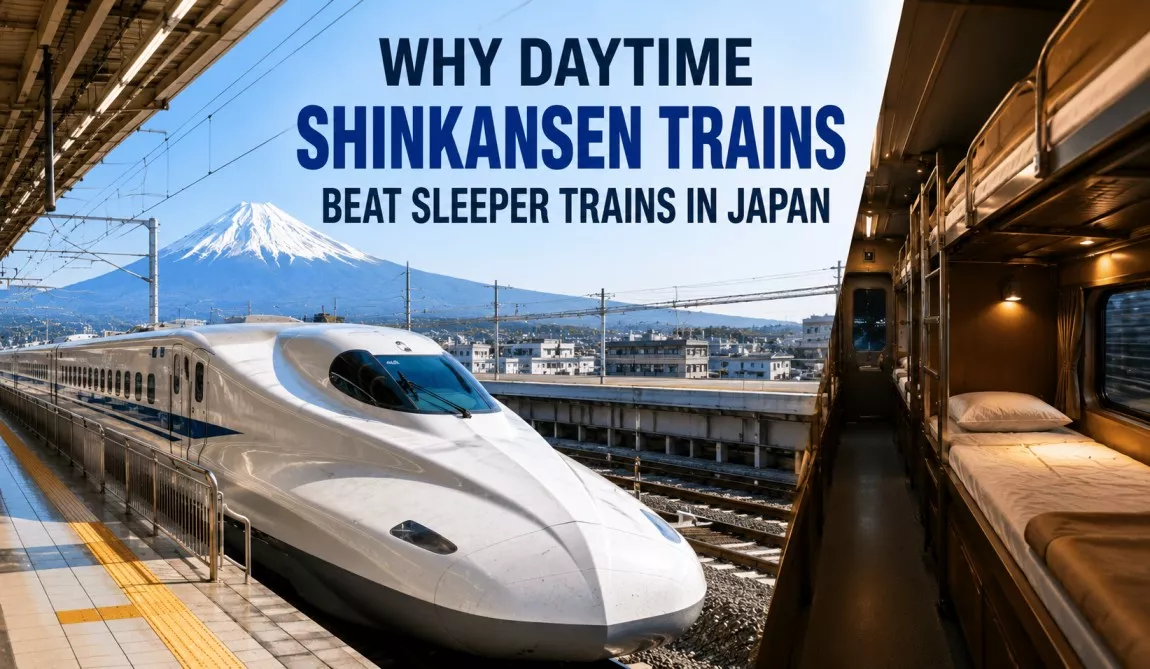
Picture two ways to cross Japan. One option speeds through the countryside at up to 320 km/h while Mt. Fuji rolls past your window. The other locks you in a small cabin overnight and drops you off in a station you can barely see in the pre-dawn light. For most travelers, the smarter choice is clearer than it first appears.
Japan’s sleeper trains once crisscrossed the entire country. Today, however, only one regular overnight service survives: the Sunrise Izumo/Seto. Meanwhile, the Shinkansen network has grown into one of the fastest, most reliable rail systems on Earth. As a result, the daytime bullet train now wins on nearly every practical measure that matters to travelers.
Quick Answer
Daytime Shinkansen trains beat sleeper trains in Japan because they travel faster, run far more often, and cost about the same once you add a sleeper surcharge. In fact, a Shinkansen trip frequently takes half the time of an equivalent overnight journey. On top of that, Japan’s last remaining sleeper train sells out within minutes of going on sale, so the Shinkansen is usually the only option you can actually book.
Key Takeaways
- The Shinkansen network now reaches nearly every major Japanese city, while only the Sunrise Izumo/Seto still runs as a regular overnight sleeper.
- A Shinkansen journey often takes less than half the time of the equivalent sleeper train route.
- Shinkansen fares typically land in the same range as sleeper train fares, and sometimes lower.
- The Shinkansen averages well under one minute of delay per year — a level of reliability no sleeper train can match.
- Sleeper train tickets open exactly one month before departure and often sell out within minutes, so most travelers can’t rely on one anyway.
What Are Shinkansen Trains and Sleeper Trains?
The Shinkansen, or “bullet train,” is Japan’s high-speed rail network. It links Tokyo with major cities such as Osaka, Kyoto, Hiroshima, Sendai, and Fukuoka at speeds of up to 320 km/h (200 mph). Moreover, the network runs almost entirely in daylight, with the first departures before 6 a.m. and the last arrivals around midnight.
A sleeper train, on the other hand, runs through the night so passengers can travel while they rest. Japan once operated dozens of these routes under names like the Hokutosei, Twilight Express, and Cassiopeia. Today, though, only the Sunrise Izumo and Sunrise Seto remain, running nightly between Tokyo and the western cities of Izumo and Takamatsu.
1. Speed and Travel Time: The Shinkansen Wins by Hours
Speed is where the Shinkansen separates itself most clearly from any overnight alternative. The Tokaido Shinkansen, for example, connects Tokyo and Shin-Osaka in as little as two hours and 21 minutes. On the Tohoku Shinkansen, meanwhile, trains reach up to 320 km/h — roughly the cruising speed of a light aircraft.
Now compare that to the Sunrise Izumo. This sleeper train needs about 12 hours to travel from Tokyo to Izumoshi Station. By contrast, the same trip by Shinkansen plus a connecting limited express train takes roughly six and a half hours. Better yet, it happens during the day, so you can actually watch the scenery go by. So even after accounting for the transfer at Okayama, the daytime option still finishes in nearly half the time.
2. Frequency and Flexibility: Every Few Minutes vs. Once a Day
Frequency matters just as much as raw speed. On the Tokaido Shinkansen alone, roughly 365 trains run every single day, and departures happen every few minutes during peak hours. Consequently, if you miss one train, another usually arrives within minutes.
The Sunrise Izumo/Seto offers no such flexibility. Only one train runs in each direction per day, departing Tokyo at around 9:50 p.m. Therefore, missing this single nightly departure means waiting a full 24 hours for the next chance, or giving up on the sleeper train altogether.
3. Daytime Scenery vs. a Missed View
A Shinkansen window seat delivers views that many travelers rank among their trip’s highlights. Expect Mt. Fuji, the Pacific coastline, terraced rice fields, and sweeping mountain passes. Since the trains run during the day, none of this scenery goes to waste.
Sleeper trains, in contrast, cover most of their distance after dark. Passengers on the Sunrise Izumo do catch a brief sunrise over the Seto Inland Sea. Otherwise, though, they sleep through the bulk of the journey. In other words, the very landscape that makes Japan worth visiting slides by unseen.
4. Comfort and Space Onboard
Standard Shinkansen seating already includes generous legroom, a reclining seat, and a fold-down tray table. Passengers who want more can upgrade to Green Car seating or, on select routes, the even more luxurious Gran Class. Either way, everyone gets a proper seat, a clean restroom, and room to move around.
By comparison, sleeper train comfort depends heavily on which cabin you book. The cheapest option, the Nobinobi seat, is really just a carpeted floor space behind a low partition. There’s no true bed, and the shared shower costs an extra ¥330 per use. Private cabins solve this problem, but only if you pay a significant supplement. Even then, you still need to book one before it sells out.
5. Reliability: A Punctuality Record Few Systems Can Touch
The Shinkansen has built its reputation on precision. According to JR Central and JR East data, the network’s average delay lands well under one minute per year across the system. Some measurements run as low as 24 seconds. This consistency comes from dedicated tracks, centralized control systems, and tightly scheduled maintenance windows.
A single daily sleeper train, however, carries far more risk. If a typhoon, mechanical fault, or line obstruction disrupts the Sunrise Izumo/Seto on any given night, there’s no backup service. Passengers simply wait until the following evening for the next train. Thus, the Shinkansen’s redundancy — dozens of trains running throughout the day — makes it the safer bet for travelers working around a schedule.
6. Cost: Surprisingly Close, Sometimes Cheaper
Many travelers assume a sleeper train saves money by combining transport and accommodation into one overnight ticket. In practice, though, the math works out closer than most people expect. A one-way trip from Tokyo to Izumo costs around ¥21,000 by Shinkansen and limited express train.
The Sunrise Izumo costs about ¥16,000 for the no-privacy Nobinobi seat. A private Single cabin, however, climbs to roughly ¥23,000. That’s essentially the same price as the daytime option, minus the privacy of an actual hotel room.
Rail pass holders face a similar trade-off. The 2026 nationwide seven-day Ordinary Japan Rail Pass costs ¥50,000 and covers most Shinkansen services, aside from a supplement on the fastest Nozomi and Mizuho trains. It also covers the Nobinobi seat on the Sunrise trains at no extra charge, though private sleeper cabins still require a supplement on top of the pass.
7. Booking Ease: One Ticket vs. Dozens of Daily Options
Reserving a Shinkansen seat rarely requires much advance planning. Travelers can book reserved seats up to a month ahead, but unreserved cars remain available on most routes for anyone who prefers to walk up and board. Either way, another train usually departs within minutes.
Booking the Sunrise Izumo/Seto is a different story entirely. JR releases tickets exactly one month before departure, at 10:00 a.m. JST. By some accounts, more than 90% of departures sold out within minutes in 2025. As a result, many travelers who want the sleeper train experience simply can’t get a seat, which pushes them toward the Shinkansen by default.
The Decline of Japan’s Sleeper Trains
Japan’s overnight “Blue Trains” once formed a nationwide network. At their peak in 1975, they made 39 round trips a day. Since then, however, the Shinkansen has steadily replaced them, route by route.
The retirements came in waves. All Tokyo–Kyushu sleepers, including the Asakaze, ended by 2009. The Akebono followed in 2014. Then, within about a year, both the Twilight Express and the Hokutosei ended in 2015. Finally, the Cassiopeia and Hamanasu made their last runs in March 2016, right as the Hokkaido Shinkansen opened through the Seikan Tunnel.
Notably, the Sunrise Izumo/Seto survives precisely because no Shinkansen line currently reaches its route. Neither Shikoku nor the San’in coast has full Shinkansen access yet, so the old sleeper train still fills a genuine gap. As soon as high-speed rail does arrive there, though, history suggests the sleeper train would not last much longer.
When Might a Sleeper Train Still Make Sense?
None of this means the Sunrise Izumo/Seto has no place in a Japan itinerary. In fact, a handful of situations still favor the overnight option.
- You want the experience itself. A moving hotel room remains a bucket-list novelty for many rail enthusiasts, and no Shinkansen ride replicates it.
- Your schedule has an awkward gap. If your day ends late and your next destination starts early, sleeping through the transit time can genuinely save you a travel day.
- You’re comfortable with the Nobinobi seat. Budget travelers who don’t mind a shared, no-frills space can occasionally beat the daytime fare.
Even so, these scenarios remain the exception rather than the rule. For most trips, the practical case for the Shinkansen stays overwhelming.
Shinkansen vs. Sleeper Train: Quick Comparison
| Factor | Daytime Shinkansen | Sunrise Izumo/Seto (Sleeper) |
|---|---|---|
| Top speed | Up to 320 km/h (200 mph) | Standard limited-express speed on conventional track |
| Frequency | Multiple departures per hour on major routes | One train per direction, once a day |
| Tokyo–Izumo travel time | About 6.5 hours | About 12 hours |
| One-way fare (approx.) | ~¥21,000 | ¥16,000–¥23,000, depending on cabin |
| Average delay | Well under one minute | No published network average; a missed train means a 24-hour wait |
| Booking window | Reserved seats up to 1 month ahead; unreserved cars often same-day | Opens exactly 1 month ahead; often sells out within minutes |
| JR Pass coverage | Most trains covered; Nozomi/Mizuho need a supplement | Nobinobi seat free; private rooms need a supplement |
| Daytime scenery | Full views of Mt. Fuji, coastline, and countryside | Mostly missed while passengers sleep |
Frequently Asked Questions
Is there still a sleeper train in Japan?
Yes, but only one. The Sunrise Izumo and Sunrise Seto run nightly between Tokyo and the cities of Izumo and Takamatsu. Together, they remain the last regularly scheduled overnight sleeper service in the country.
How fast is the Shinkansen?
The fastest Shinkansen trains reach up to 320 km/h (200 mph) in regular commercial service, particularly on the Tohoku Shinkansen. Most other lines, however, including the Tokaido Shinkansen between Tokyo and Osaka, top out closer to 285 km/h.
Is the Shinkansen cheaper than a sleeper train?
Usually, the two options land in a similar price range. A Shinkansen-plus-limited-express ticket often costs about the same as a private sleeper cabin, while the cheapest sleeper seating can occasionally undercut it.
Can I use the Japan Rail Pass on a sleeper train?
Yes. The JR Pass covers the Nobinobi seat on the Sunrise Izumo/Seto with no extra charge. However, private cabins such as the Single or Single Deluxe still require a paid supplement on top of the pass.
Why did Japan get rid of most of its sleeper trains?
The Shinkansen made overnight travel largely unnecessary. As high-speed lines reached more cities, aging sleeper trains steadily lost riders, so JR operators retired them one by one between 2009 and 2016.
Is the Shinkansen more comfortable than a sleeper train?
For daytime travel, yes. Every Shinkansen passenger gets a proper reclining seat, a clean restroom, and generous legroom. By comparison, sleeper train comfort varies widely by cabin type, and the cheapest option offers only a shared carpeted floor space.
Final Verdict
Japan’s daytime Shinkansen wins this comparison on nearly every practical front: speed, frequency, reliability, scenery, and often cost too. Meanwhile, the country’s last sleeper train survives mostly because geography, not preference, still gives it a route to run. So, unless you’re chasing the novelty of a night aboard the Sunrise Izumo, the bullet train remains the smarter choice for getting across Japan quickly, comfortably, and on time.


