


How Much Is Phillip Island’s Penguin Parade Worth?
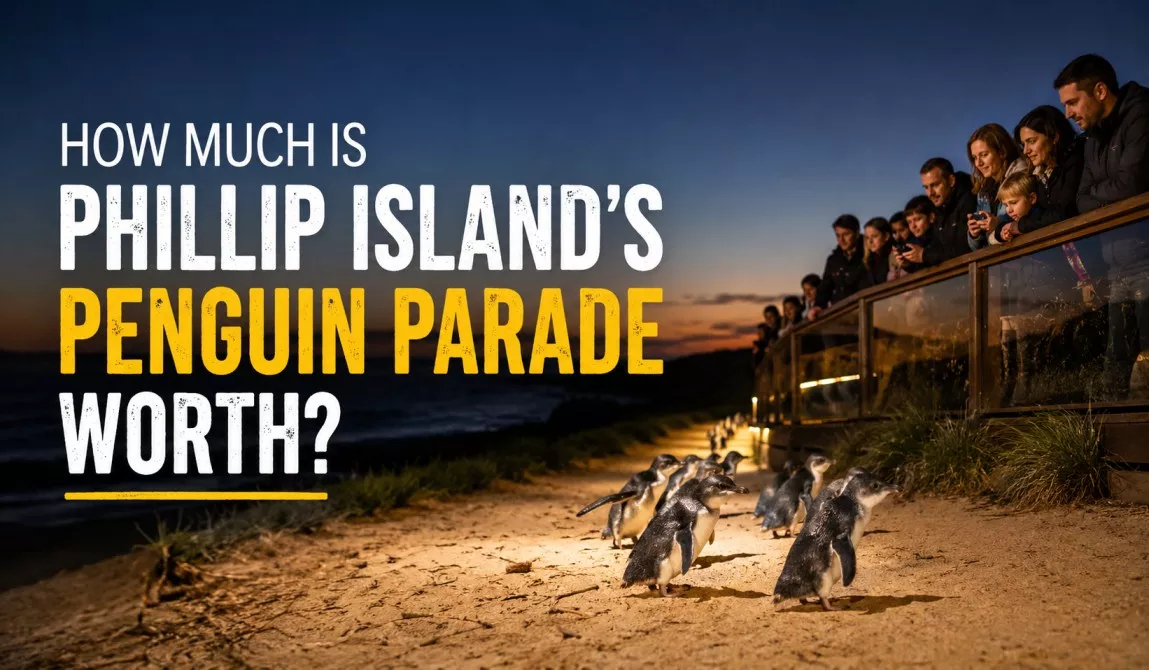
Phillip Island’s Penguin Parade is more than a popular wildlife attraction. It has become a major tourism, conservation, and economic asset for Victoria.
Every evening, little penguins return from the Southern Ocean and cross Summerland Beach to reach their burrows. That remarkable spectacle attracts hundreds of thousands of visitors each year. In fact, Phillip Island Nature Parks reports that the Penguin Parade attracts more than 700,000 visitors annually.
So, how much is Phillip Island’s Penguin Parade actually worth?
There is no single official figure that assigns a dollar value to the Penguin Parade alone. However, available visitor, revenue, employment, and tourism data show that its economic value runs into the tens of millions of dollars directly and potentially hundreds of millions of dollars when its wider tourism impact is considered.
Key Takeaways
- The Penguin Parade welcomed 709,673 visitors in 2025, according to Phillip Island Nature Parks.
- Phillip Island Nature Parks generated $31.8 million in revenue from attractions, retail, and catering in 2024–25.
- Nature Parks says its attractions and ecotourism activities support 2,600 Victorian jobs and contribute more than $600 million in direct and indirect spending across Victoria each year.
- The organisation invested $5.2 million in conservation and research during 2024–25, using tourism-generated revenue to support wildlife and environmental programs.
- General admission prices for the Penguin Parade ranged from $33 for adults and $16.50 for children for the 2025–26 pricing period, while premium experiences cost more.
What Is the Penguin Parade Worth Financially?
The most important point is that the Penguin Parade does not operate as a standalone business with a publicly stated market valuation.
Phillip Island Nature Parks manages several attractions, including the Penguin Parade, Koala Conservation Reserve, and Churchill Island. Therefore, its reported revenue covers multiple activities rather than Penguin Parade ticket sales alone.
Still, the numbers provide a useful picture.
In the 2024–25 financial year, attraction revenue, retail, and catering generated $31.8 million, representing a 13% increase from the previous year. Revenue excluding government funding reached $32.8 million.
Because the Penguin Parade attracts more than 700,000 people a year, it represents a major part of this tourism model.
However, it would be inaccurate to say that the Penguin Parade alone generates the entire $31.8 million. That figure belongs to the broader Nature Parks operation.
How Many People Visit the Penguin Parade?
Visitor numbers provide one of the clearest indicators of the attraction’s value.
Phillip Island Nature Parks reported 709,673 Penguin Parade visitors in 2025. That figure placed the Penguin Parade well ahead of the Koala Conservation Reserve and Churchill Island in visitor volume during the same period.
The attraction also recorded 131 sell-out nights during the 2024–25 financial year, including a record 52 sell-out nights during the summer holiday period.
That demand matters because the Parade operates every evening. Unlike a once-a-year festival or occasional sporting event, it creates a steady stream of visitors throughout the year.
Moreover, international tourism has become an increasingly important part of that audience. In 2023–24, the Penguin Parade attracted 709,527 visitors, while international visitor numbers rose by 71% from the previous year.
How Much Revenue Can Ticket Sales Generate?
A simple calculation helps explain the scale, although it should not be treated as an official revenue figure.
For the 2025–26 pricing period, general viewing cost $33 for adults and $16.50 for children. Premium products such as Penguins Premium, Underground Viewing, and guided tours cost substantially more.
Suppose 709,673 visitors paid the adult general-viewing price of $33. That hypothetical calculation would produce about $23.4 million in gross ticket sales.
However, real revenue would differ because the audience includes children, families, locals with discounted access, premium-ticket customers, guided-tour guests, and other ticket categories.
Therefore, the calculation demonstrates scale rather than providing an official Penguin Parade revenue number.
A Simple Revenue Illustration
| Scenario | Approximate gross ticket value |
|---|---|
| 709,673 visitors × $33 | $23.4 million |
| 709,673 visitors × $50 average spend | $35.5 million |
| 709,673 visitors × $75 average spend | $53.2 million |
These figures are illustrative only. They do not represent official reported Penguin Parade revenue.
The important takeaway is that even modest average visitor spending can produce a very large annual economic footprint.
The Penguin Parade’s Wider Economic Value
Ticket sales tell only part of the story.
Visitors who travel to Phillip Island may also pay for hotels, holiday rentals, restaurants, cafes, petrol, attractions, tours, shopping, and transportation.
That spending spreads beyond the Penguin Parade itself.
Phillip Island Nature Parks says its ecotourism operations support 2,600 Victorian jobs and contribute more than $600 million in direct and indirect spending within Victoria annually.
This figure covers the wider Nature Parks contribution, not the Penguin Parade alone. Nevertheless, the Parade plays a central role because it remains one of Phillip Island’s biggest paid attractions.
The attraction also helps motivate visitors to stay longer. A traveler who comes specifically for the penguins may add beaches, wildlife experiences, restaurants, and overnight accommodation to the trip.
As a result, one Penguin Parade ticket can generate spending several times larger than its face value.
Why the Penguin Parade Matters to Phillip Island
The Penguin Parade has become a tourism anchor for the island.
For many visitors, seeing little penguins return to shore represents the highlight of a Phillip Island trip. That reputation benefits nearby businesses as well.
Accommodation providers can attract overnight visitors. Restaurants benefit from evening traffic. Tour operators can build packages around the Parade. Retail businesses can capture additional visitor spending.
Consequently, the Penguin Parade creates value far beyond the ticket counter.
Phillip Island Nature Parks also reports that its broader attractions passed the one-million paid visitor mark in 2024–25, highlighting the island’s growing nature-tourism market.
The Conservation Value Makes It Different
Economic value becomes even more interesting when conservation enters the picture.
Unlike a conventional entertainment venue, the Penguin Parade helps fund environmental protection.
Phillip Island Nature Parks reported that it invested $5.2 million in conservation and research during 2024–25.
That investment supports work connected to wildlife, habitat management, research, environmental protection, and public education.
The Nature Parks uses revenue from ecotourism activities to support conservation and public assets.
Therefore, the economic value of the Penguin Parade cannot be measured only by profit.
Its business model creates a cycle:
Visitors → tourism revenue → conservation investment → wildlife protection → stronger visitor experience → continued tourism demand
That cycle gives the attraction a value that extends beyond ordinary commercial returns.
How Infrastructure Investment Protects Its Future
A successful tourist attraction still needs investment.
The Penguin Parade has undergone major upgrades because aging infrastructure, accessibility issues, and coastal erosion could threaten the long-term visitor experience.
The Victorian Government provided $5 million through the Regional Tourism Investment Fund for improvements, including the Shearwater Boardwalk and upgraded viewing facilities.
The upgrades increased accessibility, improved visitor flow, and added seating.
In addition, Stage 3 of the Penguin Parade redevelopment is now underway. The project includes new amenities, viewing areas, and a return boardwalk to the visitor centre, with construction phases extending into 2027.
These investments matter because the value of an attraction depends partly on its ability to remain safe, accessible, and attractive to future visitors.
Why Premium Experiences Increase Its Value
The Penguin Parade has also expanded beyond basic general admission.
Visitors can choose higher-priced experiences such as Penguins Premium, Penguins Plus, Underground Viewing, and guided tours. The 2025–26 pricing guide listed options ranging from general admission to premium experiences costing more than $100 per person.
This approach allows the Nature Parks to increase average visitor spending without simply raising the base admission price for everyone.
At the same time, premium viewing experiences can encourage visitors to spend more on the attraction itself.
That creates another potential revenue stream for conservation and infrastructure.
Is the Penguin Parade Worth Hundreds of Millions?
This question needs a careful answer.
The Penguin Parade itself does not have a publicly disclosed valuation of hundreds of millions of dollars.
However, the broader ecotourism network connected to Phillip Island Nature Parks has a much larger economic footprint.
Nature Parks estimates more than $600 million in direct and indirect spending across Victoria annually and says its operations support 2,600 jobs.
That does not mean someone could sell the Penguin Parade for $600 million.
Instead, it shows the attraction’s broader economic influence.
In practical terms, the Parade functions as an economic engine that attracts visitors and encourages them to spend elsewhere across the region.
What About the Penguins Themselves?
There is also a deeper environmental value that economists cannot fully capture through ticket revenue.
Phillip Island supports one of the world’s largest little penguin colonies. The Nature Parks currently describes the island as home to the world’s largest colony of little penguins, while recent estimates have placed the population at around 37,000 to 40,000 birds depending on the survey period and area measured.
These penguins have ecological, educational, cultural, and scientific importance.
Their value therefore goes beyond what visitors pay to watch them.
Protecting the colony also protects the long-term foundation of the tourism experience.
A Major 2026 Issue: Bird Flu
As of August 2026, the Penguin Parade also faces a new wildlife-management challenge.
Victoria has reported H5 bird flu detections in wild birds on Phillip Island. However, Agriculture Victoria stated on August 12, 2026, that there had been no detections in little penguins anywhere in Australia, while authorities continued monitoring the population.
Victoria has also begun preparations to vaccinate thousands of little penguins against H5 bird flu.
Despite the concern, Phillip Island Nature Parks currently says its attractions, reserves, and beaches remain open as usual.
This situation highlights another important part of the Parade’s value: wildlife health directly affects tourism sustainability.
What Is the Best Estimate of Its Worth?
Based on the available public data, the safest conclusion looks like this:
Direct attraction value:
The broader Phillip Island Nature Parks operation generated $31.8 million from attractions, retail, and catering in 2024–25, while the Penguin Parade itself attracted more than 700,000 visitors.
Potential ticket-sales scale:
At 2025–26 general adult pricing, 709,673 visits could theoretically represent more than $23 million if every visitor paid the full $33 adult price. Actual revenue will be lower or higher depending on the ticket mix and premium experiences.
Broader economic value:
Phillip Island Nature Parks estimates more than $600 million in direct and indirect spending across Victoria annually, along with support for approximately 2,600 Victorian jobs.
Conservation value:
The Nature Parks invested $5.2 million in conservation and research in 2024–25, showing that tourism revenue also supports environmental outcomes.
Therefore, a reasonable description is that the Penguin Parade represents a tens-of-millions-of-dollars tourism asset directly, while its wider economic and conservation influence reaches far beyond its ticket revenue.
Frequently Asked Questions
How much money does the Phillip Island Penguin Parade make?
There is no separate publicly reported figure for Penguin Parade revenue alone. Phillip Island Nature Parks reported $31.8 million in 2024–25 revenue from attractions, retail, and catering across its operations.
How many people visit the Penguin Parade each year?
Phillip Island Nature Parks reported 709,673 Penguin Parade visitors in 2025. The organisation also states that the attraction attracts more than 700,000 visitors annually.
How much does it cost to see the Phillip Island penguins?
For the 2025–26 pricing period, general viewing cost $33 for adults and $16.50 for children. Premium and guided experiences cost more.
Is the Penguin Parade profitable?
The Penguin Parade forms part of Phillip Island Nature Parks, so public financial reports do not provide a standalone profit figure. In 2024–25, the broader Nature Parks organisation recorded a $1.7 million net loss, partly because of higher depreciation associated with the Nobbies Centre.
How much does Phillip Island benefit from the penguins?
The Penguin Parade drives substantial visitor activity, while Phillip Island Nature Parks reports more than $600 million in direct and indirect annual spending across Victoria from its operations and support for 2,600 Victorian jobs.
Are the Phillip Island penguins currently safe from bird flu?
As of August 12, 2026, Agriculture Victoria said there had been no H5 bird flu detections in little penguins anywhere in Australia, although authorities continue surveillance and vaccination efforts.
Final Verdict: The Penguin Parade Is Worth Far More Than Its Ticket Price
Phillip Island’s Penguin Parade is difficult to value like a normal business because its impact stretches across tourism, employment, conservation, infrastructure, and regional spending.
The latest data show a powerful attraction with more than 700,000 annual visitors, strong sell-out demand, tens of millions of dollars in broader Nature Parks revenue, thousands of supported jobs, and millions of dollars invested in conservation.
So, how much is Phillip Island’s Penguin Parade worth?
A precise standalone market value is not publicly available. But its direct tourism value clearly reaches the tens of millions of dollars, while its wider economic and conservation contribution makes it one of Victoria’s most valuable nature-based tourism attractions.
As long as the little penguins remain protected and visitors continue to value the experience, the Penguin Parade should remain a major economic and environmental asset for Phillip Island and Victoria.


