


What’s Missing From Today’s International Travel Apps? My Insights
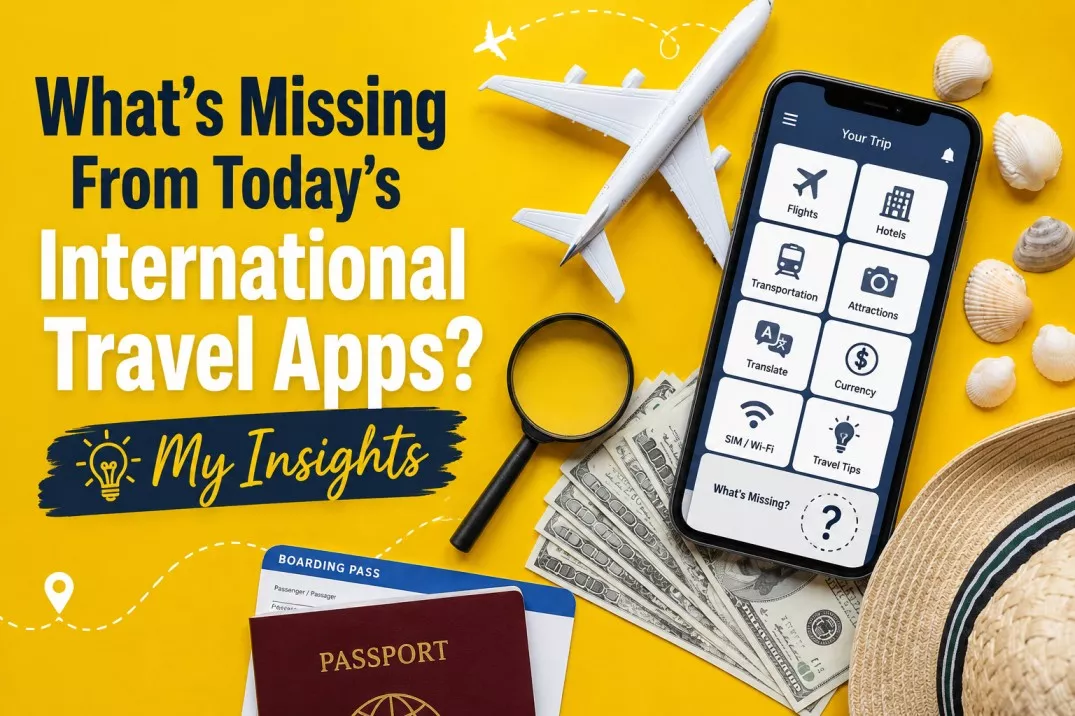
Landing in Lisbon at midnight, I once watched three different travelers stare at their phones with the same confused expression. None of their apps had warned them that the metro stopped running an hour earlier. They could check in for a flight, book a hotel, and translate a menu in seconds. Yet none of their phones could answer the one question that mattered most right then: how do I get to my hotel right now?
That gap, between what travel apps do well and what travelers actually need in the moment, is the subject of this article. I’ve used dozens of these apps across more than twenty countries, first as a backpacker, later as a UX researcher studying how people navigate unfamiliar places.
The pattern repeats everywhere I go. Today’s travel apps are powerful, but they’re also fragmented, reactive, and strangely disconnected from real travel chaos. This isn’t another generic list of “ten travel apps you need.” Instead, I want to walk through what’s actually missing, share a few original travel app ideas, and explain what a smarter generation of travel technology could look like.
What Modern Travel Apps Already Do Well
Before criticizing anything, credit where it’s due. Many of today’s best travel app features have genuinely transformed how we move through the world.
Flight tracking apps now predict delays before airlines officially announce them. Hotel booking platforms compress what used to take hours of phone calls into a two-minute checkout. Navigation apps handle real-time travel navigation well, rerouting around traffic in cities I’d never set foot in before.
Meanwhile, translation tools handle basic phrases well enough to order food or ask for directions. Ride-sharing apps work in dozens of countries with roughly the same interface. A built-in currency converter automatically adjusts as you spend, so expense tracking barely takes any real effort anymore.
These tools solved the planning problem. Booking a trip is genuinely easier than it was a decade ago. But planning isn’t the same as traveling, and that’s exactly where the cracks start to show.
The Biggest Gaps in Today’s International Travel Apps
Once you’re actually on the ground, in an unfamiliar country, with limited data and an unfamiliar language, the gaps become obvious. Here’s what I keep running into, trip after trip.
Context-Aware Offline Assistant
Most offline travel tools stop at maps, and nothing more. Once the data signal drops, so does almost every other feature.
What travelers actually need is different: an assistant that keeps working when the internet doesn’t. It should already know your itinerary, your location history, and your preferences before you ever lose signal. Picture stepping off a rural train in northern Vietnam with zero bars, then still being able to ask “how far to my guesthouse” and getting a real answer.
Country-Specific Emergency Guidance
Ask most travel apps for the local emergency number, and you’ll get silence. Yet this is exactly the kind of information that should appear automatically, based on GPS location. Think emergency numbers, nearby hospitals, the nearest embassy, late-night pharmacies, and the closest police station.
I’ve watched travelers Google “emergency number Thailand” while standing in an actual emergency. That’s a five-minute delay that shouldn’t exist in 2026.
Cultural Etiquette Coach
Tipping customs, greetings, restaurant manners, dress codes, and photography etiquette vary enormously by country. Almost no app addresses them in the moment they actually matter.
Consider tipping: Americans expect it, Japan finds it unusual, and in some contexts it can even feel insulting. A quick, location-aware nudge before you sit down to eat would prevent the awkward pause that happens when you don’t know whether to leave cash on the table.
Real-Time Scam Alerts
Every popular destination has its own local scams. Fake taxis circle the airport, ATM skimmers cluster near tourist strips, “free” bracelets come with a sudden demand for payment, and unmetered cabs overcharge without hesitation.
A crowdsourced, location-based alert system could warn travelers the moment they enter a known hotspot, the same way navigation apps already warn drivers about speed cameras. This data already exists in forums and Facebook groups. Nobody has centralized it anywhere useful yet.
AI Travel Translator With Cultural Context
Every multilingual travel app I’ve tested treats language as a vocabulary problem instead of a cultural one. Literal translation isn’t the same as accurate communication. A phrase that sounds perfectly polite in English can land as blunt, or even rude, once you translate it word-for-word into Japanese, Korean, or German.
The next generation of translation tools needs to flag tone, not just vocabulary. Instead of just translating “give me the bill,” it should explain that a more indirect phrase will land better.
Unified Travel Timeline
Right now, flights live in one app, trains in another, hotel confirmations sit in your email, and restaurant reservations hide in a third platform entirely. No single travel planner pulls them together.
A unified timeline could merge flights, trains, buses, check-ins, attractions, and reservations, then update itself automatically. That alone would finally answer the question every traveler asks at least once a day: what’s next?
Border Crossing Assistant
Cross-border travel often involves more paperwork than people expect, and requirements vary by nationality, destination, and even the specific crossing point. Still, almost no app proactively tells you what documents you’ll need before you arrive.
A genuinely useful border assistant would flag visa reminders, customs regulations, the immigration paperwork you’ll need, entry requirements, and prohibited items. It would surface all of this automatically, based on your passport and your route, well before you’re standing in line.
Local Payment Assistant
Some countries run almost entirely on cash. Others have leapfrogged straight to QR-code payments. Card compatibility, the payment methods each country accepts, and local digital wallets shift constantly, and travelers usually find out the hard way, at the register.
This is solvable. A payment-readiness feature could simply tell you what to expect before you land. For example, it might flag that you’ll need cash for street food in Hanoi, or that your card won’t work at small vendors in rural Argentina.
Live Transportation Disruption Alerts
Strikes, sudden delays, protests, and weather disruptions hit local transportation constantly. Yet most apps only register them after they’ve already ruined someone’s afternoon, and almost none suggest an alternative route once disruption hits.
Imagine getting a push notification an hour before your train strike begins, paired with two backup routes the app has already mapped out for you. That’s a small feature with an outsized impact on stress levels.
Neighborhood Intelligence
Star ratings tell you almost nothing useful about a neighborhood. What travelers actually want to know is whether an area feels quiet, walkable, safe after dark, family-friendly, or full of nightlife.
This kind of nuanced, lived-in detail almost never appears in mainstream travel apps. Yet it shapes where people choose to stay far more than a generic four-star rating ever could.
AI Itinerary Adaptation
Plans change. Weather shifts, attractions close unexpectedly, and trains run late. Still, most itinerary apps remain completely static once you’ve built them, leaving travelers to manually rebuild their day from scratch.
An itinerary that adapts automatically, suggesting a museum instead of a hike when rain rolls in, for instance, would remove an entire category of daily friction.
Universal Digital Document Vault
Passport, visa, travel insurance, hotel bookings, vaccination records, driver’s license: you’ll find these documents scattered across email, photo albums, and random apps. That becomes a real problem the moment you actually need one of them quickly.
A secure, offline-accessible vault that holds everything in one place would solve a genuine anxiety point, especially for travelers heading into regions with unreliable internet.
Common Mistakes International Travelers Make
A few patterns show up again and again, and most of them trace back to these exact app gaps.
Travelers often download translation apps but skip cultural context entirely, then wonder why a literal translation landed awkwardly. Many rely on a single navigation app without ever downloading an offline backup, so a dead zone leaves them stranded.
Others assume their card will work everywhere, only to discover too late that cash is king in that particular city. And almost everyone, at some point, books an activity without first checking whether transport disruptions might affect that day.
Myth vs. Reality: Travel App Edition
Myth: Offline maps mean you have everything you need without internet. Reality: Offline maps show roads. They rarely show real-time transit changes, emergency information, or live alerts.
Myth: Translation apps fully bridge language barriers. Reality: They translate words well but usually miss tone, formality, and cultural nuance.
Myth: More apps mean better trip coverage. Reality: More apps usually mean more fragmentation, since none of them talk to each other.
Features Frequent Travelers Wish Existed
Beyond the major gaps above, frequent travelers I’ve spoken with keep mentioning smaller, more specific wishes:
- A genuine AI travel companion that remembers preferences across trips, not just within one
- A one-tap emergency translator for medical or safety situations, no typing required
- An offline food allergy assistant that explains dietary restrictions in the local language
- Local SIM comparison tools that show coverage and pricing before you land
- Airport terminal navigation that accounts for security wait times, not just gate distance
- Queue prediction for popular attractions, museums, and immigration lines
- Dynamic budgeting that adjusts in real time as local prices shift
- Smart packing updates that respond to sudden weather changes mid-trip
- Local event recommendations based on what’s actually happening that week, not generic listicles
- Traveler networking for solo travelers who want company without using a dating app
How AI Could Transform Future Travel Apps
At its core, every traveler wants the same thing: an AI travel assistant that anticipates problems instead of just answering questions after they’ve already happened. This is where things get genuinely interesting, and also where the industry needs to tread carefully.
Predictive travel assistance could flag a looming transit strike days in advance, based on pattern recognition across news and social signals. Recommendations could finally reflect your actual travel style instead of mimicking whatever’s trending nearby. AI-driven route optimization could factor in weather, crowd levels, and your energy at 4 p.m. on day three of a trip, not just raw distance.
Voice-based assistants matter even more abroad, since typing in an unfamiliar alphabet or keyboard layout slows everyone down. Smart safety monitoring could quietly flag unusual deviations from a planned route without feeling invasive. On-device AI, meanwhile, solves the connectivity problem directly, since processing happens locally instead of depending on a signal that might not exist.
Agentic AI trip planning is the next real frontier. Picture an assistant that doesn’t just suggest a backup train but actually books it, with permission, the moment it detects a disruption.
The catch, of course, is privacy. Travelers will only trust this kind of automation if the app keeps their data genuinely private. That means processing location and document details on-device wherever possible, instead of storing them on some distant server indefinitely.
These trends point toward less typing, less searching, and more anticipation. Still, the apps that win this race will be the ones that treat privacy as a feature, not an afterthought.
If I Built an International Travel App
If I were building this from scratch, I wouldn’t start with another booking engine. Instead, I’d start with the moment after booking, when a traveler stands on an unfamiliar street wondering what to do next.
The core would be a single, living timeline that pulls in flights, trains, hotels, and reservations automatically. On top of that, I’d build in a genuine travel safety layer: emergency numbers, embassy contacts, and scam alerts. The app would surface these automatically by location, instead of hiding them inside a settings menu nobody opens.
Then I’d build the cultural layer: etiquette nudges that appear right before you need them, not as a static guide nobody reads in advance. Offline functionality wouldn’t be a secondary feature. It would be the foundation, since the moments travelers need help most are usually the moments with the least connectivity.
Finally, I’d keep the AI assistant quiet by default, surfacing only when something actually changes, rather than constantly pushing notifications that train people to ignore it.
Key Lessons for Travel App Developers
Travelers don’t need another booking platform. They need a trusted companion that works before, during, and after the journey, not just at the moment of purchase.
Build for the offline moment first, since that’s when travelers decide whether to trust you. Treat safety information as a default feature, not a premium add-on. Respect privacy from day one, because location and document data are the most sensitive things a travel app will ever touch.
Above all, design for the traveler standing confused on a street corner, not the one comfortably planning from their couch back home.
Future Trends in Travel Technology
Travelers can expect agentic assistants that automatically handle flight changes, hotel rebookings, and itinerary adjustments. On-device AI will reduce dependence on internet connectivity while enabling faster, more reliable travel assistance and smarter safety features that evolve from reactive alerts to genuinely predictive warnings.
At the same time, privacy-first design will become increasingly important as travelers grow more cautious about apps that continuously track their movements.
Conclusion
The biggest gaps in today’s international travel apps aren’t really about missing buttons or features. Instead, they’re about a mismatch: apps optimize heavily for the planning phase, while travelers actually struggle most with the in-the-moment chaos of being somewhere new.
The next generation of travel apps will likely focus less on booking. Instead, expect more emphasis on reducing uncertainty, improving safety, respecting local customs, and offering genuinely personalized assistance throughout the entire journey, not just before it begins.
AI is moving further on-device, and agentic assistants are becoming trustworthy enough to act on a traveler’s behalf. As that shift continues, the apps that win will feel less like tools and more like a digital travel companion walking beside you.
Key Takeaways
- Today’s travel apps excel at booking and planning but largely fail once a traveler reaches the ground
- Offline functionality, emergency guidance, and cultural context remain the biggest unmet needs
- Crowdsourced scam alerts and neighborhood intelligence could prevent common traveler frustrations
- AI’s biggest opportunity lies in agentic, on-device assistance that respects privacy
- Developers should prioritize the in-the-moment traveler over the at-home planner
Current Travel Apps vs. Missing Features
| Current Travel Apps Offer | What’s Still Missing |
|---|---|
| Flight and hotel booking | A unified, automatically updated travel timeline |
| Basic offline maps | A context-aware offline assistant |
| Literal translation | Culturally aware translation that flags tone |
| Generic star ratings | Neighborhood-level safety and vibe data |
| Static itineraries | Real-time AI itinerary adaptation |
| Manual document storage | A secure, offline-accessible document vault |
| Reactive transit updates | Predictive disruption alerts with alternatives |
Frequently Asked Questions
What is missing from today’s travel apps?
Most apps handle booking well but fall short on in-the-moment needs, including offline assistance, emergency guidance, cultural context, and real-time scam alerts.
Which travel app features are most useful abroad?
Offline maps, currency conversion, and translation remain essential. That said, emergency guidance and local payment information matter just as much once you’ve actually landed.
Can AI replace travel guides?
Not entirely. AI can personalize recommendations and adapt plans in real time, but local guides still offer judgment and nuance that algorithms struggle to replicate.
What features should every travel app include?
At minimum, every travel app should include offline functionality, location-based emergency information, and some form of cultural context, not just literal translation.
How can travel apps improve traveler safety?
By surfacing emergency numbers, embassy locations, and crowdsourced scam alerts automatically, based on GPS, instead of requiring travelers to search for them manually.
Why do travelers still need multiple apps?
Because no single app currently merges booking, navigation, translation, safety, and document storage into one coherent experience.
What are the biggest frustrations with travel apps?
Fragmentation tops the list. Right behind it: features that stop working the moment data access disappears.
How will AI change travel apps?
Expect more predictive, agentic assistance: apps that anticipate disruptions and act on them, rather than simply reporting what already happened.
What makes a great international travel app?
One that works offline, respects local culture, prioritizes safety, and adapts automatically when plans inevitably change.
What should travel startups build next?
A genuinely unified travel companion, rather than another isolated booking tool competing in an already crowded space.
Is offline functionality really that important?
Yes. Many of the most stressful travel moments, including missed connections, emergencies, and getting lost, happen exactly when data access is unreliable.
Do digital nomads need different features than tourists?
Often, yes. Digital nomads tend to care more about SIM comparisons, reliable connectivity data, and longer-term local intelligence than quick-hit tourist features.


