


HubSpot’s New AEO Tool: My Experience, Insights, and SEO Impact
When organic traffic numbers started sliding — and I mean consistently, not just a bad month — I knew something structural had changed. Our content hadn’t gotten worse. Our technical SEO was solid. But buyers were finding answers somewhere else before they ever reached us.
That “somewhere else” turned out to be ChatGPT, Perplexity, and Gemini. And HubSpot’s new AEO tool is the first platform I’ve used that actually tries to measure — and influence — what happens in that invisible layer.
I’ve been testing HubSpot AEO since shortly after its April 14, 2026 Spring Spotlight launch. This article is my honest, experience-based breakdown: what the tool does well, where it struggles, what it taught me about AI search, and whether it belongs in your marketing stack.
What Is HubSpot’s AEO Tool, and Why Does It Exist?
Answer Engine Optimization — AEO — is the practice of optimizing content so your brand appears inside AI-generated answers, not just traditional search results. When someone types a question into ChatGPT, Gemini, or Perplexity, those platforms synthesize information from multiple sources and deliver a direct response. Your brand either shows up in that response, or it doesn’t. There’s no page two.
HubSpot’s AEO tool was built specifically to track and improve that visibility. It came out of HubSpot’s October 2025 acquisition of XFunnel, a young Israeli startup that had built monitoring infrastructure for AI answer engines. HubSpot describes the resulting product as “XFunnel 2.0” — essentially the core monitoring engine rebuilt inside HubSpot’s CRM ecosystem with the advantage of actual customer and competitor data baked in.
The timing is hard to argue with. HubSpot’s own internal data shows that organic traffic for its customers fell 27% year-over-year. Meanwhile, AI-referred sessions grew by more than 500% in the same period. That’s still a small percentage of total traffic, but the trajectory is obvious and the conversion quality is reportedly far higher. HubSpot’s internal teams say AI-sourced leads convert three times better than traditional search traffic — which is consistent with the broader shift toward longer, more intent-rich prompts in AI search versus the 3-word queries typical on Google.
Traditional SEO vs. AEO: What’s Actually Different
I want to be precise here, because the “SEO is dead” narrative is both tired and wrong.
| Dimension | Traditional SEO | AEO |
|---|---|---|
| Goal | Rank in blue-link results | Appear in AI-generated answers |
| Primary signal | Backlinks, on-page relevance, authority | Topical authority, entity clarity, citation trust |
| Traffic mechanism | Clicks to your website | Brand mentions and citations in AI responses |
| Measurement | Rankings, organic sessions | Visibility score, share of voice, sentiment |
| Content format | Optimized pages and posts | Answer-first, structured, expert-sourced content |
| Tools | Semrush, Ahrefs, Search Console | HubSpot AEO, Profound, custom LLM monitoring |
SEO and AEO are complementary, not competing. Strong SEO signals — expertise, authoritativeness, trustworthiness — translate directly into better AI citation likelihood. Technical SEO keeps your content crawlable and indexable, which is still how most AI training data gets sourced. What AEO adds is a monitoring and optimization layer specifically for the AI response surface.
My First Impression of the Tool
Setup took less than 20 minutes for an existing HubSpot Marketing Hub user. If you’re coming in as a standalone customer (the tool is $50/month without a full HubSpot subscription), onboarding asks you to describe your business, your competitors, and your target customers. From there, it generates initial prompt suggestions — and this is the first thing that genuinely surprised me.
Most AEO tools I’ve evaluated start with broad, generic category prompts: “what is the best [category] software?” HubSpot’s tool, because it has access to your CRM data, suggests prompts grounded in your actual buyer segments. If your CRM shows that a significant portion of your pipeline comes from mid-market operations teams, you’ll see prompts reflecting that context. It’s not perfect — the suggestions still need curation — but the starting point is meaningfully more relevant than a blank template.
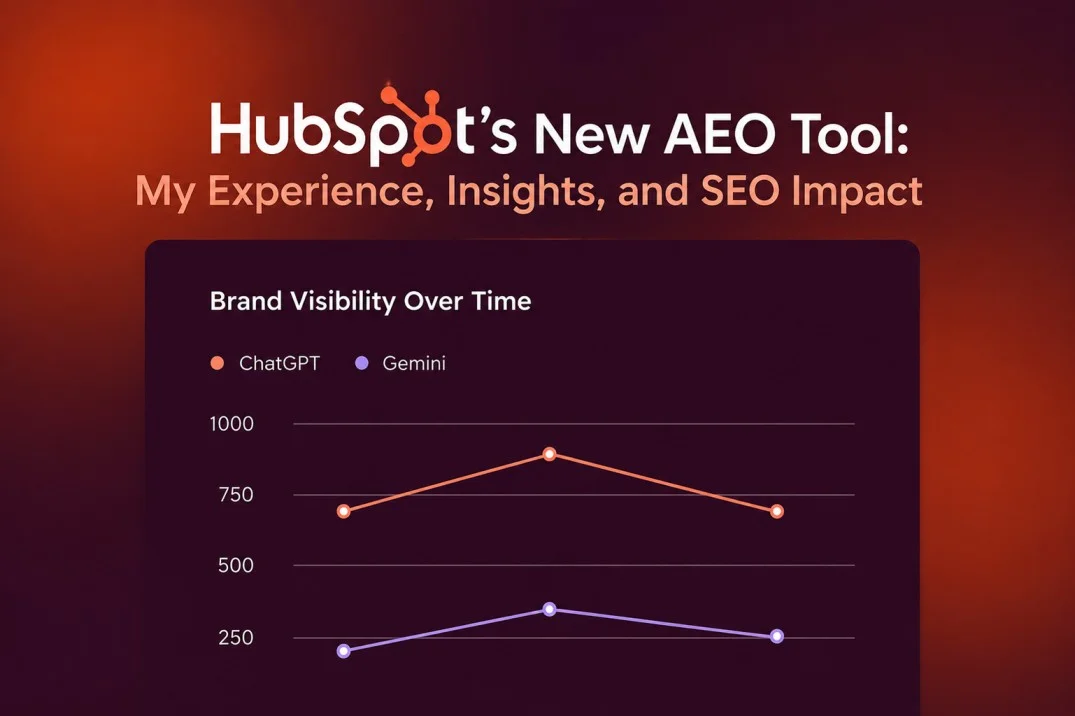
The main dashboard surfaces four things: a brand visibility score, trend tracking, sentiment analysis, and competitive share of voice. The visibility score is simple: what percentage of your tracked prompts include your brand in the AI-generated answer. If you’re tracking 25 prompts and you appear in 18 responses, your score is 72%. It’s an imperfect metric, but it gives you something concrete to move.
What I didn’t expect was how confronting the competitor data would be. Seeing that a competitor was mentioned in AI answers at twice my brand’s rate — across multiple tracked prompts — was useful in a way that keyword gap analysis rarely is. It made the problem tangible.
Features I Tested Personally
AI Visibility Score and Trend Tracking
The visibility score is your north star metric inside the tool. The trend view shows week-over-week movement across ChatGPT, Gemini, and Perplexity separately, which matters more than a blended average. I noticed almost immediately that our visibility on Perplexity was notably stronger than on ChatGPT — a pattern that turned out to reflect differences in how our content was structured versus how those models weight citation sources.
Who benefits most: Anyone with content marketing investment who needs to justify or measure its impact beyond traditional traffic metrics.
Limitation: The tool only tracks the three engines it monitors. Google AI Overviews — arguably the highest-volume AI surface for most brands — is absent. Claude is also missing. For B2B brands whose audiences skew toward business professionals using Claude for research, this is a genuine gap.
CRM-Powered Prompt Suggestions
This is where HubSpot’s ownership of your customer data pays off. The tool analyzes your CRM records, deal history, customer segments, and competitor intelligence to suggest the prompts your buyers are actually likely to use in AI search. You’re not guessing from a keyword planner — you’re working from your own pipeline data.
Practical experience: About 60% of the suggestions were immediately usable. The other 40% needed modification, either because they were too generic or reflected customer segments that weren’t our core focus. I’d recommend reviewing and curating these carefully before tracking them — your visibility score is only as meaningful as the quality of the prompts you choose to measure.
Limitation: The AI can’t directly observe what prompts real users are entering into LLMs — nobody can, because those queries aren’t exposed. The suggestions are intelligent estimates, not verified search volume data.
Citation Monitoring and Source Analysis
This feature tracks which sources AI platforms are citing when they mention your brand or answer prompts in your topic area. It’s one of the most strategically useful features in the tool because it shows you where your authority gaps are.
In practice, I discovered that several of our best-trafficked blog posts were not being cited in AI answers, while older, more detailed technical guides were cited regularly. The pattern pointed clearly to content depth and specificity as a citation driver — which directly shaped how I prioritized our content calendar.
Limitation: Citation tracking has coverage gaps. Perplexity tends to show citations more explicitly than ChatGPT, which often synthesizes without attributing sources. This makes citation monitoring inherently incomplete, and you should treat it as directional rather than definitive.
Competitor Visibility Benchmarking
Share of voice metrics show how often your brand appears in AI answers compared to named competitors across your tracked prompt set. This is useful for quarterly reviews and for understanding category positioning in AI search.
I found this feature most valuable as a strategic conversation starter — less about day-to-day optimization and more about long-term category leadership in AI search. If a competitor is consistently dominating AI answers in a specific topical area, that’s a signal about their content depth, not just their promotional activity.
Content Recommendations and Optimization Suggestions
Based on your visibility gaps and citation patterns, the tool surfaces recommendations for what to create or update. These range from “write a comprehensive comparison page covering X and Y” to “add a structured FAQ section to your existing guide on Z.”
The recommendations are generally sound, but they’re not magic. They reflect the same logic a thoughtful content strategist would apply after reviewing the same data. The tool’s value here is speed and systematization — it surfaces these gaps faster than manual analysis would.
How This Tool Changed How I Think About SEO Strategy
Here’s the honest shift this experience produced: I started thinking less about keyword ranking positions and more about topical authority as a whole entity.
AI models don’t just reference your latest well-optimized post. They build a picture of what your brand is genuinely expert in, based on the depth, consistency, and quality of your content across a topic. A brand that has produced ten shallow blog posts about a topic will lose to a brand that has produced three deeply researched, well-structured pieces — even if the shallow posts rank higher in traditional search.
Why AEO Doesn’t Replace Technical SEO
I want to be explicit about this because I’ve seen some overreach in how AEO is being positioned: you cannot ignore technical SEO and win at AEO.
AI models primarily learn from content they can crawl and index. Broken canonicals, slow page speed, crawl errors, and thin site architecture all degrade your content’s ability to be surfaced in AI training and retrieval. Fixing Core Web Vitals still matters. Proper schema markup still matters — possibly more, because it gives AI systems explicit semantic context for your content.
The relationship looks like this:
- Technical SEO = making sure your content is accessible and readable
- Traditional on-page SEO = ensuring relevance and crawl priority
- E-E-A-T signals = building trust signals that AI systems can evaluate
- AEO-specific work = structuring content for extraction and monitoring where you land
Each layer depends on the ones below it.
Entity-Based Optimization and Semantic Clarity
One insight that crystallized for me during this process: AI models understand content through entities and relationships, not keyword density. A piece of content that clearly establishes who you are, what you do, who you serve, what problems you solve, and how you’re different — using natural, specific language — performs better in AI answers than a piece that mentions a target keyword seventeen times.
This aligns with the broader shift in Google’s own ranking systems and makes E-E-A-T more important, not less. First-hand experience, demonstrable expertise, real credentials, and genuine trust signals all contribute to how AI systems evaluate the authority of a citation source.
What I Liked Most
The CRM integration changes the starting point. Most AEO tools hand you a blank slate and ask you to guess which prompts matter. HubSpot uses your actual customer data to give you a more informed starting point. For existing HubSpot users, this is a genuine competitive advantage over standalone tools.
Trend data creates accountability. Having a weekly visibility score to report on has made AI search performance a real agenda item in our marketing reviews, not a theoretical concern. That behavioral shift has value even beyond the tool’s direct optimization features.
Citation source analysis reframes the content strategy conversation. Understanding which of your content is being cited — and which isn’t — is more actionable than almost any other content audit I’ve done. It forces honest conversations about quality versus volume.
The competitive share of voice view. Seeing where you’re winning and losing in AI search, by competitor, across specific topic areas, is the kind of strategic visibility that used to require expensive custom research or manual testing.
Pricing accessibility. $50/month as a standalone product lowers the barrier to entry meaningfully. The 28-day free trial with no credit card required makes it easy to evaluate before committing.
What Could Be Improved
Google AI Overviews is the glaring omission. For most businesses, Google AI Overviews — which are embedded directly in standard Google search results — represent the highest-volume AI answer surface they need to influence. HubSpot AEO doesn’t track it. This isn’t a minor gap.
Claude is absent. For professional and B2B audiences, Claude is a primary AI assistant. Not tracking it means blind spots for companies whose buyers skew toward that platform.
Prompt tracking is still an estimation game. Because LLMs don’t expose actual user query data, the prompts you track are intelligent guesses at what buyers are searching. The tool is transparent about this, but it means your visibility score measures performance on estimated prompts, not verified queries.
Citation tracking is incomplete by design. ChatGPT in particular often synthesizes without showing explicit sources. This means citation monitoring is necessarily partial — useful as a directional signal but not as a complete audit.
The learning curve for AEO as a discipline is steeper than for traditional SEO. The tool itself is fairly intuitive, but the underlying strategic concepts — topical authority, entity consistency, AI citation dynamics — are newer. Teams without a strong content strategy foundation may struggle to act on the recommendations effectively.
Volatility in AI answers is real. AI models update, retrain, and shift their response patterns in ways that aren’t always visible or predictable. A visibility score that moves 15 points in a week might reflect a model update rather than your content performance.
Real SEO Insights After Using This Tool
After several weeks of active use, here are the patterns I’ve found most meaningful:
Depth beats breadth in AI citation. Long-form, comprehensive content on a specific topic consistently outperformed shorter posts in citation frequency. This isn’t about word count for its own sake — it’s about genuinely covering a topic from multiple angles, addressing follow-up questions, and demonstrating real expertise.
Conversational structure helps. Content that mirrored how someone might naturally ask a question — including explicit Q&A sections, FAQ structures, and direct answers before longer explanation — performed better across AI surfaces. This isn’t surprising in retrospect; AI systems are essentially pattern-matching to find the most direct answer to a query.
Generic AI-generated content is already struggling. This one matters a lot: content that was produced at scale using AI generation without meaningful human editing and expertise layering showed notably weaker citation performance. AI models appear to have some ability to detect and downweight thin, formulaic content. This is exactly the direction Google has been signaling with its helpful content approach, and it applies equally in AI answer contexts.
Authority signals compound. Brands that already had strong E-E-A-T signals — verified author bios, institutional credibility, external citations, original research — saw higher baseline visibility scores than brands of similar content volume without those signals. Trust infrastructure built for traditional SEO carries over directly.
FAQs are working harder than I expected. Properly structured FAQ sections — answering specific, specific questions that real buyers ask — were among the most cited content types in our analysis. This reinforces the value of schema markup (FAQ schema specifically) as a way of surfacing these sections to AI crawlers.
AEO Best Practices I’d Recommend
These are the practices that have produced the most consistent results in my experience. I want to be direct about one thing first: there are no reliable “AEO hacks.” Excessive content chunking tactics, prompt injection attempts, and shortcut strategies produce inconsistent results at best and can undermine brand trust at worst. Long-term AEO performance comes from genuine authority, not manipulation.
Build Real Topical Depth
Pick the topic clusters that matter most to your business and go deeper than your competitors are willing to go. Not just a pillar page and cluster posts — but comprehensive coverage that addresses expert-level questions, edge cases, common misconceptions, and nuanced distinctions. AI models cite sources that demonstrate genuine command of a subject.
Write People-First Content, Then Optimize for Extraction
Start with your reader. Answer their actual question as clearly as possible. Then apply structural optimization: clear headings, direct answer-first paragraphs, FAQ sections, comparison tables. The optimization layer should serve clarity, not replace it.
Establish Entity Clarity Across Your Content
Make it clear who you are, what you do, and how you’re different — consistently, across your entire content footprint. AI models build entity understanding from patterns across multiple documents. Inconsistent positioning, vague author attribution, and unclear organizational identity create fuzzy entity signals.
Use Schema Markup Strategically
FAQ schema, Article schema with author markup, HowTo schema where applicable, Organization schema, and Product schema all help AI systems parse your content accurately. This is one of the clearest bridges between traditional technical SEO and AEO.
Strengthen E-E-A-T Signals Explicitly
- Add verified author bios with genuine credentials
- Include original data, research, or firsthand experience
- Earn external citations from authoritative sources
- Maintain factual accuracy and update content regularly
Optimize Internal Linking for Topical Coherence
AI systems don’t just evaluate individual pages — they assess topical authority at the site level. A strong internal linking architecture that connects your content within topic clusters reinforces your authority signals. This is old-school SEO wisdom that has renewed relevance in an AEO context.
Monitor and Adjust Regularly
AI answer patterns shift. Run your prompt tracking at least monthly, review which content is being cited, identify gaps, and iterate. The brands winning at AEO are the ones treating it as an ongoing discipline rather than a one-time audit.
The Future of AEO and AI Search
I want to be realistic here rather than speculative.
AI Overviews are mainstream, not experimental. Google’s AI Overview feature is now a standard part of search for hundreds of millions of queries. For most businesses, this is the most important AI answer surface to influence, and it’s the one that connects most directly to traditional SEO authority signals.
AI agents are changing the discovery layer. Browser-integrated AI agents — which can research, compare, and recommend products or services autonomously — represent a meaningful shift in how buyers interact with information. These agents pull from structured data, authoritative content, and trusted sources. The brands with strong topical authority and clear entity profiles will have a structural advantage.
Conversational search is raising the quality bar. The average prompt in a conversational AI interface is much longer and more specific than a traditional search query. Buyers are arriving at AI answers after more deliberate, context-rich research. This means the content that earns citations needs to meet a higher specificity bar than traditional SEO content.
Personalization is increasing. AI search results are increasingly personalized based on prior interactions, stated preferences, and inferred context. This makes universal “ranking” less meaningful and brand-level authority more important. A trusted, well-established brand in a category will appear in personalized responses more consistently than an algorithmically optimized but unfamiliar one.
SEO and AEO will converge into a unified discipline. The underlying signals — expertise, trust, authority, clear entity definition, high-quality content — are the same. The monitoring tools and content tactics differ. But teams that treat SEO and AEO as separate programs will be less efficient than those who build an integrated approach.
FAQ
What is HubSpot’s AEO tool?
HubSpot AEO is an Answer Engine Optimization platform launched on April 14, 2026, built on HubSpot’s acquisition of XFunnel. It tracks how your brand appears in AI-generated answers across ChatGPT, Gemini, and Perplexity, measures sentiment and share of voice against competitors, and delivers prioritized recommendations for improving your AI search visibility. It’s available as a standalone product for $50/month or included with Marketing Hub Pro and Enterprise plans.
Is AEO replacing SEO?
No — and this framing is actively misleading. AEO and SEO address different but related surfaces. SEO drives visibility in traditional search results; AEO shapes how AI platforms represent your brand when buyers skip those results entirely. Strong SEO foundations — technical health, topical authority, E-E-A-T signals — directly support AEO performance. Teams that abandon SEO for AEO are making a strategic mistake.
How does AI search optimization work?
AI systems learn from vast amounts of content and, when generating answers, synthesize information from sources they’ve indexed or retrieved. Optimizing for AI search means becoming one of those trusted, citable sources: building deep topical authority, structuring content for clear extraction, maintaining strong E-E-A-T signals, and ensuring your content is technically accessible and semantically clear.
Does HubSpot’s AEO tool track AI citations?
Yes, though with important limitations. The tool tracks citation sources visible in AI-generated responses, which is most reliable in Perplexity, which tends to show explicit citations. ChatGPT often synthesizes without attributing sources, so citation tracking there is inherently partial. Treat citation data as directional signal rather than a complete audit.
What content performs best in AI search?
Based on my experience and broader patterns in the field: comprehensive, expert-driven content that addresses specific questions with genuine depth. Long-form guides, comparison pages with real analysis, FAQ sections with specific questions and direct answers, and original research all perform well. Generic, thin, or highly formulaic content — including bulk AI-generated content without meaningful human expertise layered in — underperforms.
Is AEO worth investing in?
For businesses where content marketing is a primary acquisition channel, yes. The monitoring capability alone has strategic value — understanding how AI platforms represent your brand, and whether they’re representing you accurately and favorably, is important information. The content optimization guidance that flows from that monitoring is actionable. At $50/month, the cost-benefit case is easier to make than for more expensive enterprise AEO platforms.
Can small businesses benefit from AEO?
Yes, and potentially more than large ones. Small businesses with deep expertise in a niche topic can dominate AI citations for specific, high-intent prompts even if they lack the brand authority to compete broadly. The key is focused topical depth: pick the two or three problem areas you genuinely understand better than anyone, and build comprehensive, expert content around them.
How do you optimize content for AI search?
Start with people-first content that genuinely answers real questions. Structure it clearly with direct answers before explanations, meaningful headings, FAQ sections, and comparison formats where applicable. Apply schema markup to help AI systems parse your content accurately. Build internal linking structures that reinforce topical coherence. Maintain strong author attribution and E-E-A-T signals. And monitor regularly — AI answer patterns evolve, and optimization is an ongoing process, not a one-time exercise.
Key Takeaways
- HubSpot AEO launched April 14, 2026, built from the XFunnel acquisition, tracks AI visibility across ChatGPT, Gemini, and Perplexity
- The tool’s standout feature is CRM-powered prompt suggestion — it uses your customer data to suggest relevant prompts, not generic category templates
- Organic traffic is structurally declining (HubSpot’s own data shows 27% YoY drop for its customers); AI-referred traffic is growing fast and converts better
- AEO complements SEO — it does not replace it; strong technical SEO foundations directly support AEO performance
- The biggest tool limitation: Google AI Overviews and Claude are not tracked, creating material blind spots
- Citation tracking is incomplete by design — treat it as directional, not definitive
- The content that wins in AI search is deep, expert-driven, and genuinely helpful; generic or thin content is already underperforming
- FAQs, structured headings, schema markup, and entity clarity are practical tactics that produce measurable results
- At $50/month standalone with a 28-day free trial, the barrier to evaluating this tool is low enough to justify testing it directly
Conclusion
The emergence of AI search as a meaningful buyer discovery channel isn’t a prediction anymore — it’s a present-tense reality that’s showing up in traffic reports across the industry. HubSpot’s AEO tool is a genuinely useful instrument for measuring and influencing that reality, especially for businesses already in the HubSpot ecosystem.
It isn’t perfect. The missing coverage of Google AI Overviews and Claude are real gaps that matter for many audiences. The underlying volatility of AI answer patterns means no tool can give you the same confidence that a stable keyword ranking once provided. And the prompt tracking is, by necessity, an estimation exercise.
But the core value proposition holds: if you don’t know how AI platforms are representing your brand, you’re operating with a significant blind spot. HubSpot AEO gives you visibility into that representation, a competitive benchmark to work against, and a structured path toward improving your AI search presence.
What I’d recommend: start by running the free AEO Grader to get a baseline snapshot across ChatGPT, Gemini, and Perplexity. That snapshot alone will likely surface something worth acting on. Then evaluate whether the ongoing monitoring and optimization features of the full tool are worth the investment for your content program.
And regardless of what tool you use: build better content. More specific. More expert. More genuinely useful. That’s the thing that works in AI search, in traditional search, and in every search environment we’re likely to see in the years ahead.
References:
- HubSpot AEO Product Page — official product details and pricing
- HubSpot Blog: AEO Best Practices — official guidance
- Google Search Central: Understanding E-E-A-T — Google’s helpful content documentation
- Gartner: AI Search Trends Report — enterprise AI adoption data
- Search Engine Land: AEO Coverage — ongoing industry analysis of AI search developments


