


Why Heel Stability Is the Hidden Key to Balance, Comfort & Injury Prevention
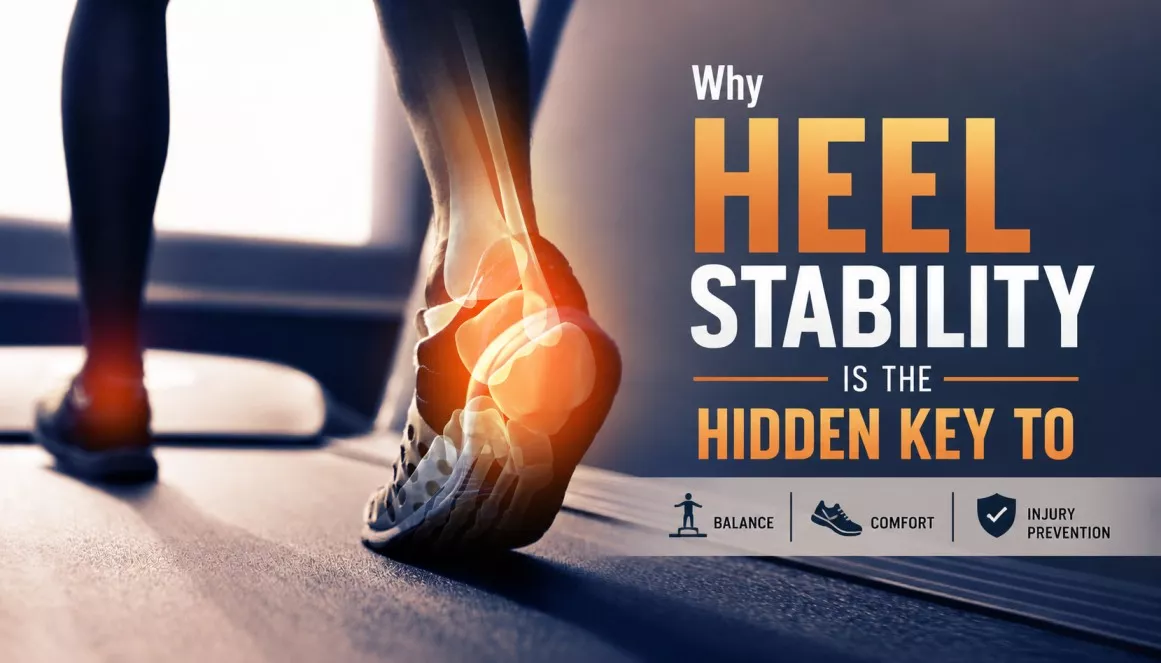
Heel stability is the foundational anchor of human movement, serving as the critical control point that regulates balance, enhances physical comfort, and prevents acute and chronic lower-limb injuries. When your heel strikes the ground, it dictates how forces are distributed upward through your ankles, knees, hips, and spine. If the heel bone—known as the calcaneus—is allowed to wobble, roll excessively, or lack structural support, it triggers a chaotic biomechanical chain reaction that destabilizes your entire posture and forces your muscles to overcompensate. By securing the heel, you stabilize the subtalar joint, flatten the path of your center of pressure, and provide a rigid lever for efficient movement, effectively shielding your body from the kinetic stress that causes falls and overuse injuries.
The House Built on Sand: Understanding the Biomechanical Foundation
To understand why heel stability is so vital, we must first look at the anatomy of a single step. Think of your body as a high-rise building. If the foundation is unstable, the upper floors will sway, crack, and eventually suffer structural failure. In the human body, the heel is that foundation.
The human heel bone, or calcaneus, is the first part of the skeletal system to absorb impact during a standard walking gait cycle. Positioned directly above it is the talus, which connects the foot to the lower leg. Together, they form the subtalar joint (Teixeira, 2015). This joint is responsible for the complex inward and outward tilting motions of the foot, known scientifically as pronation and supination.
       [ Tibia / Fibula (Lower Leg) ]
                     |
                     v
         [ Talus (Ankle Bone) ]
                     |  <--- Subtalar Joint (The Balance Pivot)
                     v
       [ Calcaneus (Heel Bone) ]  ===> Primary Impact Zone
When your foot functions properly, the heel lands with a slight outward tilt, rolls inward slightly to absorb the shock of your body weight, and then locks into a rigid structure to push you forward (Paulus et al., 2023).
However, if your heel lacks stability, this finely tuned process breaks down completely:
- Excessive Pronation: The heel rolls too far inward, causing the internal arch of the foot to collapse. This forces the lower leg to twist inward abnormally.
- Excessive Supination: The heel remains rigid and tilted outward, failing to absorb shock and sending harsh impact forces directly up into the skeleton.
- Micro-Wobbles: Tiny, involuntary shifts of the heel bone require continuous muscular micro-corrections, leading to rapid fatigue and loss of balance.
1. The Key to Balance: Mastering the Center of Pressure
Balance is often thought of as something controlled entirely by the inner ear or the core muscles. While those systems play major roles, they cannot function effectively without clear data and a firm platform at the ground level.
The Role of Proprioception
Your feet are packed with thousands of nerve endings called proprioceptors. These sensors continuously send data to your brain regarding surface texture, slope, and body position. When the heel bone is locked securely in place, these nerve endings can precisely read the environment. If the heel is constantly slipping or shifting inside a shoe, the sensory signals become scrambled, delaying your brain’s reaction time to a slip or trip.
Controlling the Center of Pressure (COP)
Biomechanical research tracks balance by monitoring the Center of Pressure (COP)—the specific point where your body weight concentrates on the ground (Choi & Baek, 2020). During a stable gait cycle, the COP follows a clean, predictable line from the center of the heel, along the outside of the foot, and across the ball of the foot to the big toe.
When heel stability is compromised, the COP fluctuates erratically (Guo et al., 2024). Studies evaluating movement dynamics show that an unstable rearfoot significantly increases lateral postural sway, meaning your body has to exert far more energy just to keep you upright (Choi & Baek, 2020). By locking the heel into a neutral alignment, you stabilize the subtalar joint, which directly helps maintain a centered weight distribution and drastically minimizes the risk of accidental falls (Choi & Baek, 2020).
2. The Comfort Multiplier: Eliminating Muscle Fatigue
Many people assume that foot comfort is entirely about soft, pillowy cushioning. However, excessive, unstable cushioning can actually make your feet ache more by the end of the day.
When you stand or walk on a soft, unstructured surface, the small intrinsic muscles in your feet, along with the larger stabilizing muscles in your lower calves—such as the peroneus longus and tibialis posterior—have to work overtime (Choi & Baek, 2020). They flex and contract continuously to keep the heel bone from rolling out of alignment.
+-------------------------------------------------------------+
|               THE VICIOUS CYCLE OF HEEL INSTABILITY         |
+-------------------------------------------------------------+
|  Unstable Heel Base -> Subtalar Joint Tilts Erratically    |
|  -> Muscle Overcompensation (Peroneus/Tibialis)             |
|  -> Premature Muscle Fatigue & Chronic Foot Strain          |
|  -> Kinetic Realignment Failure (Knee & Hip Pain)           |
+-------------------------------------------------------------+
This phenomenon is known as muscular overcompensation. When a shoe provides a secure heel counter (the rigid cup at the back of the shoe), it acts as an external skeleton for the rearfoot. By physically holding the calcaneus in its optimal vertical alignment, it relieves these stabilizing muscles of their heavy lifting, preventing early-onset fatigue, cramping, and deep aches.
3. The Ultimate Shield Against Injury
An unstable heel is a primary driver behind a vast array of common sports injuries and chronic pain conditions. Because the body functions as an interconnected kinetic chain, an error at the base of the chain creates destructive forces further up.
Plantar Fasciitis
The plantar fascia is a thick band of tissue running along the bottom of your foot, connecting your heel bone to your toes. Its job is to act like a bowstring, maintaining the structural arch of your foot. When the heel rolls inward excessively due to poor stability, it stretches this bowstring past its functional limit (Ribeiro, 2021). Over time, this repetitive stretching causes microscopic tears at the site where the fascia inserts into the heel bone, leading to the sharp, burning morning pain characteristic of plantar fasciitis (Ribeiro, 2021).
Acute Ankle Sprains
Lateral ankle sprains are among the most common musculoskeletal injuries in the world (Guo et al., 2024). They almost always occur when the foot lands on an uneven surface and the heel rolls violently outward, tearing the supportive ligaments on the outside of the ankle. A stabilized heel base acts as an early warning and physical barrier against this rolling motion, keeping the subtalar joint within a safe, functional range of motion (Teixeira, 2015).
The Ascending Kinetic Chain: Knee, Hip, and Back Pain
When your heel rolls inward (pronation), it forces the large shin bone (tibia) to rotate inward along with it. This internal rotation travels straight up into the knee joint. Because the knee is primarily a hinge joint meant to move forward and backward, this twisting force places immense stress on the patellar tendon and the cartilage beneath the kneecap.
If this twisting continues unchecked, the thigh bone (femur) rotates inward as well, pulling the pelvis out of alignment and straining the muscles of the lower back. Protecting your heels can prevent this entire chain reaction from starting.
| Injury Type | The Role of Heel Instability | The Solution Provided by Heel Stability |
| Plantar Fasciitis | Heel tilt causes the foot arch to collapse, overstretching the plantar fascia (Ribeiro, 2021). | Locks the calcaneus in place, protecting the arch from structural collapse (Ribeiro, 2021). |
| Ankle Sprains | The rearfoot wobbles upon landing, causing the ankle to roll past its safe limits (Guo et al., 2024). | Provides lateral support to ensure clean, vertical ground contact (Guo et al., 2024). |
| Knee & Hip Pain | Inward heel roll forces an inward twisting of the tibia and femur bones. | Aligns the entire lower leg, ensuring force travels straight up through the joints. |
Practical Ways to Improve Your Heel Stability
Achieving optimal heel stability does not require medical intervention for most people. Instead, it involves making intentional choices regarding your footwear, daily habits, and physical conditioning.
1. Evaluate the “Heel Counter” of Your Shoes
The next time you purchase shoes, ignore the color and style for a moment and look closely at the back of the shoe. Press your thumb against the very back of the heel cup.
- If the material easily collapses under light pressure, it provides low stability.
- If the heel cup feels firm, rigid, and resistant to squeezing, it offers high stability. This structural rigidity is crucial for keeping your heel centered over the sole of the shoe.
2. Utilize the Runner’s Loop (Heel Lock Lacing)
If you experience your heel slipping up and down or sliding side-to-side inside your athletic shoes, you can modify your lacing pattern. Most running shoes have an extra, seemingly redundant eyelet at the very top. By threading your laces through these holes to create loops on either side, and crossing the opposite lace through those loops, you create a “heel lock” (Tedeschi et al., 2024). This technique cinches the upper material of the shoe securely down over the instep, physically locking your heel back into the protective heel counter (Tedeschi et al., 2024).
3. Incorporate Focused Exercises
You can build intrinsic stability by strengthening the muscles that support the heel and ankle complex (Caparrós-Manosalva, 2025). Try incorporating these two movements into your routine:
- Controlled Bilateral Heel Rises: Stand barefoot with your feet hip-width apart. Slowly raise up onto your toes over a count of three seconds, hold for one second, and lower back down over three seconds (Caparrós-Manosalva, 2025). Focus intensely on ensuring your heels move straight up and down without bowing outward or collapsing inward.
- Single-Leg Balance Training: Practice standing on one foot on a flat floor for 30 to 60 seconds. To advance this exercise, close your eyes or stand on a soft foam pad. You will feel the micro-adjustments occurring across your heel and midfoot as your nervous system learns to stabilize your center of mass.
The Takeaway: True physical comfort and systemic joint protection don’t come from excessive cushioning that mimics walking on pillows. They come from a stable foundation. By prioritizing footwear and movements that secure your heel, you protect your body’s kinetic chain from the ground up, unlocking effortless balance and long-term joint health.


