


What Makes San Francisco’s Climate Worth Moving For?
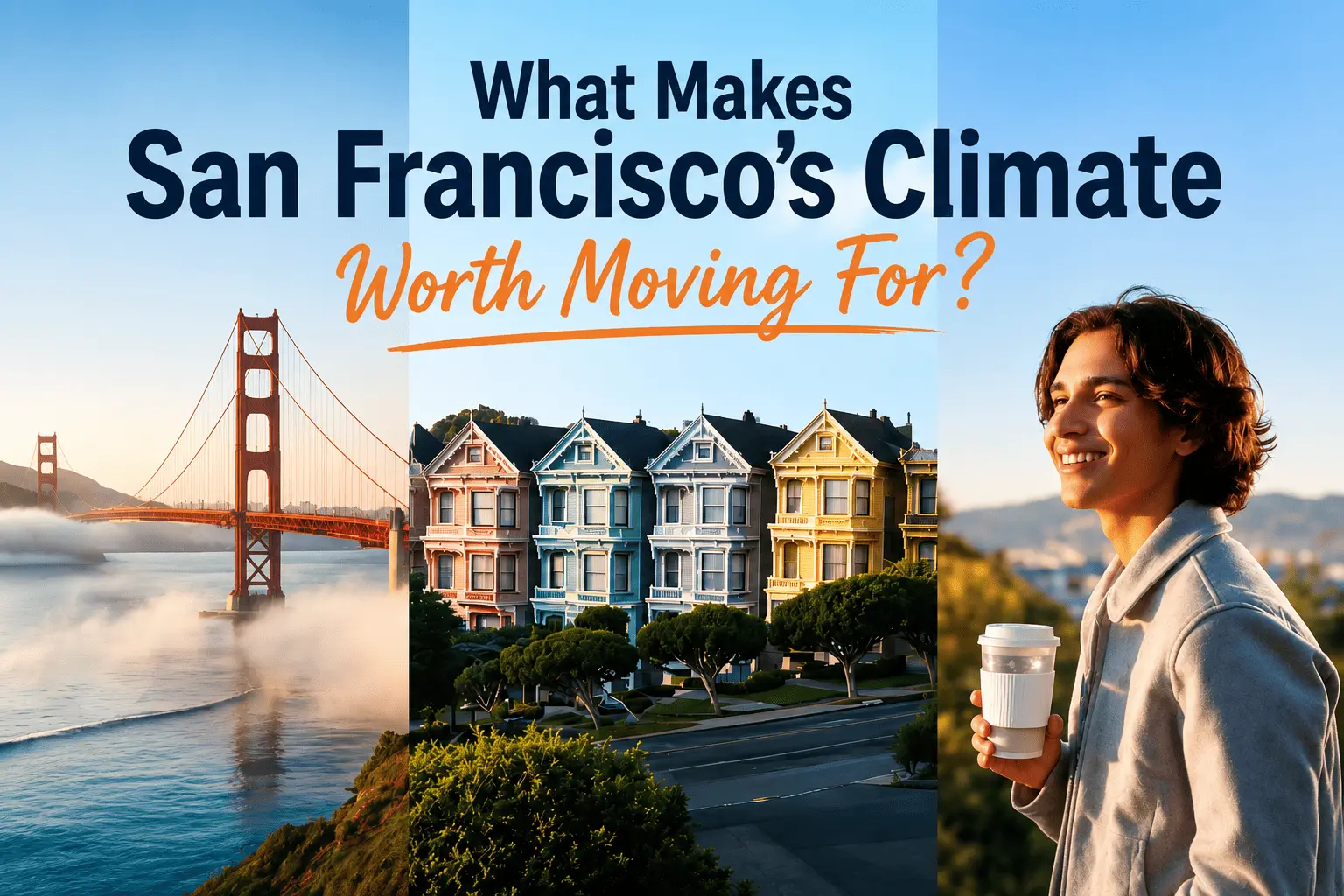
San Francisco offers one of the mildest climates in the United States. In fact, the city rarely experiences extreme heat, bitter cold, or severe storms. Instead, residents enjoy cool summers, gentle winters, and comfortable temperatures nearly every month of the year. Moreover, this consistency pairs with the famous coastal fog to create a genuinely livable, moderate climate. Overall, that rare combination is exactly what makes San Francisco’s weather worth moving for.
San Francisco Climate at a Glance
Before exploring the details, here’s the quick version:
- Climate type: Warm-summer Mediterranean (Köppen Csb)
- Average highs: 57°F to 73°F (14°C to 23°C) year-round
- Average lows: 45°F to 55°F (7°C to 13°C) year-round
- Warmest month: September, not July or August
- Coldest month: January, though freezing temperatures almost never occur
- Rainy season: November through March
- Annual rainfall: About 23 inches, mostly falling in winter
- Days above 90°F: Just three per year, on average
Now, let’s break down why these numbers add up to one of the most sought-after climates in America.
What Type of Climate Does San Francisco Have?
San Francisco has a warm-summer Mediterranean climate, classified as Csb under the Köppen system. This classification means the city experiences dry summers and wetter winters, similar to coastal regions in Portugal or Southern Europe.
However, San Francisco’s version comes with one major twist: the cold Pacific Ocean keeps temperatures far cooler than a typical Mediterranean city. As a result, summers stay mild instead of hot, and most homes never need air conditioning at all.
Why Are San Francisco’s Temperatures So Mild Year-Round?
San Francisco’s temperatures stay remarkably stable throughout the year. Unlike most American cities, the gap between summer and winter here rarely exceeds 15 degrees. This stability comes down to one main factor: the Pacific Ocean.
Cool, Comfortable Summers
Summer in San Francisco rarely feels like summer anywhere else. Average highs hover in the mid-60s to low-70s, and true heat waves stay rare.
Therefore, residents skip the sweat-soaked commutes and sleepless, humid nights common in cities like Houston or Atlanta. Additionally, most homes never install air conditioning, since the ocean breeze handles that job for free.
Winters That Rarely Freeze
Winter in San Francisco stays gentle too. Average lows dip into the 40s, yet freezing temperatures remain extremely rare within the city itself.
Consequently, residents trade snow shovels and icy sidewalks for light jackets and the occasional rain shower. Even in January, the coldest month, outdoor activities remain fully on the table.
Why Is San Francisco So Foggy?
Ask any local, and they’ll mention “Karl the Fog” almost immediately. This nickname refers to the thick marine layer that regularly rolls through the Golden Gate.
Specifically, the frigid California Current chills ocean water just offshore, and that cold water triggers the fog. As warm air rises over land, cool, moist ocean air rushes in to replace it.
This fog actually peaks during summer, not winter, which surprises many newcomers. Locals often joke about “May Gray” and “Fogust” when describing the foggiest stretches of the year.
Interestingly, this same fog acts as a natural air conditioner, keeping the city cool even during regional heat waves. Without it, San Francisco’s summer temperatures would likely climb much higher.
What Are San Francisco’s Microclimates?
A microclimate is a small, localized area where weather differs noticeably from the surrounding region. Perhaps no other feature defines San Francisco’s climate more than this phenomenon. Within just a few miles, temperatures can swing by 15 to 20 degrees or more.
For example, one October afternoon brought a cool 69°F to Ocean Beach while the Mission District sweltered near 90°F. This dramatic variation happens because of the city’s hills, wind corridors, and closeness to the water.
Neighborhoods near the coast, like the Sunset and Richmond, stay foggier and cooler most of the year. Meanwhile, neighborhoods sheltered by hills, like the Mission and Noe Valley, enjoy far more sun and warmth.
The table below breaks down the general pattern by area:
| Neighborhood Type | Examples | Typical Weather |
|---|---|---|
| Foggy & Cool | Sunset, Richmond, Twin Peaks | Overcast mornings, cooler afternoons, frequent wind |
| Sunny & Warm | Mission, Noe Valley, Potrero Hill | Clear skies, warmer afternoons, less fog |
| Mixed & Breezy | Marina, North Beach, SoMa | Moderate sun, bay breezes, variable fog |
As a result, many people choose their San Francisco neighborhood based on weather preference alone. In fact, homebuyers sometimes pay a premium of up to 20% more for homes in sunnier micro-zones.
How Does San Francisco’s Climate Support Everyday Life?
Consistent, mild weather does more than just feel pleasant. It actually shapes how people live, work, and spend their free time.
First, outdoor activities stay possible all year long. Hiking, biking, and outdoor dining rarely face weather cancellations, since extreme conditions almost never strike.
Second, the mild climate supports year-round gardening. A wide range of plants thrive somewhere across the city’s many microclimates.
Additionally, San Francisco’s weather may support long-term health. Extreme heat and cold both carry real health risks, especially for older adults.
Therefore, a moderate climate can reduce exposure to weather-related illness. Meanwhile, the reliably cool air often encourages walking and cycling — habits that stay much harder to maintain in more extreme climates.
How Does San Francisco’s Weather Compare to Other U.S. Cities?
Compared to most major American cities, San Francisco’s climate stands out as unusually mild and stable. The table below shows how it stacks up:
| City | Summer Highs | Winter Lows | Snow | Humidity |
|---|---|---|---|---|
| San Francisco | 65-73°F | 45-49°F | None | Low to moderate |
| New York City | 82-85°F | 27-32°F | Frequent | High in summer |
| Phoenix | 104-106°F | 45-50°F | None | Low, but extreme heat |
| Chicago | 80-84°F | 20-25°F | Frequent | Moderate |
| Miami | 89-90°F | 60-65°F | None | Very high |
Clearly, San Francisco avoids the extremes that define most other major cities. It skips the brutal humidity of Miami, the freezing winters of Chicago, and the scorching summers of Phoenix. Instead, it offers something rarer: genuine, year-round moderation.
What Should You Know Before Moving to San Francisco?
Of course, no climate is perfect, and San Francisco’s weather comes with real trade-offs.
- Fog fatigue is real. Some residents find the persistent gray skies, especially in summer, mentally draining over time.
- Packing gets tricky. Layers become essential, since a 60°F morning can turn into a 75°F afternoon just a few blocks away.
- Rain season means real rain. Winter storms can bring heavy downpours, occasional flooding, and gusty winds.
- Sun-seekers may feel shortchanged. Anyone craving hot, dry summers might find San Francisco’s coolness disappointing rather than refreshing.
Despite these caveats, most residents still consider the trade-off worthwhile. After all, the alternative in most other cities involves far more extreme heat, cold, or humidity.
Frequently Asked Questions About San Francisco’s Climate
Does it ever snow in San Francisco?
No, snow essentially never falls in San Francisco proper. The city has gone decades without measurable snowfall, and even light dustings remain exceptionally rare thanks to the moderating ocean influence.
What is the warmest month in San Francisco?
September typically brings San Francisco’s warmest weather, not July or August. This happens because summer fog thins out by early fall, which allows more direct sunshine to reach the city.
Do I need air conditioning in San Francisco?
Most homes in San Francisco skip air conditioning entirely, and most residents never miss it. Cool ocean breezes and fog naturally regulate indoor temperatures, even during rare warm spells.
What should I pack for San Francisco’s weather?
Layers work best for San Francisco’s climate. A light jacket, a sweater, and breathable layers underneath handle almost any day. After all, temperatures can shift significantly between morning and afternoon.
Which San Francisco neighborhood has the best weather?
Neighborhoods like Noe Valley, the Mission, and Potrero Hill generally see the most sun and warmth. Meanwhile, areas like the Sunset and Richmond stay cooler and foggier most of the year.
The Bottom Line: Is San Francisco’s Climate Worth Moving For?
Ultimately, San Francisco’s climate delivers something few other places can: genuine, year-round comfort. Summers stay cool, winters stay mild, and extreme weather essentially never happens.
Meanwhile, the fog and microclimates add character rather than inconvenience, giving residents endless options for their ideal conditions. For anyone tired of brutal summers, freezing winters, or unpredictable storms, San Francisco’s climate offers a legitimate, weather-driven reason to move.


