


Can You Eat for Weight Loss and Longevity at the Same Time?
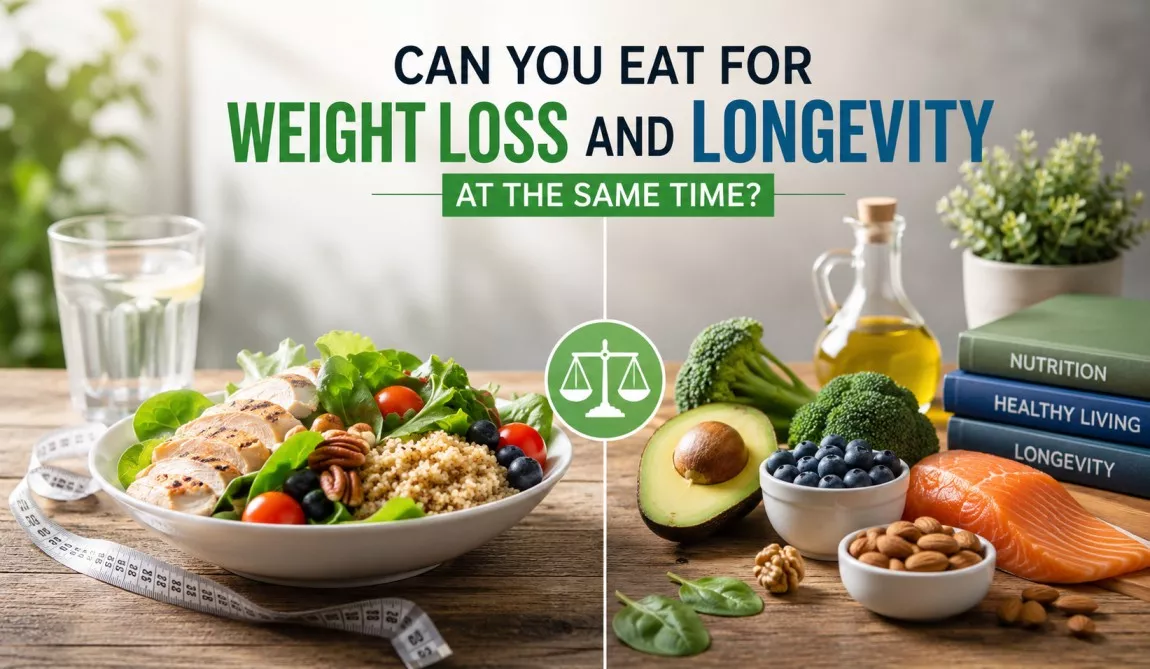
Yes, for most people. The eating habits that support healthy weight loss and the habits linked to a longer life overlap heavily. Both favor whole foods, steady protein intake, and a moderate calorie balance instead of extremes.
That said, the two goals aren’t perfect twins. Fast, aggressive weight loss can sometimes work against long-term healthspan, especially when it costs you muscle instead of fat. This guide breaks down where the two goals line up, where they clash, and how to build a plate that genuinely serves both.
Why This Question Matters
People chase weight loss for confidence, comfort, and better health markers. Longevity research, meanwhile, asks a bigger question: which daily habits help you live well for longer?
For years, most people assumed these two goals always moved together. A landmark 2024 study complicates that assumption.
Researchers at the Jackson Laboratory tracked nearly 1,000 genetically diverse mice across five different diets. The diets ranged from unrestricted eating to severe calorie restriction, and the team published its results in the journal Nature. As expected, cutting calories extended lifespan overall, and the most restricted mice lived the longest on average.
However, a surprising pattern showed up within each diet group. The mice that lost the least weight while eating less actually lived the longest. In contrast, mice that lost the most weight often had low energy and weaker immune and reproductive function, and many died earlier.
Notably, lead researcher Gary Churchill explained that weight loss and lifespan extension work as separate outcomes of calorie restriction, not interchangeable ones. His team also found that immune health and blood markers tracked with lifespan more closely than the metabolic markers many human weight-loss studies rely on.
This finding doesn’t mean weight loss works against you. Instead, it means diet quality and overall resilience matter more than the number on the scale.
So here’s the real answer to the headline question: you can absolutely eat in a way that supports weight loss and longevity together. You just need to prioritize food quality over quick fixes.
Where Weight Loss and Longevity Diets Overlap
Nutrition scientists agree on several habits that clearly serve both goals at once. Let’s walk through the biggest points of overlap.
1. Whole, Minimally Processed Foods
Multiple large studies published in 2025 connected ultra-processed food intake to higher death rates. One study in The Lancet Regional Health – Europe followed more than 428,000 people across nine countries.
The researchers linked higher ultra-processed food intake to a greater risk of dying from heart disease, digestive disease, and even Parkinson’s disease. This risk held true independent of alcohol use. Similarly, a UK Biobank study of over 172,000 adults connected ultra-processed food intake to faster biological aging.
At the same time, these foods make weight management harder. Manufacturers engineer them to be hyper-palatable, which pushes people to overeat without noticing. Therefore, swapping packaged snacks and fast food for whole ingredients supports weight loss and longevity in one single move.
2. Protein for Muscle Preservation
When you lose weight through calorie-cutting alone, a meaningful share of that loss can come from muscle rather than fat. This matters a great deal, because muscle mass strongly predicts healthy aging. Low muscle mass raises the risk of falls, frailty, and earlier death, especially among older adults.
Research consistently points to a higher protein target than the standard 0.8 g/kg recommendation. Most studies support roughly 1.0–1.2 grams of protein per kilogram of body weight for older adults, and some research backs up to 1.6 g/kg for people actively losing weight.
However, protein alone doesn’t guarantee muscle preservation. One 12-week trial found no meaningful difference in muscle retention between a high-protein diet (1.7 g/kg) and a normal-protein diet (0.9 g/kg) when neither group exercised.
On the other hand, a separate randomized trial found that resistance exercise paired with higher protein intake preserved far more lean mass than diet changes alone. So pairing protein with strength training gives you the best odds of protecting muscle while you lose fat.
3. Fiber-Rich, Plant-Forward Meals
Vegetables, legumes, whole grains, and fruit show up in nearly every longevity-linked eating pattern on record. These foods fill you up on fewer calories, which naturally supports a calorie deficit.
Additionally, high-fiber diets consistently track with lower rates of chronic disease and lower all-cause mortality across large population studies. This dual benefit makes fiber one of the simplest overlap points between the two goals.
4. A Moderate, Sustainable Calorie Balance
Neither goal actually requires extreme calorie-cutting. Yale researchers found that a modest 14% calorie reduction over two years improved immune defense without harming growth or reproductive health.
Meanwhile, Columbia University researchers used a biological aging clock called DunedinPACE to study a major calorie-restriction trial. They found that calorie restriction slowed participants’ pace of aging. Notably, neither study required extreme restriction to produce real benefits.
In short, moderate and consistent beats extreme and short-lived, every single time.
Lessons From the Blue Zones
Researchers coined the term “Blue Zones” to describe five regions where people live unusually long lives. These regions include Okinawa in Japan, Sardinia in Italy, Ikaria in Greece, Nicoya in Costa Rica, and Loma Linda in California.
Across these regions, diets share a few clear traits. Meals lean heavily plant-based, with legumes acting as the main protein source. Fish appears on the table too, though usually in small amounts and just a few times a week.
Notably, Okinawan elders traditionally practice “hara hachi bu,” a habit of stopping when they feel about 80% full. They don’t count calories or track macros. Instead, they build gentle food boundaries into daily life through culture and habit.
It’s worth noting, though, that Blue Zones research relies mostly on observational data rather than controlled trials. Some researchers have also questioned the accuracy of reported ages in these regions.
Still, the overall dietary pattern closely mirrors other well-studied approaches, like the Mediterranean diet. Beyond food, Blue Zones residents also move naturally throughout the day, maintain close social ties, and hold a strong sense of purpose. In other words, diet plays a real role, but it works alongside lifestyle, not in isolation.
The Mediterranean Diet: A Real-World Test Case
If Blue Zones research feels too observational for your taste, the Mediterranean diet offers much stronger clinical backing. JAMA Network Open published a 2024 study that followed more than 25,000 women for up to 25 years.
Women with high adherence to the Mediterranean pattern showed up to a 23% lower risk of dying from any cause during the study period. Researchers linked this benefit partly to improvements in body mass index, inflammation, and insulin resistance.
Beyond longevity, the Mediterranean diet also supports weight management directly. The MedWeight study followed 565 adults who had intentionally lost at least 10% of their body weight.
People who stuck closely to a Mediterranean eating pattern kept more weight off over the following year. Those who drifted away from the pattern regained more. Interestingly, higher protein intake also separated successful “maintainers” from people who regained weight.
Together, these findings make the Mediterranean diet one of the best-documented examples of an eating pattern that genuinely serves weight loss and longevity at once.
Where the Two Goals Can Clash
Despite all this overlap, weight loss and longevity goals can pull apart under certain conditions. Understanding these clash points helps you avoid common traps.
Crash Diets and Muscle Loss
Very-low-calorie diets often produce fast results on the scale. However, rapid weight loss tends to strip away muscle along with fat, sometimes at a much higher rate than slower, steadier approaches allow. Because muscle protects against frailty and metabolic decline, this trade-off can hurt long-term healthspan even as short-term weight numbers improve.
Over-Restriction and Nutrient Gaps
Extremely restrictive diets can also create nutrient gaps, particularly in vitamin D, B12, iron, calcium, and omega-3 fats. Over time, these gaps can quietly undercut the very health benefits a person hoped to gain from weight loss.
As a result, “eating less” doesn’t automatically mean “eating better,” especially when the remaining food lacks variety.
The Intermittent Fasting Myth
Intermittent fasting and time-restricted eating have earned a reputation as longevity hacks. Animal studies do show real lifespan extension from these approaches. Yet human evidence tells a more modest story.
A 2025 review in Endocrine Reviews found that most human fasting trials run short, typically lasting a few weeks to six months. Furthermore, research suggests that much of the benefit people see from time-restricted eating actually comes from eating fewer total calories, not from the timing itself.
When researchers control for calorie intake directly, fasting windows generally show no extra advantage over standard calorie control. In other words, intermittent fasting can help some people naturally eat less, but it isn’t a magic longevity switch on its own.
Quick Comparison: Alignment vs. Conflict
| Factor | Supports Both Goals | Can Create Conflict |
|---|---|---|
| Food quality | Whole, fiber-rich, minimally processed foods | Ultra-processed, low-nutrient foods |
| Protein intake | 1.0–1.6 g/kg, paired with resistance training | Very low protein during a deficit |
| Calorie approach | Moderate, sustained deficit (roughly 10–20%) | Extreme, rapid restriction |
| Eating pattern | Consistent, sustainable habits | Yo-yo dieting and repeated crash diets |
| Meal timing | Flexible windows that fit your life | Rigid fasting chased purely as a “hack” |
Building Your Plate: A Simple Framework
You don’t need to count every gram to eat for both goals at once. Instead, try building most meals around this simple structure:
- Half your plate: non-starchy vegetables, plus some fruit
- A quarter of your plate: a protein source such as fish, poultry, eggs, legumes, or tofu
- A quarter of your plate: whole grains or a starchy vegetable
- A thumb-sized portion of healthy fat: olive oil, nuts, seeds, or avocado
This structure naturally increases fiber and protein while limiting ultra-processed foods, all without forcing you to track every calorie. Of course, individual needs vary based on age, activity level, and health history. So it’s worth checking in with a doctor or registered dietitian before making major changes, especially if you manage a chronic condition.
Common Mistakes to Avoid
Even well-intentioned eaters fall into a few predictable traps. Watch out for these:
- Chasing rapid weight loss. Fast results often cost you muscle, which works against long-term healthspan.
- Under-eating protein. Low protein intake during a deficit speeds up muscle loss, particularly with age.
- Treating Blue Zones as a rigid diet plan. These regions offer lifestyle inspiration, not a clinically proven prescription.
- Relying on fasting alone. Timing helps some people eat less, but it can’t replace food quality.
- Yo-yo dieting. Repeated cycles of loss and regain stress your metabolism more than steady, moderate change does.
- Ignoring nutrient variety. Cutting calories without variety often leads to quiet deficiencies over time.
Frequently Asked Questions
Can I lose weight and still eat for longevity?
Yes. Most eating patterns linked to longevity, like the Mediterranean diet, also support healthy weight loss. Focus on whole foods, adequate protein, and a moderate calorie deficit rather than extreme restriction.
What is the best diet for weight loss and longevity together?
The Mediterranean diet currently holds the strongest research backing for both goals. It emphasizes vegetables, legumes, whole grains, fish, and olive oil, alongside limited processed food and added sugar.
Does intermittent fasting help with both weight loss and longevity?
It can help indirectly. Time-restricted eating often leads people to eat fewer calories naturally. However, research suggests the timing itself adds little extra benefit once total calorie intake matches across groups.
How much protein do I need for weight loss and healthy aging?
Most research supports roughly 1.0–1.2 grams of protein per kilogram of body weight, with some studies backing up to 1.6 g/kg during active weight loss. Pairing protein with resistance training strengthens the effect considerably.
Is losing weight always good for longevity?
Not necessarily. Some research shows that rapid weight loss, especially from extreme restriction, can strip away muscle and other protective health markers. Slow, steady weight loss from a nutrient-dense diet tends to serve long-term health far better.
The Bottom Line
So, can you eat for weight loss and longevity at the same time? For most people, yes.
The two goals share far more common ground than conflict. Whole foods, adequate protein, fiber, and a moderate calorie balance clearly support both outcomes at once.
Still, the details matter. Rapid, extreme approaches to weight loss can quietly work against your long-term healthspan, even while the scale moves in the “right” direction.
Therefore, aim for steady progress built on food quality, not just calorie math. Over time, that approach protects both your waistline and your future self.
This article shares general nutrition information and doesn’t replace personalized medical advice. Talk with a doctor or registered dietitian before making major changes to your diet, especially if you manage a chronic health condition.


