


Why More Americans Are Choosing Mental Health Apps in 2026?
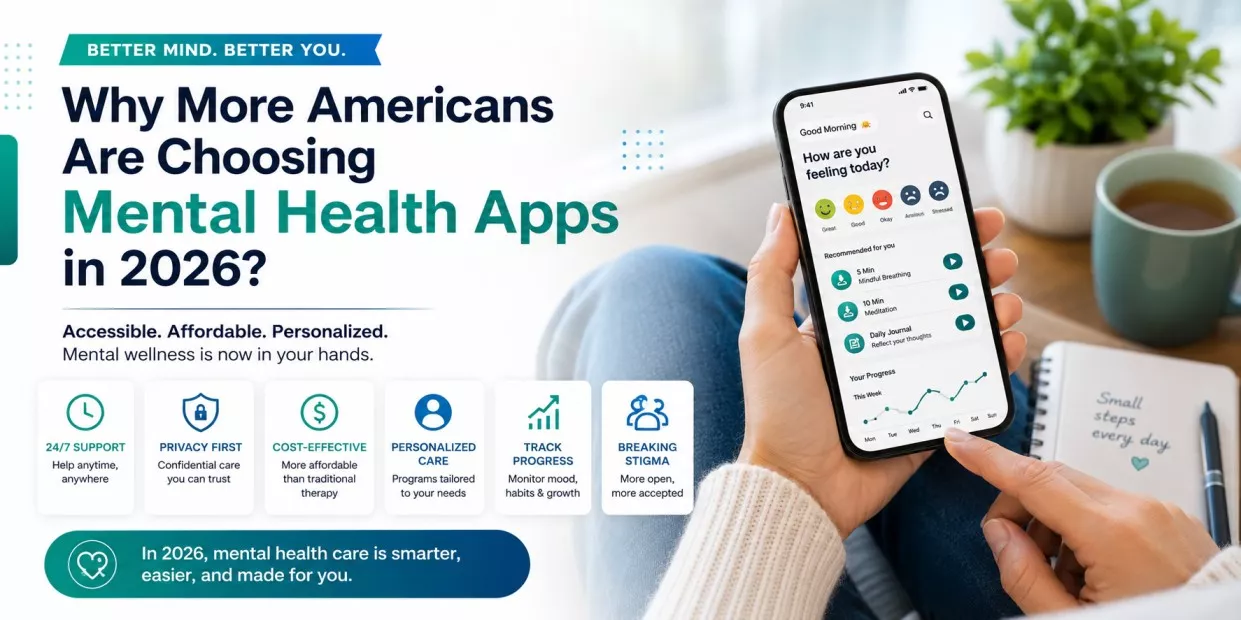
Picture this: it’s 11 p.m. on a Tuesday, and anxiety has kept you awake for the third night in a row. Your therapist has a three-month waitlist. Your insurance barely covers mental health visits. And even if it did, you’re not sure you’re ready to talk to a stranger in a clinical office just yet. You reach for your phone — and millions of Americans are doing exactly the same thing.
Mental health app downloads surged in the years following COVID-19, and the momentum hasn’t slowed. In 2026, what once felt like a niche tech novelty has become a mainstream, billion-dollar healthcare ecosystem. The U.S. mental health apps market hit approximately $3.87 billion in 2025. Analysts project it will reach $18.14 billion by 2035 — a compound annual growth rate of nearly 17%. Understanding why means looking honestly at three forces: healthcare gaps, technology breakthroughs, and a cultural shift in how Americans approach mental wellness.
What Are Mental Health Apps?
Mental health apps are smartphone or tablet-based tools designed to support psychological wellbeing. They range from broadly preventive to clinically adjacent, and most fall into one of several core categories.
Meditation and mindfulness apps like Calm and Headspace guide users through breathing exercises, sleep stories, and stress-reduction practices. Mood tracking apps let users log emotional states daily, spot patterns, and share data with clinicians. Therapy platforms such as BetterHelp and Talkspace connect users with licensed therapists through video, chat, or voice — often at a fraction of in-person costs. AI-powered support tools like Woebot and Wysa deliver round-the-clock, text-based emotional support. They use conversational AI grounded in cognitive behavioral therapy (CBT) techniques. Stress management apps provide guided interventions for workplace burnout and daily anxiety, while sleep improvement apps target insomnia and disrupted rest with evidence-based behavioral strategies.
In 2026, product teams are hybridizing these categories. Users want one comprehensive solution — not several separate apps. A successful platform now bundles self-guided CBT, on-demand teletherapy, and mood analytics in a single interface.
Why Mental Health Apps Are Growing in Popularity in 2026
The Provider Shortage Is Real and Severe
The most powerful driver behind app adoption isn’t enthusiasm for technology. It’s desperation born from an overburdened care system. As of late 2025, 137 million Americans live in federally designated Mental Health Professional Shortage Areas. Roughly 40% of the U.S. population cannot access adequate psychiatric care where they live.
Six in ten psychologists turned away new patients as of 2025. For those who maintained waitlists, average wait times stretched three months or longer. Some rural residents waited up to three times longer than city dwellers.
The math is stark. Federal projections show demand for mental health services will jump 49% by 2033. The workforce? It will grow by just 11% in that same window. Waiting three months for a first appointment isn’t just inconvenient. For someone managing a crisis, it can cause real harm. Mental health apps step into this gap, offering something the traditional system simply can’t: help right now.
Affordability That Actually Matters
Without insurance, therapy costs $100 to $200 per session. Many insurance plans offer limited mental health coverage. For someone managing anxiety or mild depression, consistent weekly therapy can run $400 to $800 per month. Mental health apps typically cost $10 to $70 per month. Most offer free tiers for core features.
That price gap isn’t marginal. For tens of millions of Americans who need ongoing support, it’s the difference between access and nothing.
Employers have recognized this too. Companies now bundle mental health app subscriptions into employee assistance programs (EAPs). Workers gain access at no direct cost. This shift from direct-to-consumer payments to employer-and-payer funding is changing how apps reach users — and it’s a major growth driver.
Accessibility for Underserved and Rural Communities
For someone in a rural county with no psychiatrist within 100 miles, a smartphone app isn’t a supplement to care. It may be their only option. Mental health apps transcend geography in ways brick-and-mortar practices never can. They’re available at midnight, on weekends, during a lunch break, or in a parked car between errands.
This 24/7 availability matters most for communities that traditional care has long ignored. Rural residents, people without transportation, those with disabilities, and shift workers all benefit. Skip the commute, avoid the waiting room, and forget about scheduling around office hours.
Privacy and the Permission to Start Quietly
Stigma around mental health remains a real barrier to care. Many people who need support aren’t ready to walk into a therapist’s office. They’re not ready to tell their doctor either. Mental health apps offer something uniquely valuable: a private, low-stakes entry point.
Users can explore meditation, journal, or try a CBT exercise — all on their own terms, with no disclosure required. This discretion lowers the barrier to getting started. People can begin their wellness journey long before they feel ready for formal care.
A Cultural Shift Toward Preventive Wellness
Younger generations don’t wait for a crisis. Gen Z and millennials treat mental wellness as an ongoing practice — like going to the gym. This preventive mindset is well-suited to apps, which build in daily or weekly engagement rather than monthly clinical appointments.
Social media has normalized therapy talk. Conversations about anxiety, burnout, and self-care that felt taboo a decade ago now fill social feeds. Workplace wellness programs have reinforced this shift. Employers now frame mental health support as a performance and retention strategy — not a last resort.
Benefits Americans Report from Using Mental Health Apps
Consistent app users report meaningful, real-world improvements. Users who engage regularly with mindfulness tools report measurable drops in stress and anxiety. Those gains rank among the most commonly cited benefits.
Better sleep is another common outcome. Sleep hygiene education, guided wind-down routines, and tracking tools reveal patterns users never noticed before.
Many users describe improved consistency in self-care as one of the subtler but more meaningful changes. Before apps, stress management was reactive — something people tried only when things got bad. Apps turn mental wellness into a daily habit. Think of it like a fitness tracker, but for your mind.
Users with mild to moderate anxiety say mood tracking alone transforms their self-awareness. Logging feelings daily helps them spot triggers. It leads to concrete behavioral change.
Therapy platform users report outcomes that mirror traditional care: sharper coping strategies, fewer depressive symptoms, and stronger communication in relationships. These platforms connect users with licensed professionals. Users get clinical-quality support at a pace and price that actually fits their life.
The Role of Artificial Intelligence in Mental Wellness
Artificial intelligence is the defining technological force reshaping mental health apps in 2026. 61% of wellness app developers now build AI-driven therapy tools into their platforms. The sophistication of those tools has grown fast.
Today’s leading AI-powered apps don’t offer generic advice — they adapt in real time. Tools like Woebot use natural language processing to read the emotional tone of a user’s message. They then respond with CBT-based techniques matched to that exact moment. Machine learning models track mood logs over weeks and months. They spot patterns — a consistent mid-week dip, elevated Sunday evening anxiety — and surface those insights with actionable suggestions.
Personalization is now a baseline expectation. Users want their mental health app to adapt to their goals, diagnoses, time zones, and communication style. Apps that deliver this feel meaningfully different from static content libraries.
But AI-based tools have genuine limitations. Honest developers acknowledge them clearly. Current conversational AI can’t replicate a licensed therapist’s judgment, relational depth, or clinical training. This is especially true for trauma, complex conditions, and personality disorders.
AI tools aren’t built for crisis intervention either. A person in acute distress needs immediate human support — not a chatbot. The best apps acknowledge these limits directly. They point users to emergency services or crisis lines when the platform flags signs of serious distress.
Potential Concerns and Limitations
Data Privacy Is a Legitimate Risk
Mental health data ranks among the most sensitive information a person can share. Yet the privacy protections governing mental health apps are far weaker than those covering licensed therapists or HIPAA-regulated healthcare entities.
A 2026 academic study examined 25 popular Android mental health apps. Every single one contained at least one undisclosed tracker — absent from its own privacy policy. 68% of those apps hid at least half of their trackers from users entirely.
A March 2026 TechRadar report found more than 1,500 security vulnerabilities across widely downloaded mental health apps. Researchers classified dozens as high severity. Hackers could potentially access therapy notes, mood logs, and self-harm indicators.
Duke University researchers found data brokers selling information that identified individuals by mental health diagnoses, including depression, anxiety, PTSD, and bipolar disorder. Regulatory efforts like the proposed HIPRA legislation — introduced in late 2025 — aim to extend protections to health apps. Until those rules take effect, users should not assume their mental health data carries the same protections as their medical records.
Not a Replacement for Clinical Care
Apps work well for mild to moderate challenges and preventive wellness. They also supplement professional care effectively. But they are not the right primary tool for serious mental illness, suicidal ideation, psychosis, eating disorders, or substance dependence. These conditions require human clinical judgment, structured treatment plans, and often medication management. Using an app in place of necessary clinical care can delay treatment that saves lives.
Quality Varies Enormously
No federal body regulates mental health apps the way it regulates pharmaceuticals or medical devices. Some apps use robust, clinically validated frameworks with licensed oversight. Others are content libraries dressed up with wellness branding and no evidence behind them. Users have no easy way to tell the difference from an app store listing alone.
How to Choose a Mental Health App
Given the range in quality, these questions serve as a practical filter when evaluating any mental health app.
- Is it evidence-based? Does the app cite peer-reviewed research? Does it build on recognized frameworks like CBT, DBT, or ACT?
- Are licensed professionals involved? For therapy platforms, are therapists licensed in your state? Do clinical advisors shape the content?
- Is the privacy policy readable and specific? Does it state what data it collects, who sees it, and whether anyone sells it?
- How recently was it updated? An app untouched for months is unlikely to have patched its security flaws.
- Is pricing transparent? Avoid apps that bury subscription costs or make cancellation confusing.
- Does it acknowledge its limits? A credible app states clearly that it is not a crisis service and directs users to emergency resources when needed.
Future Trends for Mental Health Apps Beyond 2026
The next phase of mental health technology is already taking shape. 58% of developers are already building wearable compatibility into their platforms. Integration is moving fast. Devices that track heart rate variability, sleep architecture, and galvanic skin response will feed richer data into mental health apps. Earlier, more accurate detection of stress, mood shifts, and sleep disruption will follow.
Advanced AI coaching will move beyond reactive responses. Imagine an app that notices you’ve slept poorly for a week, exercised less, and written with growing negativity — and surfaces support before a crisis hits. That’s where predictive mental health monitoring is heading. This shift from reactive care to preventive wellness is one of the most consequential changes in digital healthcare.
Digital therapeutics represent a more rigorous tier of app-based care. These are clinically validated, FDA-reviewed software interventions. Unlike consumer wellness apps, they target specific conditions. Clinical evidence already supports their use for insomnia, PTSD, and substance use disorders. As reimbursement pathways mature, doctors may prescribe them as routinely as medication.
Employer-sponsored wellness platforms will keep expanding. Mental health app benefits are becoming a standard part of competitive compensation packages. Employers increasingly see the direct link between mental health and productivity, attendance, and retention.
Expert Analysis: Why This Shift Is Structural, Not a Trend
What’s happening with mental health apps isn’t a wellness fad. It isn’t a technology novelty. It’s a structural response to a healthcare system that simply cannot meet demand.
137 million Americans live in provider shortage areas. The average psychologist waitlist exceeds three months. A weekly therapy session costs as much as a car payment. In that environment, the conditions for mass adoption of digital alternatives aren’t just present — they’re overwhelming.
The apps gaining ground take the clinical dimension seriously. They partner with licensed professionals. They invest in evidence-based content, stay transparent about limits, and design for long-term engagement — not just initial downloads. Users are becoming more discerning. Basic features and slick branding no longer cut it. The apps that earn lasting trust deliver measurable improvements in how people feel.
Mental health technology is also democratizing access. And it matters morally. A 23-year-old with generalized anxiety in rural Mississippi and a 45-year-old professional in Chicago can now access the same CBT tools. At the same price. That equity in access — imperfect as the ecosystem remains — represents a genuine step forward. It starts to close a gap that has left tens of millions of Americans behind for decades.
Conclusion
The surge in mental health app adoption across the United States reflects something deeper than technology enthusiasm. It reflects hard realities. Anxiety, depression, and stress are widespread. The traditional care system can’t serve everyone. People are finding real value in tools that meet them where they are — on their phones, at midnight, without judgment.
The benefits are genuine and growing. Greater accessibility. Dramatically lower costs. Privacy that lowers the stigma barrier. AI personalization that makes support feel relevant, not generic.
The limitations are equally real. Data privacy remains a serious concern. Quality across the market varies wildly. And apps are not — and should not be framed as — a substitute for clinical care when clinical care is what’s needed.
Digital mental wellness tools are no longer peripheral to American healthcare. They are becoming part of its core infrastructure. The most important question ahead isn’t whether mental health apps will keep growing — they will. It’s whether developers, policymakers, and the industry can build them with the seriousness those stakes demand.


