


Alhambra Night Tour Revenue Insights: Attendance, Ticket Sales & Tourism Impact
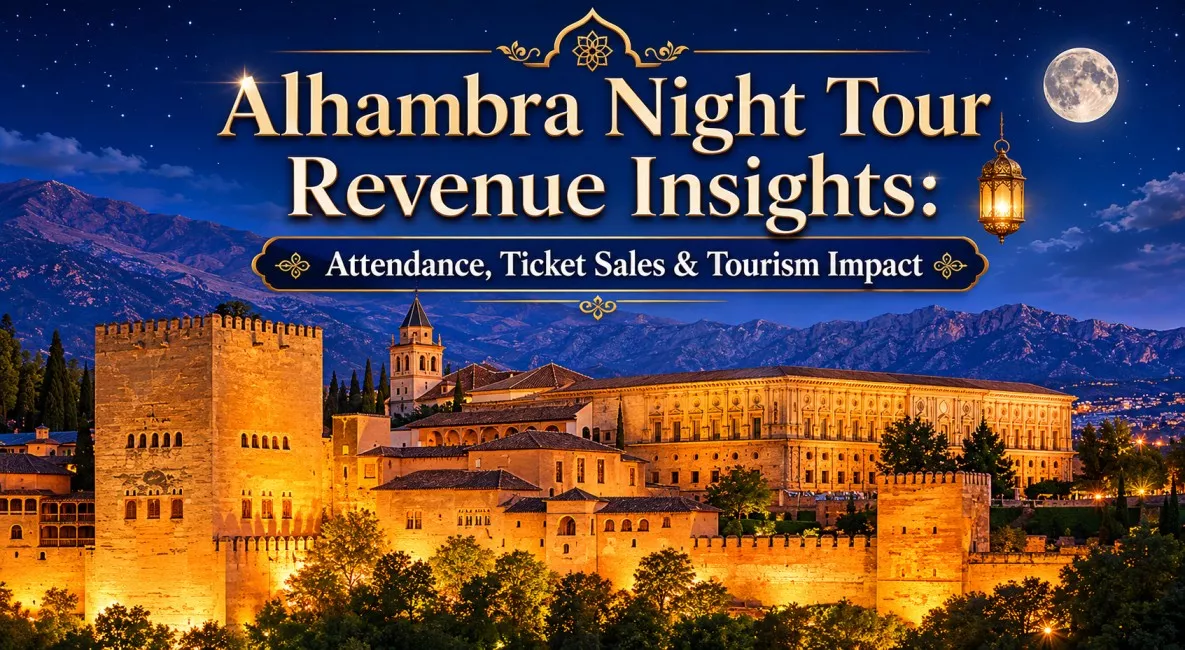
As one of Europe’s most architecturally significant landmarks, the Alhambra in Granada, Spain, provides a perfect case study for high-yield asset optimization in Spain cultural tourism. The site attracts over 2.5 million visitors annually. Because of this massive popularity, the governing trust faces a continuous dilemma: how can it satisfy an insatiable Alhambra ticket demand while protecting delicate medieval Islamic architecture?
The expansion of Granada night tourism offers a strategic solution to this challenge. Far from a mere novelty, the Alhambra Palace night experience has evolved into a vital macroeconomic driver for the Granada tourism economy. By converting a static, daytime heritage site into a multi-tiered evening ecosystem, destination marketers have successfully unlocked high-margin revenue streams.
Understanding the Alhambra Night Tour Experience
The Patronato de la Alhambra y Generalife (the governing trust) splits its evening programming into two distinct paths. This structural choice distributes foot traffic and maximizes revenue across separate ticket types:
- The Nasrid Palaces Night Visit: This path focuses exclusively on the core palatial complex, including the Mexuar, Comares Palace, and Court of the Lions.
- The Gardens and Generalife Night Visit: This option highlights the low-light illumination of the royal summer estate and its agricultural terraces.
Architectural Lightscapes and Sensory Differentiation
Daytime visits often feature high ambient noise and rapid visitor flows, but Alhambra evening visits prioritize sensory immersion instead. The lighting design relies on low-lux, highly focused directional illumination. Therefore, the design accentuates the intricate Nasrid stucco work, epigraphic carvings, and muqarnas (honeycomb vaulting) while leaving upper structures in shadow.
Furthermore, the acoustic footprint shifts dramatically after dark. The sound of trickling water from the channels in the Court of the Lions and the Generalife’s water staircases becomes central to the visitor experience. Consequently, this acoustic shift replicates the original sensory intent of the 13th- and 14th-century Moorish architects.
Structural Differences: Day vs. Night
From an operational perspective, night tours are not simply daytime tours after sunset. On the contrary, they operate as highly condensed, curated access corridors.
A daytime general admission ticket grants sprawling access to the Alcazaba fortress, Charles V Palace, Nasrid Palaces, and Generalife over several hours. In contrast, the evening ticket restricts spatial movement to specific zones to ensure security in low-light environments. Because of this spatial restriction, management can run daytime and nighttime operations as entirely independent revenue loops. As a result, they effectively sell the same physical space twice within a single 24-hour cycle.
Alhambra Night Tour Attendance Trends

Managing Alhambra night tour attendance requires a careful balance between historical preservation and global travel demand. For conservation reasons, the Nasrid Palaces enforce a strict daytime cap of 300 visitors per 30-minute window. During evening operations, management throttles this capacity even further to maintain safety in reduced visibility.
Seasonality and Peak Capacity Allocation
Attendance patterns fluctuate heavily based on broader Andalusia tourism trends. The shoulder seasons of spring (April–May) and autumn (September–October) represent the absolute peak for ticket demand. During these windows, nocturnal temperatures in Granada’s high-altitude climate remain optimal, meaning tickets routinely sell out months in advance.
| Season | Demand Level | Capacity Allocation | Primary Visitor Demographic |
| Spring (Apr–May) | Peak | 100% (Sold out weeks out) | North American, EU, Domestic |
| Summer (Jun–Aug) | High / Nocturnal Shift | 95% – 100% | Global Leisure, GCC Region |
| Autumn (Sep–Oct) | Peak | 100% | Luxury FIT, Cultural Researchers |
| Winter (Nov–Mar) | Moderate / Low | 40% – 60% | Domestic, Regional European |
In the peak summer months of July and August, daytime temperatures in Granada frequently exceed 40°C (104°F). This intense heat causes a distinct behavioral pivot among international travelers. Consequently, evening slots become highly sought-after alternatives to daytime sun exposure.
Demographic Profiles and Yield Management
The international demographic profile of night tours skews heavily toward higher-spending, independent travelers (FITs) and specialized tour operators.
According to regional Alhambra visitor statistics, North American, Asian, and premium Western European markets show a high preference for Alhambra guided night tours. These cohorts demonstrate a lower sensitivity to premium pricing. Instead, they seek exclusive, less crowded cultural experiences.
Ticket Sales & Revenue Analysis
To understand how much revenue do Alhambra night tours generate, one must look at the monument’s multi-tiered pricing architecture and the commercial layers added by third-party channels.
The Direct Ticket Pricing Structure
The base financial layer consists of direct ticket sales managed by the Patronato. In the current tariff structures, direct general public tickets cleanly segment demand:
- Direct Nasrid Palaces Night Ticket: ~€10.61 (Base institutional rate, excluding fees)
- Direct Gardens & Generalife Night Ticket: ~€7.42
- The “Alhambra Experiences” Combo Package: ~€19.09 (This institutional mechanism pairs a night visit to the Nasrid Palaces with a daytime visit to the Gardens and Alcazaba on consecutive days).
The B2B Distribution Loop and Premium Packaging
While institutional ticket prices remain remarkably accessible, the real economic yield expands in the secondary market. Because direct tickets are tightly limited, a vast network of destination management companies (DMCs), OTA platforms, and local guide collectives bundle these tickets into premium products.
For example, a standard, authorized third-party Alhambra guided night tour with an official heritage guide typically commands between €65 and €99 per person.
Institutional Base Ticket (~€10.61)
   └── B2B Distribution & Guide Packaging
        └── Premium Consumer Product (€65 - €99)
Industry analysts estimate that evening ticketing and associated guide concessions account for roughly 12% to 15% of the Alhambra’s total direct annual ticketing revenue. This represents an exceptionally high-margin operational segment. Because fixed overhead costs like security and administration are already heavily subsidized by daytime operations, the night tours run with minimal extra expense.
Capacity vs. Demand: Market Value Optimization
The financial value of the night tour lies in its scarcity. Because the nocturnal capacity of the Nasrid Palaces remains tightly capped, the economic value of each slot rises significantly higher than its face value. This mismatch between supply and demand powers a profitable secondary market of premium tour operators and private nocturnal openings.
Economic Impact on Granada’s Tourism Industry
The structural value of the night tours extends far beyond the gates of the monument. In fact, the true systemic value of evening access lies in its role as an economic anchor for the broader Granada tourism economy.
Mitigating the “Day-Tripper” Economic Leakage
Historically, Granada suffered from an economic imbalance because it operated primarily as a day-trip destination for coastal resorts and urban hubs like Seville. Tourists would arrive via motorcoach, tour the Alhambra during the day, buy a light lunch, and depart by evening. Consequently, they left minimal revenue for local hospitality providers.
The introduction and scaling of the Alhambra Palace night experience fundamentally altered this dynamic.
The Overnight Multiplier Effect: A traveler holding a night tour ticket entering at 21:30 or 22:00 must secure overnight accommodation in Granada.
Day-Trip Model:  Arrive (Coastal Resort) ➔ Day Tour ➔ Depart ➔ Minimal Local Economic Yield
Night-Tour Model: Arrive ➔ Evening Tour ➔ Hotel Stay ➔ Dinner/Nightlife ➔ High Local Economic Yield
Data from regional tourism observatories indicate that the average daily spend of an overnight heritage tourist in Granada is roughly €120–€150. In contrast, a day-tripper spends just €35–€45. The night tours act as a primary catalyst for this shift, anchoring visitors in the city for at least one to two nights.
Downstream Economic Impacts
- Hotel Sector Stabilization: Luxury boutique properties in the historical Albayzín and Realejo quarters experience a direct correlation between night tour availability and higher average daily room rates (ADR).
- Gastronomic Ecosystem Growth: Because night tours finish late (often between 23:00 and 23:30), they extend food and beverage service hours across downtown Granada. This fuels a high-end night economy of tapas bars and flamenco tablaos.
- Direct and Indirect Employment: Beyond official monument staff, evening operations support hundreds of licensed local tourist guides, private security personnel, transport drivers, and late-night hospitality workers.
Why Night Tours Increase Tourist Spending
The expansion of evening cultural tourism aligns with a global structural shift toward experience-driven luxury travel.
Premium Experience Desires and High-Yield Audiences
Modern affluent travelers increasingly reject mass-market, high-density daytime sightseeing. Instead, they seek exclusive, low-density environments that offer emotional and artistic resonance. The night tour inherently satisfies this demand by controlling crowd volume and presenting the monument through a dramatic visual lens.
Maximizing the Photographic and Artistic Value
In the digital tourism economy, destination branding relies heavily on peer-to-peer visual media. The lighting palette of the Alhambra at night provides unique photographic conditions.
For instance, the reflection of illuminated Moorish arches in the still waters of the Court of the Myrtles creates iconic visual assets. These images travel through social networks, consistently reinforcing Granada’s premium destination branding without requiring additional public marketing expenditure.
Tourism Management & Sustainability Challenges
Cultivating a high-yield night tourism model requires managing significant physical and operational challenges.
Microclimate Alteration and Structural Conservation
The introduction of human bodies into enclosed medieval spaces alters the delicate indoor microclimate. In spaces like the Nasrid Palaces, sudden spikes in relative humidity and carbon dioxide ($CO_2$) can accelerate the degradation of historic plasterwork, wooden ceilings, and original pigments.
Therefore, nocturnal operations require continuous microclimatic monitoring. Sensor arrays track air exchange rates and humidity profiles in real time to ensure that nighttime crowds do not induce structural condensation.
Balancing Conservation and Profitability
The Patronato operates under a strict conservation mandate. Every evening ticket sold represents a balance between generating operational revenue and mitigating structural wear.
To offset this friction, the site employs sustainable tourism initiatives. These include high-efficiency LED lighting arrays that emit zero ultraviolet or infrared radiation, which prevents material degradation and reduces light pollution over the Granada basin.
Future Outlook for Alhambra Night Tourism
The next phase of growth for the Alhambra’s evening ecosystem relies on integrating smart tourism infrastructure and digital experience curation.
Next-Generation Ticketing and Identity Verification
To combat ticket scalping and unregulated secondary manipulation, the Alhambra utilizes advanced digital ticketing solutions. The current framework matches all entries to personal identity documents via high-speed scanners at all entry bottlenecks.
Future systems aim to deploy dynamic pricing models and predictive AI allocations. These tools will balance ticket availability across daytime and nighttime slots based on real-time weather, regional occupancy data, and conservation metrics.
[Real-Time Weather & Occupancy Data]
                │
                ▼
   [Predictive AI Allocation]
                │
                ▼
[Dynamic Day/Night Ticket Distribution]
Augmented and Personalized Evening Curations
While traditional group tours remain a staple, demand is rising for personalized, tech-assisted independent visits. The deployment of ultra-wideband (UWB) spatial tracking and localized audio apps allows for immersive, self-guided evening itineraries. These systems deliver contextually relevant historical narratives directly to a visitor’s device based on their precise location. Consequently, this removes the need for obtrusive physical signage or noisy tour groups.
Key Takeaways
- Dual-Loop Asset Optimization: Management effectively sells the same physical space twice within a 24-hour cycle by running completely independent daytime and nighttime operational models.
- Mitigating Tourism Leakage: Night tours serve as an economic anchor. They require visitors to stay overnight and transform Granada from a short day-trip destination into a high-yield market.
- Premium Market Appeal: Restricted entry numbers and unique lighting design position the night tour as a premium experience, which attracts low-price-sensitivity international travelers.
- Strict Conservation Limits: Microclimatic management and strict visitor caps protect historic stucco and woodwork from the humidity and foot traffic of evening crowds.
- Data-Driven Smart Tourism: Advanced digital identity mapping and predictive AI scheduling help balance high commercial demand with preservation requirements.
Frequently Asked Questions
How much revenue do Alhambra night tours generate?
While the operating trust closely guards exact standalone figures, industry analysts estimate that night tours and associated guide concessions contribute approximately 12% to 15% of the Alhambra’s total direct annual ticketing revenue. This represents a highly profitable, high-margin revenue stream that leverages existing daytime infrastructure.
Are Alhambra night tours worth it?
Yes. For travelers seeking an intimate, atmospheric experience, the night tours provide excellent value. They feature significantly lower crowd densities, specialized architectural lighting, and a cooler environment. However, because they cover only specific zones (the Nasrid Palaces or the Generalife Gardens), travelers should use them as a premium complement to a comprehensive daytime visit.
Why are Alhambra night tickets limited?
The trust limits tickets due to structural preservation and visitor safety demands. Low-light conditions require smaller, highly controlled groups to prevent accidental damage to fragile historic elements. Additionally, restricted capacities help manage indoor humidity and $CO_2$ levels, which protects delicate medieval stuccowork from rapid degradation.
What is the best season for visiting the Alhambra at night?
The shoulder seasons of spring (April to May) and autumn (September to October) offer ideal weather conditions. During these months, evening temperatures remain mild, making the outdoor segments very comfortable. Summer is also highly popular as a cool escape from daytime heat, though tickets sell out months in advance.
How do night tours impact Granada’s economy?
Night tours serve as a major weapon against day-tripper tourism leakage. Because the tours conclude late in the evening, they encourage travelers to book overnight hotel accommodations, eat at local restaurants, and engage with the city’s nightlife. This dramatically increases the average daily visitor spend.
Are guided Alhambra night tours better than self-guided visits?
Guided night tours offer substantial value because expert guides understand the unique layout and historical context under evening illumination. They easily point out subtle architectural elements that are difficult to see in low light. For independent travelers, however, an authorized audio-guided application offers a quieter, more self-paced alternative.
Conclusion
The evolution of the Alhambra night tour demonstrates the potential of sustainable, high-yield cultural tourism management. By transforming a historic asset into a premium nocturnal experience, the city of Granada has addressed modern conservation challenges while expanding its regional economy.
As global travel shifts toward intentional, experience-driven itineraries, the Alhambra night tour revenue model serves as an important point of reference for heritage preservationists and tourism economists worldwide. Balancing cultural stewardship with smart monetization ensures that this landmark remains protected and vibrant for generations to come.