


Nano-Influencers: Why Brands Prefer Accounts With <5k Followers
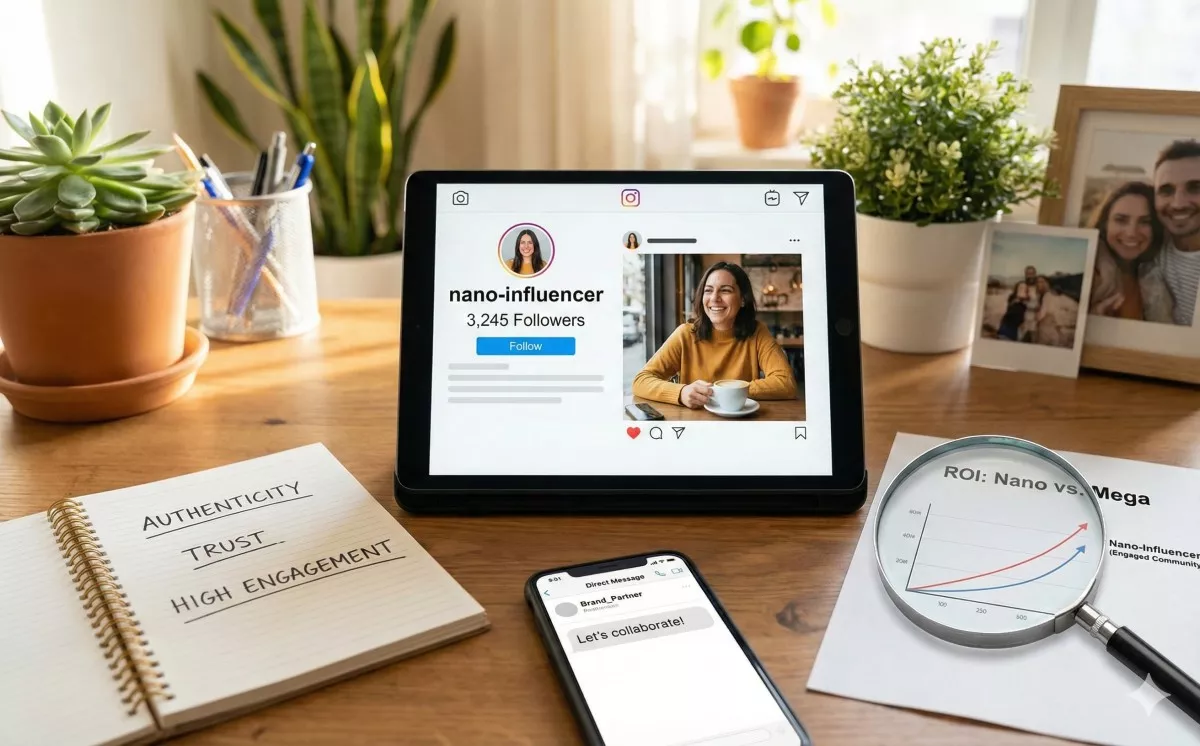
Brands are aggressively pivoting toward nano-influencers (creators with under 5,000 followers) because they deliver the highest engagement rates in the industry, typically between 4% and 9%. Unlike celebrities, these everyday creators hold genuine influence within hyper-specific niches, offering brands trusted “peer-to-peer” recommendations that drive actual sales rather than just passive views. By leveraging the cost-effectiveness and authenticity of nano-influencers, companies can generate massive amounts of relatable user-generated content (UGC) and hack social media algorithms that now prioritize engagement over follower count.
The Great Vibe Shift: Why “Famous” Is Out and “Real” Is In
Let’s be honest for a second. When was the last time a celebrity holding a bottle of shampoo in a marble bathroom actually convinced you to buy it? You probably scrolled right past it, didn’t you?
You aren’t alone. We are living through a massive “Vibe Shift” in marketing. The era of the perfectly curated, airbrushed Instagram feed is gasping for air. We are tired of perfection. We are tired of being sold a lifestyle we can’t afford by people we don’t actually know.
Enter the Nano-Influencer.
They don’t have a verified blue checkmark. They don’t have a glam squad. They are the cool mom at the school drop-off who knows exactly which stain remover works on grass stains. They are the college student showing you how to decorate a dorm room on a budget. They are the home barista perfecting latte art in a messy kitchen.
Brands have realized that while celebrities have audiences, nano-influencers have communities. And in 2026, community is the only currency that matters.
1. The Engagement “Dinner Party” Theory
To understand why brands love small accounts, you have to visualize the difference between a stadium and a dinner party.
- The Macro-Influencer (The Stadium): Imagine Beyoncé standing on a stage in front of 50,000 people. She shouts, “I love this lipstick!” The crowd cheers. But can she hear what the person in row 400 says back? No. It’s a monologue.
- The Nano-Influencer (The Dinner Party): Now, imagine you are at a dinner table with 5 friends. One friend says, “Guys, I found this lipstick and it literally lasted through a burger.” What happens? Everyone leans in. They ask questions. They ask to see it. They trust it.
The Data Backs The Theory: Statistics consistently show that as follower counts go up, engagement goes down. It’s a sliding scale. A nano-influencer with 3,000 followers often sees engagement rates (likes, comments, shares) hovering around 7-10%. A mega-influencer with 2 million followers? They are lucky to scrape by with 1%.
For a brand, that “Dinner Party” energy is gold. It means when a nano-influencer posts, people aren’t just scrolling; they are stopping, reading, and replying.
2. The “BS Radar” and The Trust Factor
Humans have developed a highly sensitive “BS Radar.” After a decade of sponsored posts, we can smell a generic ad from a mile away.
When a celebrity promotes a teeth-whitening kit, we subconsciously think: “They were paid $50,000 to say that.” When a nano-influencer with 800 followers promotes the same kit, we think: “They probably actually like it, because nobody is paying them enough to lie.”
The Psychology of Relatability
This is where the magic happens. Nano-influencers are relatable. They live in apartments that look like ours. They wear clothes we can afford. They have bad hair days.
- Aspiration (Macro): “I wish I could be her.” (Passive)
- Inspiration (Nano): “I can be like her right now.” (Active)
Brands know that relatability drives conversion. If a user feels that the creator is a “peer”—someone on their level—the psychological barrier to purchasing removes itself. It’s not marketing; it’s a recommendation from a friend.
3. The “Inch Wide, Mile Deep” Strategy
Here is a question for you: If you sell vegan, gluten-free dog treats, would you rather reach:
- 100,000 random people?
- 1,000 people who are obsessed with their dog’s diet?
Smart brands choose option 2 every single time.
Big influencers are forced to be broad. To keep 1 million people interested, you have to be generally appealing to everyone. But Nano-influencers are masters of the Niche.
There are nano-influencers for everything:
- Dads who collect vintage mechanical keyboards.
- Hikers who only hike with cats.
- Gen Z knitters who use sustainable wool.
Why Brands Love This: When a brand partners with a nano-influencer in a specific niche, there is zero “waste.” Every dollar spent reaches a qualified lead. The audience is pre-vetted. It allows brands to penetrate specific subcultures that big ads simply cannot reach.
4. The Content Factory: Getting More for Less
Let’s talk money. Marketing budgets are tight.
Hiring a professional creative agency to shoot a social media campaign is expensive. You need a photographer ($2,000), a studio rental ($1,000), a model ($500), and an editor ($1,000). You just spent $4,500 for maybe five photos.
Or…
You could take that same $4,500 and send free products to 150 nano-influencers. Even if only 50% of them post, you now have 75 unique pieces of content.
- 75 different backgrounds.
- 75 different faces.
- 75 different styles of video.
The Secret Weapon: Usage Rights Here is the kicker that marketing managers don’t tell you. Nano-influencers are often just happy to be acknowledged. They are usually willing to let the brand use their photos and videos for ads in exchange for the free product or a small fee.
Brands aren’t just hiring influencers; they are crowdsourcing their content production. They are getting authentic, “native-looking” content that performs better in ads than polished studio shots, all for the cost of shipping out some inventory.
5. Hacking the Algorithm (TikTok & Reels)
The algorithms governing TikTok, Instagram Reels, and YouTube Shorts have changed the game completely.
In 2015, the algorithm showed you content based on who you followed. In 2026, the algorithm shows you content based on what is entertaining.
This is the “Interest Graph.” It means a creator with 400 followers can have a video go viral and hit 2 million views if the content is good enough.
Why Nanos Win Here: Nano-influencers are hungry. They are trying to grow. They try harder. They use the trending audio, they jump on the challenges, and they engage with every single comment to boost their ranking. Brands prefer this “hustle” because it means the content has a higher chance of being picked up by the algorithm and shown to people who don’t even follow the influencer yet.
6. The SEO Boost You Didn’t Expect
Here is a technical point that often gets overlooked: Google is watching social media.
When 50 nano-influencers all start talking about a brand at the same time, using specific keywords and hashtags, it creates a “digital footprint.”
For local businesses, this is crucial. Imagine a new coffee shop opens in Austin, Texas.
- Strategy A: Pay a national food blogger. (Useless for local foot traffic).
- Strategy B: Find 30 nano-influencers who specifically live in Austin.
When those 30 locals post and tag the location “Austin, Texas” and use text overlays like “Best Latte in Austin,” they are signaling to the search engines that this business is relevant in this specific area. It is Hyper-Local SEO fueled by humans.
7. Real-World Scenario: The “Seeding” Strategy
Let’s look at how this actually plays out in the real world. Let’s imagine a startup brand called “HydroBottle.”
The Old School Launch: HydroBottle pays a celebrity $20,000 for one Instagram Story.
- Result: The story is up for 24 hours. People swipe up. Maybe they get 50 sales. The next day, the story is gone, and the buzz is dead. ROI: Low.
The Nano “Seeding” Launch: HydroBottle takes $5,000 and manufactures 200 extra bottles. They identify 200 nano-influencers who post about hiking, gym routines, and eco-friendly living. They send a nice package with a handwritten note: “No pressure to post, just thought you’d love this.”
- The Ripple Effect:
- Week 1: 40 influencers post “unboxing” videos because they are excited to get a gift.
- Week 2: 30 more influencers post videos of them actually using the bottle at the gym.
- Week 3: Followers of those influencers start asking, “Where did you get that?”
- Week 4: HydroBottle DM’s the creators of the best videos and asks, “Can we run this as an ad?”
Suddenly, HydroBottle isn’t just a product; it’s a movement. It feels like everyone on the feed has this bottle. This creates the “FOMO” (Fear Of Missing Out) effect that drives massive sales.
The Challenges: It’s Not All Sunshine and Roses
To be fair, we have to look at the downsides. If nano-influencers are so great, why doesn’t everyone use them exclusively?
- The Logistics Nightmare: Managing one celebrity is easy. Managing 200 nano-influencers is like herding cats. You have to track 200 shipping addresses, 200 DMs, and check 200 accounts to see if they posted.
- Quality Control: These aren’t professional photographers. Sometimes the lighting is bad. Sometimes they mispronounce the brand name. It’s raw—sometimes too raw.
- The “Ghosting” Risk: Since there are often no formal contracts involved in gifting campaigns, some influencers will take the free product and never post. Brands have to accept this “shrinkage” as part of the cost.
However, technology is solving this. New AI-driven platforms allow brands to automate the outreach and tracking, turning a chaotic process into a streamlined workflow.
The Future: Everyone Is an Influencer
As we look toward the end of 2026 and beyond, the line between “customer” and “influencer” is dissolving completely.
We are entering the age of the KOC (Key Opinion Consumer). Brands are starting to realize that their best influencers are the people already buying their products.
In the future, brands won’t just look for accounts with <5k followers. They will look for accounts with <500 followers. They will incentivize you—the regular customer—to post a video for a 20% discount code.
Conclusion: The Power of Small
In a world that is loud, messy, and overwhelming, we are craving connection. We don’t want to be shouted at by billboards; we want to be talked to by people.
Brands prefer nano-influencers because they represent the return of humanity to marketing. They prove that you don’t need a million followers to make an impact. You just need to be real, you need to be passionate, and you need to be trusted.
So, if you have 1,200 followers and think you “aren’t big enough” to work with brands—think again. You are exactly what they are looking for.


